
An LLC and an S corporation are not really competing choices. An LLC is a legal structure created under state law. An S corporation is a federal tax status. Most owners asking this question are actually deciding whether their LLC should stay on its default tax treatment or elect to be taxed as an S corporation, and the answer comes down to how much profit you make, what salary you can defend, and how much extra paperwork you will tolerate.
TL;DR
- An LLC can be taxed as a sole proprietorship, a partnership, or, by election, as an S corporation. The S corp label changes the tax treatment, not the legal protection.
- The main savings come from payroll taxes: with an S corp election, only your salary is hit by Social Security and Medicare taxes, not every dollar of profit.
- You must pay yourself a reasonable salary. The IRS can reclassify distributions as wages if you pay too little.
- The election adds payroll, a separate corporate return (Form 1120-S), and basis tracking, so it rarely pays off at low profit levels.
- If you missed the Form 2553 deadline, relief may still be available.
Table of Contents
- The core difference: legal entity versus tax election
- How an LLC is taxed by default
- How an LLC taxed as an S corp is treated
- A worked example
- The reasonable salary rule
- Other tradeoffs to weigh before you elect
- When the election makes sense, and when it does not
- How to elect S corp status for your LLC
- Independent contractor vs. employee: why it matters here
- Perspective: what we see at our practice
- Get a second opinion before you file
- FAQ
- Sources
The core difference: legal entity versus tax election
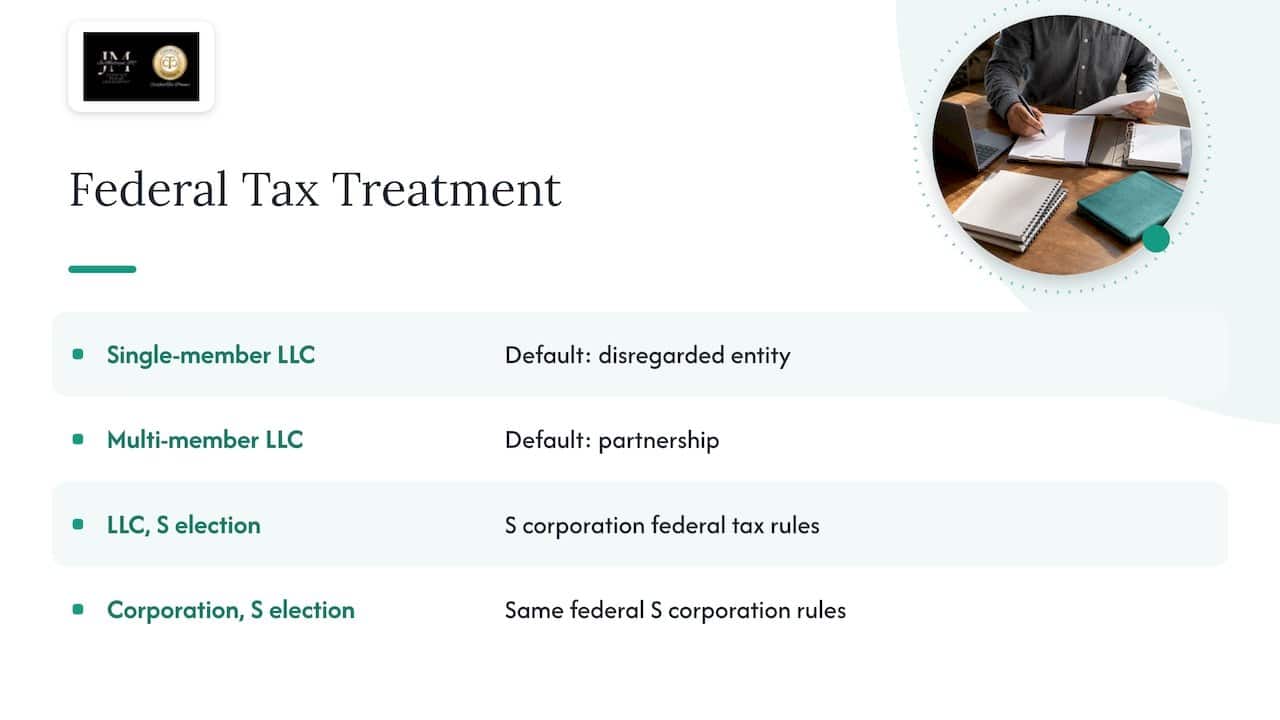
An LLC is formed by filing with your state. It gives you a liability shield and a flexible way to organize ownership. The IRS does not have a separate tax category called “LLC.” Instead, a domestic LLC with one member is generally a disregarded entity, and with two or more members it is a partnership unless it files an election to be taxed as a corporation or S corporation.
An S corporation is what the IRS calls a corporation that has elected pass-through treatment. Profits, losses, deductions and credits flow to the owners’ personal returns instead of being taxed at the corporate level. A corporation formed under state law can make that election, and so can an LLC.
That is the answer to the question many readers type as “LLC taxed as an S corp vs. S corp.” Once the election is in effect, the two are taxed the same way at the federal level. The difference is the state-law wrapper. An LLC taxed as an S corp keeps the LLC’s flexible operating agreement and fewer formalities, but it must still follow the S corporation’s tax rules, including the ownership limits for a small business corporation. A traditional corporation that elects S status must also hold the corporate formalities your state requires, such as bylaws and meetings.
How an LLC is taxed by default
Single-member LLC
You report business income and expenses on Schedule C of your personal return. All net profit is subject to income tax, and it is also subject to self-employment tax. The IRS puts the self-employment tax rate at 15.3%, made up of 12.4% for Social Security and 2.9% for Medicare.
Multi-member LLC
The LLC files a partnership return and issues each member a Schedule K-1. Members are not employees of the LLC for tax purposes. As Nolo explains, they are business owners, so their share of profit generally carries self-employment tax as well.
The common thread: under default treatment, you pay self-employment tax on your whole share of net profit, whether you take the money out or leave it in the business.
How an LLC taxed as an S corp is treated
With the S election, you wear two hats. You are a shareholder and, if you work in the business, also an employee. Nolo describes this as the defining feature of an active S corporation owner.
- Salary: The company pays you W-2 wages through payroll. Those wages carry Social Security and Medicare taxes (FICA), split between the company and you, plus income tax withholding.
- Distributions: Remaining profit can be paid out as distributions. Wolters Kluwer explains that the main reason to elect is to split income into a salary subject to FICA and distributions not subject to self-employment tax.
- Income tax: The profit still passes through to your personal return and is taxed at your regular rates, whether or not it was distributed.
The S election does not make income tax disappear. It targets the payroll tax layer only.
A worked example
The numbers below are a simplified illustration, not a promise. They ignore state taxes, the Social Security wage cap, and deductions.
Assume an LLC owner earns $100,000 of net profit.
| Default LLC (sole proprietor) | LLC taxed as S corp | |
|---|---|---|
| Net profit | $100,000 | $100,000 |
| Owner salary | None | $60,000 |
| Distributions | Not applicable | $40,000 |
| Payroll or self-employment tax | About $14,130 (15.3% of 92.35% of profit) | About $9,180 (15.3% of salary, employer and employee halves) |
| Rough difference | About $4,950 less |
Then subtract what the election costs you: payroll service fees, the extra tax return, possibly higher state fees or taxes, and your time. If those run $1,500 to $3,000 a year, which is a realistic range for many small businesses but varies widely, the net benefit shrinks fast. Below roughly $40,000 to $50,000 of profit, there is often nothing left to save. Above $100,000, the case usually gets stronger, but only if the salary holds up.
The reasonable salary rule
This is where most S corp problems begin. Paying yourself a $20,000 salary on $150,000 of profit invites trouble. The IRS may recharacterize non-wage distributions to shareholder-employees as wages when they were paid in place of reasonable compensation.
How does the IRS judge reasonable? It looks at training, experience, duties, time devoted to the business, and what comparable businesses pay for similar services. It also asks whether the revenue came from your personal services or from capital, equipment, or other employees.
Practical steps:
- Write down what a business like yours would pay someone else to do your job.
- Run payroll on a regular schedule, not one lump sum at year-end.
- Keep the salary figure consistent with the hours and role you actually work.
- Keep your documentation in a file in case a notice arrives.
If you want to see how examiners approach this, read our memo on the reasonable salary audit.
Other tradeoffs to weigh before you elect
More compliance. An S corporation files Form 1120-S, and it is due by the 15th day of the 3rd month after the tax year ends, with a Schedule K-1 for each shareholder. Calendar-year companies therefore file in mid-March, a month earlier than many partnerships and individuals. Mismatched K-1 data is a common source of IRS notices, and our guide to a K-1 mismatch notice explains how to respond.
Basis tracking. Non-dividend distributions are tax-free only up to your stock basis, and tracking that basis is your responsibility, not the corporation’s. Distributions above basis can trigger capital gain.
Less flexibility than a partnership. Partnerships can allocate income unevenly among members. S corporations generally must split profit by ownership percentage, and only one class of stock is allowed. Eligibility is also limited. An election ends automatically if the entity stops qualifying as a small business corporation.
Deduction interplay. Pass-through owners may be eligible for the qualified business income deduction, and wages paid to yourself can affect how it is calculated. Model both sides before you assume the salary split is purely a payroll tax matter.
State rules. Some states tax or charge fees on S corporations or LLCs differently. Check your state before you decide.
When the election makes sense, and when it does not
| Situation | Usually favors |
|---|---|
| Profit under about $40,000 to $50,000 | Default LLC treatment |
| Profit well above what you would pay a manager to do the same job | LLC taxed as S corp |
| Multiple owners who want uneven profit splits | Partnership treatment |
| Owners who are not U.S. individuals, or complex ownership | Default LLC or another structure |
| Income mainly from passive sources, such as rent | Usually default treatment |
| You want to retain earnings and avoid payroll administration | Default LLC treatment |
These are rules of thumb. Your state, your other income, and your plans for retirement contributions or selling the business all matter.
How to elect S corp status for your LLC
- Confirm eligibility. Domestic entity, no more than 100 shareholders, one class of stock, and eligible shareholders only.
- File Form 2553. An LLC elects S status by filing Form 2553, which also avoids filing Form 8832 separately. It is typically due within 2 months and 15 days of the start of the tax year the election is to take effect.
- Set up payroll. Register for payroll accounts and start paying yourself wages.
- File annually. Form 1120-S, K-1s, and your personal return reflecting the K-1.
Miss the window and you do not necessarily lose the year. See our article on a late S corp election for how to fix a missed Form 2553.
Independent contractor vs. employee: why it matters here
The S election changes how you are treated as an owner, but it does not change how the IRS views the people you hire. Many owners hire help and label them contractors to avoid payroll. That is risky. The IRS applies common law rules across three categories: behavioral control, financial control, and the relationship between the parties. There is no magic number of factors, and the IRS weighs all the evidence of control.
The label in your contract does not settle it either. If an employer-employee relationship exists, the label is immaterial.
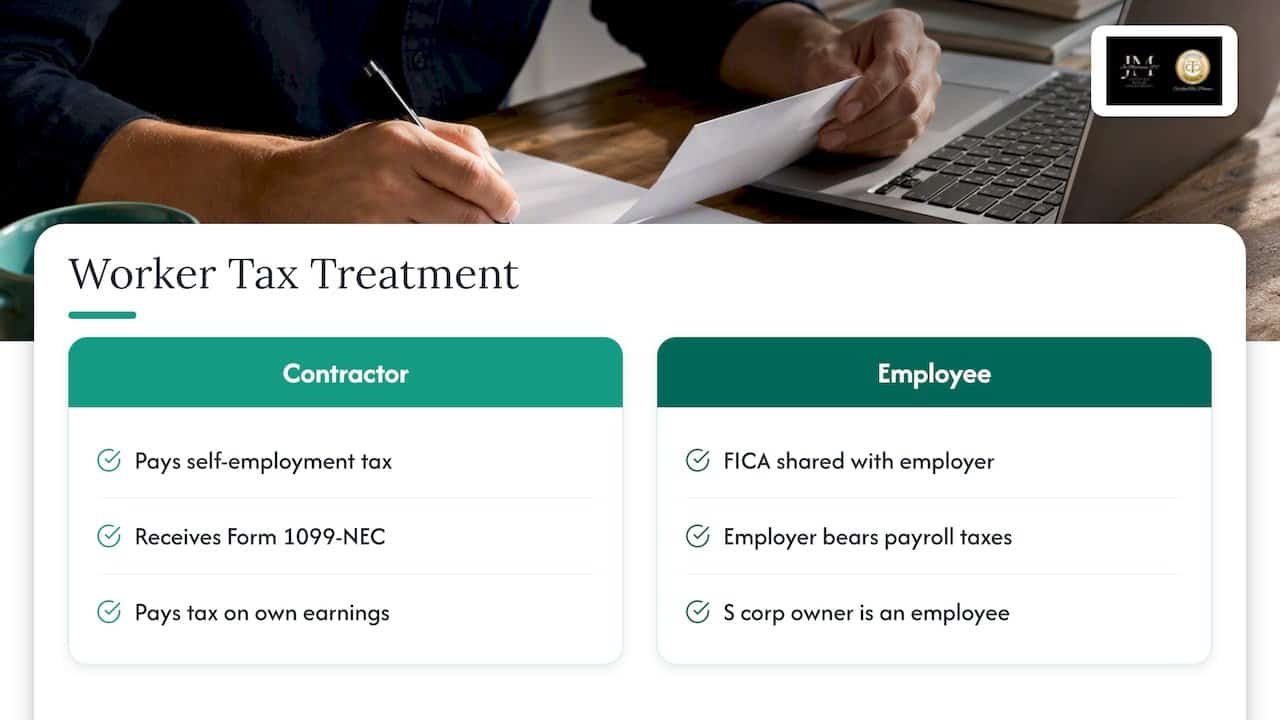
The tax result is different on each side. A true contractor pays self-employment tax on his or her own earnings and receives a Form 1099-NEC. An employee has FICA withheld and shares it with the employer, who also bears employer payroll taxes. If you misclassify, the employer can be liable for the payroll taxes that should have been withheld. When you set up an S corporation, you are an employee of your own company, so the same payroll discipline applies to you as well.
Perspective: what we see at our practice
We have handled IRS cases for more than 45 years, and the S corp election is one of the most misunderstood tools we see. Owners hear about the savings, file Form 2553, and then never run payroll properly. A year or two later a notice arrives, and what looked like a smart move is now a payroll tax problem.
Our advice is plain. Run the numbers on your real profit before electing, choose a salary you could explain to an examiner in one paragraph, and treat payroll as non-negotiable once you are in. The election works well for the right owner. It is not a free lunch for everyone, and it is certainly not a fix for a business that is barely profitable.
We also fix the other side of this. When an owner elected too late, paid no salary, or filed a messy 1120-S, we help clean it up and represent them before the IRS. That is often cheaper than waiting for an audit to force the issue.
— Joe
Get a second opinion before you file
We prepare returns for all IRS filing entities, domestic and foreign, and we help owners decide whether to elect, how to set a defensible salary, and how to repair prior-year mistakes. You can see the full list on our services page. If you want to talk through your numbers directly, you can book a consultation with Joe.

If you are already behind on filings or have received a notice, start with our pages on IRS delinquent returns and IRS letters and notices. For broader ideas on lowering your bill within the rules, see our business tax tips.
FAQ
Why would an LLC be taxed as an S corp?
Mostly to reduce Social Security and Medicare taxes. Owners pay payroll tax on a reasonable salary and can take the rest of the profit as distributions that are not subject to self-employment tax. The savings only hold if the salary is defensible, as the IRS can reclassify distributions as wages.
Is an LLC taxed as an S corp different from an S corp?
For federal tax purposes, no. Both follow the same S corporation rules and file Form 1120-S. The difference is state-law structure: the LLC has an operating agreement and typically fewer formalities, while a corporation has bylaws, directors and shareholder meetings.
Do I file Form 8832 as well as Form 2553?
No. Filing Form 2553 is enough for an eligible LLC, because it treats the LLC as electing corporate status first. Keep a copy of the IRS acceptance letter in your records.
Can I switch back later?
Yes, but it takes planning. An S election stays in effect until it is terminated, either by revocation or because the entity stops qualifying. Revoking can also limit when you can elect again, so talk to a CPA before you change course.
Does an S corp protect me from liability better than an LLC?
No. Liability protection comes from the legal entity, not the tax election. An LLC taxed as an S corp has the same state-law protection as any other LLC, provided you keep business and personal finances separate.
Sources
- IRS: Entities FAQ
- IRS: Self-employment tax, Social Security and Medicare taxes
- Nolo: LLC S corp taxation
- Wolters Kluwer: Electing S corporation status for an LLC
- IRS: S corporation employees, shareholders and corporate officers
- IRS: S corporation compensation and medical insurance issues
- IRS Publication 509: Tax Calendars
- IRS: S corporation stock and debt basis
- IRS: Instructions for Form 1120-S
- IRS: Qualified business income deduction
- IRS: Employee (common-law employee)
- IRS: Independent contractor (self-employed) or employee?
- IRS: Employment tax worker classification guidance