
An IRS K-1 mismatch notice means a third party’s report, your Schedule K-1, doesn’t match what you filed on your tax return. You must respond by the date printed on the notice. Before you do anything else, get a copy of the K-1 in question and your IRS account transcript so you can compare the two line by line.
TL;DR:
- Check the notice deadline, request your IRS account transcript, and compare the reported figures box by box before contacting the IRS or responding.
- Use Form 8082 when you report an item differently from the entity or never received a K-1; use Form 1040-X to accept or correct adjustments.
- If the K-1 is wrong, ask the issuer in writing for a corrected K-1 and confirmation that it will file the correction with the IRS.
- Missing the deadline can lead to assessment; interest runs from the return’s original due date, and penalties may apply when underreporting is substantial.
- Trace tiered partnership income through each entity layer, reconcile K-1 boxes with ledgers and tax schedules, and keep supporting records for at least three years.
Table of Contents
- What Triggers an IRS K-1 Mismatch Notice and How IRS Matching Works
- How to Read the Notice and What to Do in the First 7-14 Days
- When to Use Form 8082 and When to File an Amended Return
- How to Request a Corrected Schedule K-1 and What to Document
- CP2000 Specifics: Timeline, Penalties, and How Replies Are Handled
- Reconciliation and Prevention: Common Benign Reasons and Records to Keep
- Why Trust This Guide: Credentials and How We Help With K-1 Mismatches
- Why Acting Quickly on a K-1 Mismatch Notice Matters
- How Taxproblem Can Help With K-1 Mismatch Notices
- FAQ
- Sources
What Triggers an IRS K-1 Mismatch Notice and How IRS Matching Works
The IRS runs an automated matching program that compares entity filings, Form 1065 for partnerships, Form 1120-S for S corporations, and Form 1041 for trusts and estates, against the K-1s those entities generate and the individual returns that should report them. Any numeric or treatment difference can trigger a notice, even a small one, because the CP2000 series is designed to flag discrepancies automatically rather than judge their size.
Several things commonly cause this:
- A K-1 arrived late or carried the wrong tax year.
- A transcription error occurred when the entity or the IRS entered the figures.
- A tiered partnership structure passed income through several layers before it reached you.
- Book-tax differences or phantom income created a gap between what you earned on paper and what hit your bank account.
- An SSN or ITIN mismatch, or an identity-theft issue, confused the matching system.
Changing your own copy of the K-1 won’t fix anything. The IRS compares your return to the issuer’s submission, not to your personal copy, so any correction has to come from the entity itself.
How to Read the Notice and What to Do in the First 7-14 Days
Start by identifying exactly what you received. Most K-1 mismatch letters arrive as part of the CP2000 series, though some taxpayers get a different letter entirely. Either way, the response deadline is printed on the notice, and missing it narrows your options fast.
- Note the deadline and mark it clearly.
- Request your IRS account transcript so you can see exactly what third-party data the IRS has on file.
- Gather your K-1, any related broker statements, trial balance, and Schedule M-1 or M-3 excerpts.
- Compare the K-1 box by box against your return and determine whether the gap is a timing issue, a characterization issue, or a straightforward numeric error.
- If you agree with the proposed change, follow the notice’s instructions. If you disagree, start building your documentation file now.
Pro Tip: Request your transcript before you call the IRS or write a response. Knowing exactly what the IRS received from the entity keeps you from arguing against a number you haven’t actually seen.
When to Use Form 8082 and When to File an Amended Return
Two forms handle two different situations, and choosing the wrong one wastes time. Form 8082 tells the IRS you’re intentionally reporting an item differently from how the pass-through entity reported it, including in BBA partnership contexts, and it’s also the correct form when you never received a K-1 by the due date at all, according to the instructions for Form 8082. Form 1040-X is for amending your return, whether you’re accepting the IRS’s proposed change or correcting an error on your own.
- File Form 8082 attached to your original or amended return when you deliberately disagree with the entity’s treatment; Part II, lines 8 through 11, covers monetary items, and the official instructions walk through each line.
- File Form 1040-X and write “CP2000” across the top when you accept the notice’s proposed change or need to adjust the return for another reason, a step confirmed in Topic No. 652.
- Amending proactively, rather than waiting for the IRS to assess, generally limits how much interest accrues.
- Skipping Form 8082 when it’s required can expose you to accuracy-related penalties, which is why documenting your reasoning matters as much as the form itself.
How to Request a Corrected Schedule K-1 and What to Document
If the K-1 itself is wrong, the fix has to come from the entity, not from your copy. The Partner’s Instructions for Schedule K-1 are direct about this: notify the partnership, trust, or S corporation and ask for a corrected K-1 sent to both you and the IRS.
- Contact the entity’s managing partner, trustee, or tax preparer in writing, and describe the specific box or boxes that appear wrong.
- Ask for a corrected K-1 and written confirmation that the entity will file it with the IRS, not just send you a revised copy.
- Keep records of every follow-up, including emails and any certified letters, since this becomes your proof that you sought a correction in good time.
- If the issuer refuses or stalls, document that refusal, consider filing Form 8082 if you need to report the item differently in the meantime, and bring in professional representation if the entity continues to be unresponsive.
CP2000 Specifics: Timeline, Penalties, and How Replies Are Handled
A CP2000 notice isn’t an audit. It’s a proposed adjustment based on information a third party, like the issuer of your K-1, reported to the IRS that doesn’t match your return. The notice series includes several variations, CP2000, CP2000A, CP2000B, CP2000C, CP2000D, and CP2000E, each tied to a slightly different stage or type of mismatch.
- If you don’t respond by the deadline, the IRS can move forward with further notices and eventually assess the proposed change.
- Interest accrues from the original due date of the return, and accuracy-related penalties can apply if the underreporting is substantial.
- A complete, well-documented reply is more likely to go to manual review rather than automatic assessment.
- If you’re amending and owe additional tax, paying what you can when you file the 1040-X limits how much interest keeps building.
One factual note: the CP2000 series itself is the mechanism; the IRS doesn’t publish a percentage of notices that get resolved informally, so don’t rely on a number that isn’t actually in the notice.
Reconciliation and Prevention: Common Benign Reasons and Records to Keep
Most K-1 mismatches aren’t fraud or carelessness. They’re usually book-tax differences, timing gaps between when income is earned and when it’s distributed, tiered partnership flows, or phantom income that shows up on paper without a matching cash distribution, a pattern commonly seen in real estate and fund structures.
- Map each K-1 box to the corresponding ledger account in your records.
- Use Schedule M-1 or M-3 to reconcile book income to taxable income.
- Treat 1099s as a subset of K-1 items rather than a separate figure, and reconcile the two.
- Trace tiered K-1s through every layer before assuming the final number is wrong.
- Document every variance you find, even small ones, as you go.
Keep your K-1s, broker statements, and reconciliation worksheets for at least three years, longer if the entity has a history of late or corrected filings.
Pro Tip: If your K-1 flows through more than one tier, like a fund of funds, call a professional before you respond. Tracing income through multiple layers is where most self-prepared reconciliations go wrong.
Why Trust This Guide: Credentials and How We Help With K-1 Mismatches
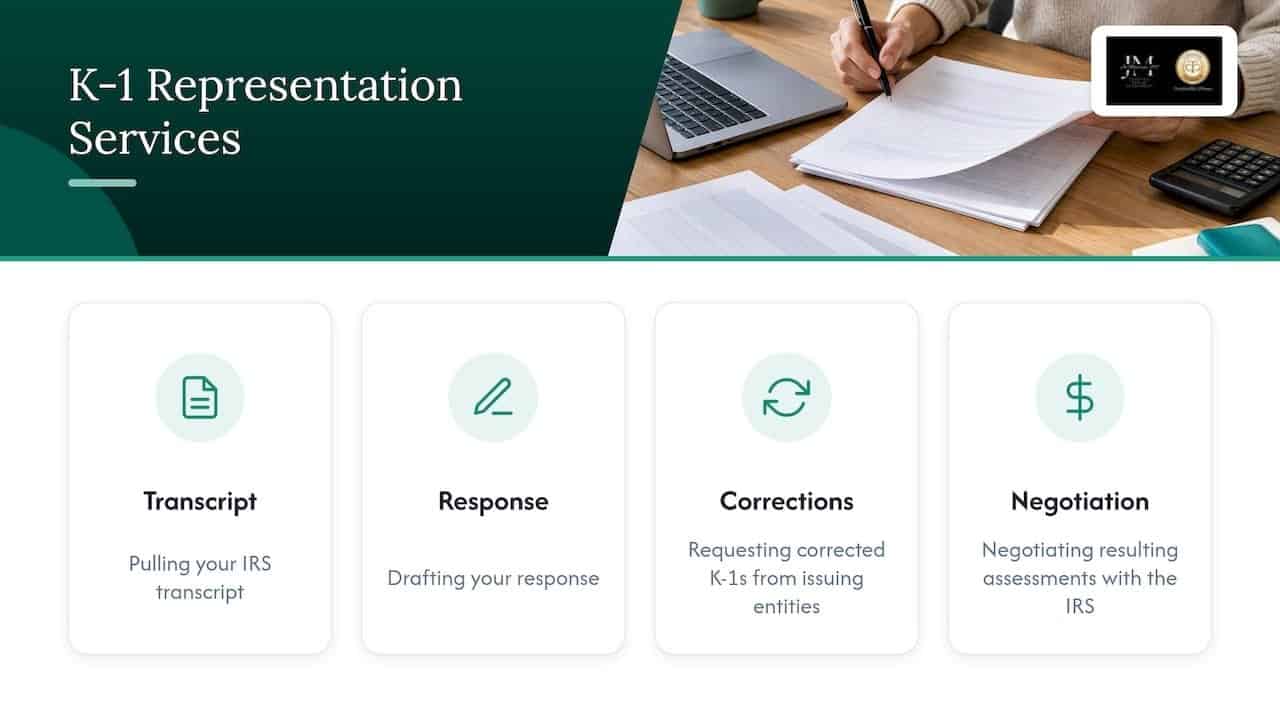
We have experience representing taxpayers before the IRS, handling audit representation, CP2000 replies, Form 8082 filings, amended returns, and penalty negotiations. When a K-1 mismatch notice lands in your mailbox, professional representation can include pulling your transcript, drafting the response, requesting corrected K-1s from issuing entities, and negotiating any resulting assessments with the IRS on your behalf.
Why Acting Quickly on a K-1 Mismatch Notice Matters
Taxpayers who act within days of receiving a notice, rather than weeks, almost always end up with a cleaner result: fewer penalties, less accrued interest, and a documented record the IRS takes seriously. Once a notice moves past its response deadline, or once an entity stops answering your requests for a corrected K-1, it’s time to bring in professional representation.
— Joe
How Taxproblem Can Help With K-1 Mismatch Notices
A K-1 mismatch notice rarely resolves itself, and the paperwork gets more complicated the longer it sits. We handle the full response process so you don’t have to decode IRS language under a deadline.

- We draft and file CP2000 responses that address the specific box-level discrepancy the IRS flagged.
- We prepare Form 8082 filings and amended returns when the K-1 itself needs correcting or when you’re intentionally reporting an item differently.
- We represent you directly before the IRS for audit defense, appeals, and negotiated payment arrangements when a mismatch leads to an assessment.
- We request corrected K-1s from unresponsive entities and keep the documented record the IRS expects to see.
Every initial review is confidential and typically starts with an evaluation of your notice and options. If you’ve received a K-1 mismatch notice, visit our services overview or set up a consultation with Joe to get a clear read on where you stand before the deadline passes.
This article is general information, not a substitute for advice from a qualified financial advisor. Consult a qualified financial professional about your own circumstances before acting on anything here.
FAQ
What happens if I never received my K-1?
If a K-1 never arrived by your filing deadline, including extensions, you can file Form 8082 to notify the IRS that the K-1 wasn’t received, as described in the instructions for Form 8082. You should still estimate the income as closely as possible using prior-year K-1s or entity communications, and correct the figure later if needed.
What happens if I forgot to report K-1 income on my return?
The IRS’s matching program will likely catch the omission and send a CP2000 notice proposing the additional tax, interest, and possibly a penalty. Filing Form 1040-X marked “CP2000” to correct the return, as outlined in Topic No. 652, before the IRS finalizes the assessment typically limits how much interest accrues.
Why is the IRS saying my K-1 information doesn’t match?
The IRS compares the K-1 the entity filed against what appears on your personal return, and any numeric or characterization difference can trigger an automated notice under the CP2000 series. Common causes include tiered partnership flows, book-tax timing differences, or a simple transcription error on either side.
Will filing a K-1 affect my taxes?
Yes. A K-1 passes through your share of income, deductions, or credits from a partnership, S corporation, or trust, and that amount gets added to your taxable income even when you received no cash distribution, a situation sometimes called phantom income, as explained in the Partner’s Instructions for Schedule K-1. Reconciling the K-1 against your own records before filing helps you catch a mismatch before the IRS does.