
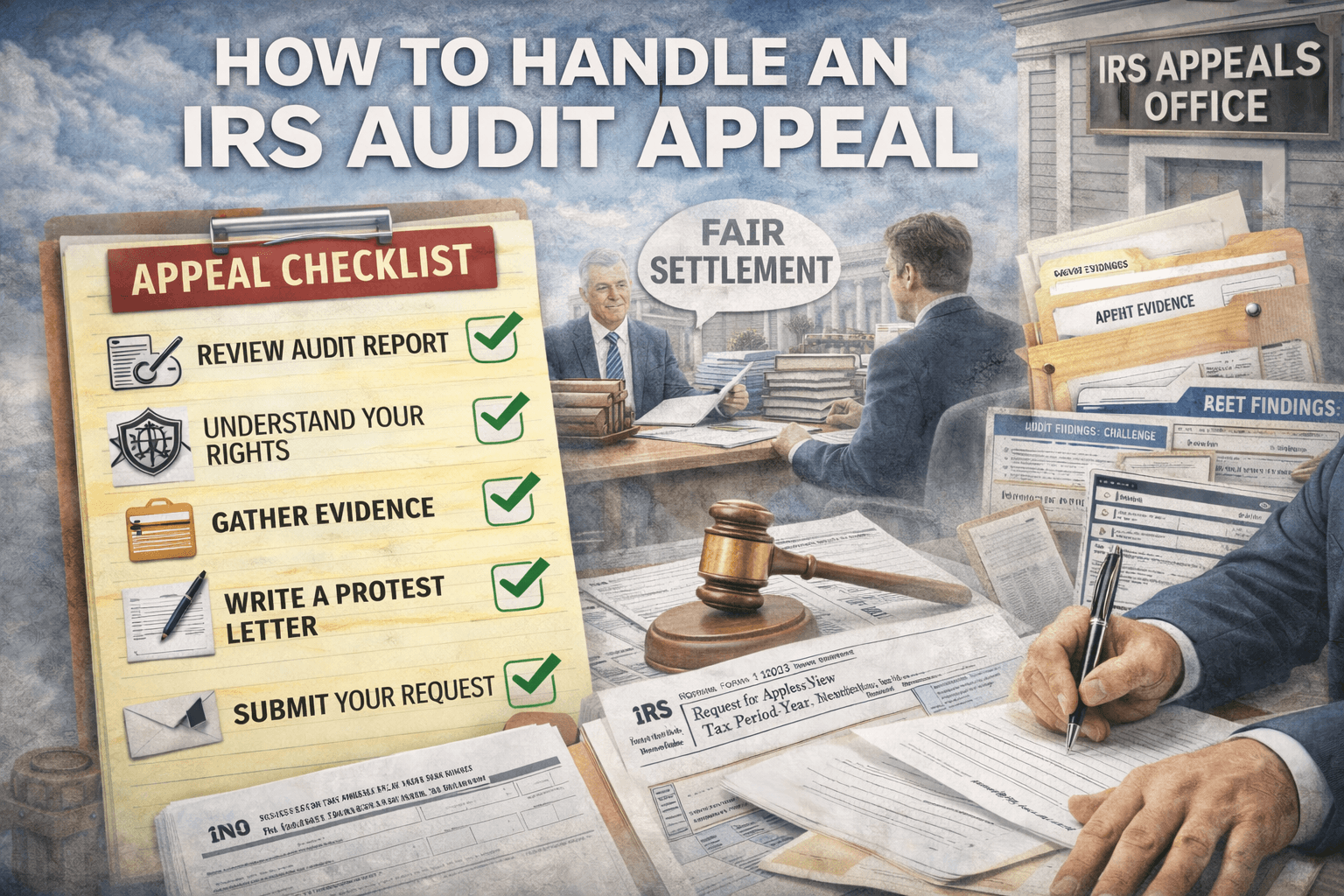
How To Handle IRS Audit Appeals
Do not attempt an audit appeal on your own — and never let an unlicensed company handle it for you. IRS auditors are primarily focused on whether the agency can win in Tax Court. They are not evaluating whether you are telling the truth or whether your documents are legitimate. You need a professionally licensed, experienced firm in your corner.
At Joe Mastriano, PC, our licensed CPAs have spent over 40 years handling IRS audit appeals for individuals and businesses throughout the Houston area. We know how auditors think, what Appeals Officers look for, and — most importantly — how to build the case that protects you.
You Have the Right to Appeal an IRS Audit Decision
If you disagree with the results of an IRS audit, you are not stuck with them. The IRS Independent Office of Appeals exists specifically to resolve tax disputes without litigation — and it operates independently from the examining division that audited you.
Your first step is to speak with the auditor’s manager. If that conversation does not resolve the disagreement, the auditor will finalize their Revenue Audit Report (RAR). From there, your deadlines are strict:
- 30 days from the RAR to file a formal request for an IRS audit appeal.
- 90 days from the date of a Notice of Deficiency to petition the U.S. Tax Court — if you miss the 30-day window and a Notice of Deficiency is issued.
Missing either deadline can cost you your right to appeal entirely. Do not wait.
You can also reach out to the IRS Taxpayer Advocate Service (TAS) to explain the hardship caused by the audit’s proposed adjustments. The TAS cannot extend your appeal or Tax Court deadlines, but it can be a useful parallel avenue when the circumstances genuinely warrant it.
How to File IRS Audit Appeals
The IRS gives you two options for requesting an appeal after an examination:
- Form 12203 — Request for Appeals Review. Use this form when the proposed changes total $25,000 or less for a single tax year. List every item you disagree with and your reason for disagreeing.
- Formal Written Protest — Required when the disputed amount exceeds $25,000 for any tax period. The protest must include a statement of facts, the law or authority you are relying on, and a signed perjury declaration. See IRS Publication 5, Your Appeal Rights and How to Prepare a Protest for the full requirements.
Mail your appeal to the IRS address printed on the letter that notified you of your appeal rights — not directly to an Appeals office. The examining division must receive and forward your file before Appeals can act on it.
For a complete overview of what Appeals Officers do and how the conference process works, the IRS publishes Publication 4227, Overview of the Appeals Process.
Step-by-Step: How to Give Yourself the Best Chance at Appeal
In our experience, most audit appeals we handle at Joe Mastriano, PC, involve clients who either missed an audit appointment or were not fully cooperative during the original examination. The good news: the Appeals process is more flexible than many people expect. Appeals Officers understand that taxpayers do not always get an adequate opportunity to gather documentation during an audit.
Here is what to do:
- File on time — even if your submission is not complete. If the 30-day deadline is approaching and your full protest is not ready, file a short-form request stating that a detailed version will follow. A late appeal is almost always worse than an imperfect but timely one.
- Know the tax law behind every disputed item. Look up the specific Code sections and IRS guidance that apply to each deduction or income item that was disallowed. The IRS’s own guide on considering an appeal outlines the legal basis required to support your position.
- Find court decisions that support your position. Appeals Officers are keenly aware of Tax Court precedent. A well-researched argument showing that similar cases were decided in the taxpayer’s favor carries real weight. Identify the federal circuit covering your state and prioritize decisions from that circuit.
- Gather notarized written statements from witnesses. Anyone with firsthand knowledge of the facts — a business partner, employee, contractor, or family member — can provide a signed, notarized statement. These third-party declarations are often the difference between an appeal that succeeds and one that does not.
- Request and review the IRS’s own case file before your conference. This is your legal right, and the Appeals Officer will not object. Reviewing their records before the conference lets you anticipate their arguments and prepare targeted responses. Going into a conference blind is an avoidable disadvantage.
- Understand what Appeals Officers are really evaluating. They are not ruling on sympathy or hardship. They are assessing litigation risk — whether the IRS would likely win or lose if your case went to Tax Court. Frame your arguments accordingly: demonstrate that the law and the facts are on your side, and that pursuing the matter in court would be a losing proposition for the government.
Appealing a Trust Fund Recovery Penalty or Civil Penalty
Trust fund and civil penalty appeals follow a stricter process than standard audit appeals and are heavily influenced by federal court decisions in your region. If a Revenue Officer and their manager have already rejected your position, they believe they have a viable case. You need to be prepared to prove otherwise.
To pursue a trust fund appeal successfully:
- File your appeal within 30 days of receiving the proposed assessment — even if only a short summary version is ready in time.
- Understand precisely what legally constitutes liability for trust fund taxes under your facts and circumstances.
- Research how courts in your federal circuit have ruled on the specific factors that establish or negate liability.
- Before your Appeals conference, request access to the IRS’s case file. Know their arguments before you walk in the door.
- Build your case around court decisions, not appeals to fairness. The question is not whether you are a good person — it is whether the IRS can prove you are legally responsible.
- Support your position with signed, notarized statements from anyone — colleagues, employees, officers — who has firsthand knowledge of who controlled finances and signed checks.
For penalty-specific appeals guidance, the IRS publishes Publication 4576, Orientation to the Penalty Appeals Process. For alternative dispute resolution options — including Fast Track Settlement and Post-Appeals Mediation — see Publication 4167, Introduction to Alternative Dispute Resolution.
Who Can Represent You Before IRS Appeals?
The IRS limits representation at Appeals conferences to licensed professionals. Only the following may represent a taxpayer before the IRS Independent Office of Appeals:
- Attorneys
- Certified Public Accountants (CPAs)
- Enrolled Agents
An unenrolled preparer — regardless of how familiar they are with your return — cannot represent you at an Appeals conference. They may attend as a witness, but they cannot speak on your behalf or negotiate for you. This is precisely why using an unlicensed “tax resolution” company for an audit appeal is so risky.
If you want a representative to speak with the IRS without you present, you must also file Form 2848, Power of Attorney and Declaration of Representative.
Key IRS Resources for IRS Audit Appeals
- IRS Independent Office of Appeals — Overview
- Considering an Appeal — Should You File?
- Preparing a Request for Appeals
- Form 12203 — Request for Appeals Review (Small Case Request)
- Publication 5 — Your Appeal Rights and How to Prepare a Protest
- Publication 3498 — The Examination Process
- All IRS Appeals Forms and Publications
- Taxpayer Advocate Service — Audit Reconsiderations
Get Professional Help With Your IRS Audit Appeal
An audit appeal is not a process you want to navigate alone — and the stakes are too high to hand to an unlicensed company. At Joe Mastriano, PC, our licensed CPAs understand how Appeals Officers evaluate cases, what arguments move the needle, and how to put together a file that gives you the strongest possible position.
If you have received an IRS audit report you disagree with, do not wait. Deadlines are strict and missing them can permanently close the door on your appeal rights.
Contact us today for a free evaluation. We serve clients throughout the Houston area — including Sugar Land, Katy, The Woodlands, Pasadena, and the surrounding communities — and we handle cases nationwide.