
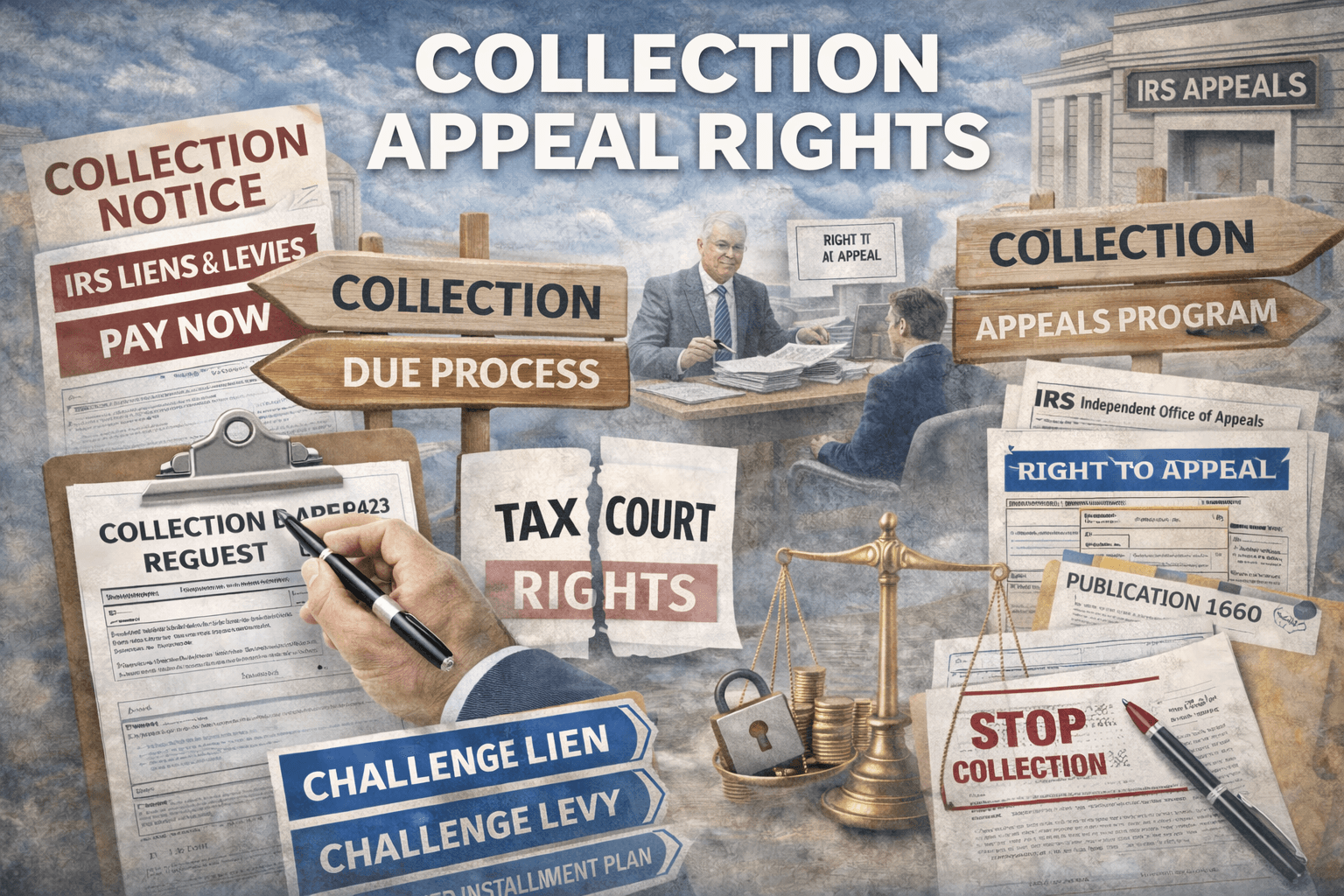
Collection Appeal Rights
Your Rights to Appeal IRS Collection Action
If the IRS is moving to file a lien, issue a levy, seize property, reject an installment agreement, or take other collection action, you may have the right to challenge that action through an administrative appeal. The IRS recognizes collection appeal rights through two main paths: Collection Due Process (CDP) and the Collection Appeals Program (CAP). Publication 1660 is the IRS’s core guide on these rights, and the IRS Independent Office of Appeals describes Appeals as the function that resolves tax disputes without litigation when possible.
At Joe Mastriano, P.C., we help taxpayers evaluate whether an IRS collection action can still be appealed, what deadline applies, and which path is more appropriate based on the exact notice, stage of enforcement, and resolution goal.
What Collection Appeal Rights Mean
Collection appeal rights are the procedures that allow a taxpayer to challenge certain IRS collection decisions before or after enforcement action is taken. Depending on the situation, an appeal may allow you to dispute the action itself, propose an alternative such as a payment arrangement, or require the IRS to route the case through the Independent Office of Appeals for review. The IRS specifically points taxpayers to Publication 1660, Collection Appeal Rights, for these rules.
These rights matter because IRS collection action is not just a billing issue. Once a case reaches lien, levy, seizure, or agreement default status, timing and procedure become critical.
The Two Main Types of Collection Appeals
Collection Due Process (CDP)
A Collection Due Process hearing is a statutory appeal right that generally applies after the IRS issues certain lien or levy notices. Publication 1660 explains that you have the right to a CDP hearing when you receive a notice advising you of that right and you timely request the hearing. The IRS also explains in its CDP FAQs that CDP applies to certain collection actions and that taxpayers should review Publication 1660 to understand their rights.
A timely CDP request can be extremely important because it may preserve broader protections than other appeal routes. In some cases, it can also preserve the right to seek review in U.S. Tax Court after Appeals issues its determination. Publication 1660 specifically states that a taxpayer may contest a CDP determination in the United States Tax Court.
If you are dealing with a lien or levy threat, also review our page on IRS liens and levies.
Collection Appeals Program (CAP)
The Collection Appeals Program is broader in some ways and faster in practice, but it is also more limited in what it protects. IRS Form 9423 states that CAP can apply to levy or seizure action that has been or will be taken, a Notice of Federal Tax Lien that has been or will be filed, certain lien certificate denials, and certain installment agreement decisions. The IRS Internal Revenue Manual also states that CAP is available for installment agreement rejections, modifications, and terminations, as well as liens, levies, and seizures.
However, CAP is not the same as CDP. CAP is generally an administrative review path, but it does not carry the same court-review rights as a timely CDP hearing. That difference matters. Publication 1660 distinguishes between CDP and CAP, and the Taxpayer Advocate Service notes that CAP appeals generally must be made within 30 days of the collection action.
If your issue involves a rejected or defaulted payment arrangement, see our page on IRS payment plans.
Common IRS Collection Actions That May Be Appealable
Depending on the facts, collection appeal rights may apply to issues such as:
- Proposed or actual levies
- Filed or proposed Notices of Federal Tax Lien
- Seizure actions
- Installment agreement rejection, modification, or termination
- Certain denials involving lien certificates such as discharge, subordination, withdrawal, or non-attachment
These categories are reflected in IRS Form 9423 and IRS guidance on collection appeals.
Why Deadlines Matter
One of the biggest mistakes in IRS collection cases is assuming there is plenty of time. There usually is not. Publication 1660 and related IRS guidance make clear that appeal rights are deadline-driven, and the exact deadline depends on the type of notice and the type of appeal involved. The Taxpayer Advocate Service states that a CDP request must generally be made within 30 days of the notice, that an Equivalent Hearing may be available within one year in some circumstances, and that CAP generally has a 30-day window tied to the collection action.
The practical rule is simple: do not wait to find out whether the deadline has already started running.
How a Collection Appeal Is Usually Started
For CAP matters, the IRS uses Form 9423, Collection Appeal Request, and the Taxpayer Advocate Service notes that a written request through Form 9423 is preferred in many CAP situations after you attempt to resolve the disagreement with Collection management. For other appeals, the IRS says you should follow the appeal instructions in the letter or notice and send the protest or hearing request to the address listed on that notice rather than mailing it directly to Appeals.
That detail matters because sending the request to the wrong place can delay the case and may jeopardize the appeal if the deadline is close.
What a Collection Appeal Can and Cannot Do
A collection appeal can be valuable because it may:
- force review by the IRS Independent Office of Appeals
- challenge whether the collection action is appropriate
- create a structured chance to propose a resolution alternative
- slow or interrupt certain actions, depending on the appeal type and timing
But collection appeals also have limits. Not every appeal stops enforcement. Not every appeal carries Tax Court rights. And an appeal does not erase the underlying tax debt by itself. Publication 1660 and the IRS’s CDP materials make clear that the effect of the appeal depends on the procedural posture of the case and whether the request was timely.
If the larger issue is whether the debt can be settled or paid over time, you may also want to review our pages on Offer in Compromise and IRS delinquent returns.
How Joe Mastriano, P.C. Helps With Collection Appeals
Collection appeals are not just about filing a form. The real work is identifying:
- what action the IRS is taking
- whether CDP, CAP, or another route applies
- what deadline controls
- whether enforcement may continue during the review
- what resolution position should be raised in the appeal
Joe Mastriano, CPA, helps taxpayers analyze the notice, determine the correct procedural path, and present a practical position grounded in the facts of the case. In collection matters, the wrong appeal path or a missed deadline can reduce leverage quickly.
External IRS Resources
For official IRS information on collection appeal rights, review:
- Publication 1660, Collection Appeal Rights
- Forms and publications about your appeal rights
- Collection Due Process FAQs
- Form 9423, Collection Appeal Request
- IRS Appeals
These are the best primary-source starting points for current IRS rules on collection appeals.
Important Disclosure
This page provides general information only and does not create legal advice or guarantee any result. Appeal rights depend on the exact IRS notice, the action being challenged, the timeliness of the request, and the taxpayer’s compliance and case facts. Because this is a high-stakes tax matter, official IRS guidance should be reviewed carefully before action is taken.
Get Help Reviewing Your Collection Appeal Rights
If the IRS is threatening levy action, filing a lien, terminating a payment plan, or taking another collection step, it is important to determine quickly whether appeal rights still exist and what route is available. Waiting can narrow your options.
You may also find these related pages helpful: