
Letter 12C means the IRS received your individual income tax return but cannot finish processing it without more information from you. It is not a bill and it is not an audit. It is a request, and it comes with a deadline: the IRS asks you to reply within 20 days, according to its own page on Understanding your Letter 12C. Read the letter closely, gather exactly what it asks for, and send it back the way the letter instructs.
This guide walks through why the letter arrives, what it typically asks for, how to answer step by step, and what is at stake if you let it sit. It is written from the point of view of a CPA firm that has handled IRS correspondence for more than 45 years.
TL;DR
- Letter 12C is a request for information, not an audit. Your return is on hold until the IRS gets what it asked for.
- Respond within 20 days, even if you disagree with the letter, and do not file Form 1040-X in response to it.
- Send only what is requested, plus a copy of the letter. Do not send a second copy of your return unless the letter says to.
- If you do not respond, the IRS may adjust your return, which can raise what you owe or reduce your refund.
- After you reply, the IRS says any refund due should arrive about 6 to 8 weeks after it receives your response.
Table of Contents
- What Letter 12C actually is
- Why you received Letter 12C
- Is Letter 12C an audit?
- What the IRS may ask you to send
- How to respond to Letter 12C, step by step
- If you disagree with what the letter says
- What happens if you ignore Letter 12C
- After you respond: timing and follow-up
- Mistakes we see with Letter 12C
- Our perspective: treat a 12C as a chance to get it right
- When it makes sense to get help
- Preventing a 12C next year
- FAQ
- Sources
What Letter 12C actually is
The IRS sends Letter 12C when an original return is found to be incomplete for processing. The Internal Revenue Manual describes it as the letter used for Individual Master File taxpayers, which is the system that holds individual income tax accounts. The same section explains that these returns are not mailed back to you. They are suspended in the IRS system while the agency waits for your answer.
Think of it as pressing pause, not delete. Your return has not been rejected, and nothing has been decided against you. The processing clock simply stops until the missing piece arrives.
The Taxpayer Advocate Service puts it the same way: the IRS received your return but needs more information to process it accurately. The notice number is printed in the upper right corner of the letter, so you can confirm you are dealing with a 12C and not a different notice.
Why you received Letter 12C
The IRS says it sends the letter when it needs more information to complete processing of your individual income tax return. In practice, the trigger is usually one of these:
- A form or schedule that should have been attached is missing, or the copy the IRS received was illegible or damaged.
- The IRS needs verification of income, withholding or credit amounts you reported.
- A Social Security number or individual taxpayer identification number is missing or does not match.
- Advance payments of the Premium Tax Credit need to be reconciled.
The Taxpayer Advocate Service lists these same categories on its Letter 12C page. The specific reason for your letter is written in the body of the notice. Do not guess. Find the paragraph that lists what the IRS needs and treat it as your checklist.
Common real-world examples include a W-2 that was left off the return, a 1099 that did not get attached, a dependent whose number was entered incorrectly, and a marketplace health insurance reconciliation that was never completed.
Is Letter 12C an audit?
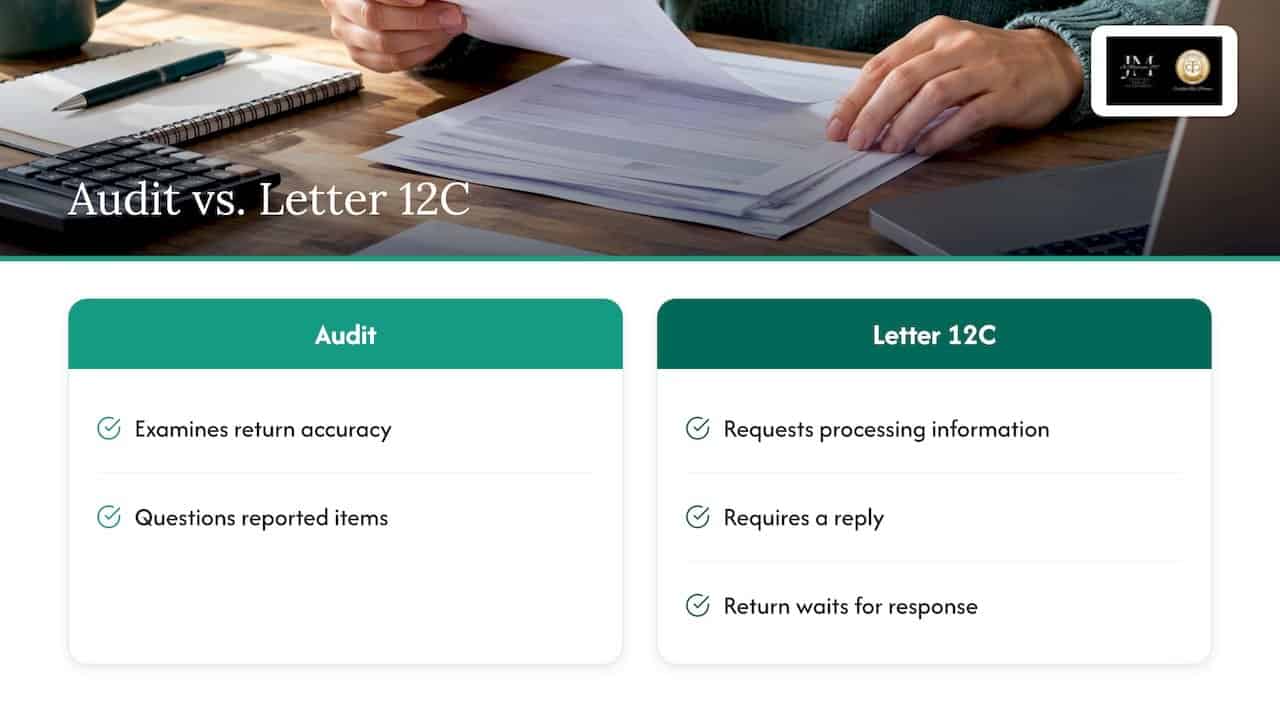
No. An audit, also called an examination, questions whether the items on a return are correct. Letter 12C asks for information the IRS needs to finish processing. The IRS describes it as a request for additional information needed to process your return, and nothing in its explanation frames it as an examination.
Even the tax software industry makes the same point in general terms: receiving an IRS letter does not necessarily mean you are being audited, and some letters do not even require a reply. Letter 12C is different in one respect. It does require a reply, because your return cannot move forward without one.
That said, a careless response can create new problems. If you send documents that contradict your return, you may invite follow-up questions. This is one reason we read every 12C response before it goes out the door. If you want to understand how a true examination works, our page on what audit representation is and why it matters explains the difference.
What the IRS may ask you to send
The table below summarizes the typical requests and the kind of response each one calls for. Your letter controls. If it asks for something not listed here, follow the letter.
| What the letter may say | What it usually means | What to prepare |
|---|---|---|
| Missing form or schedule | A required page was not attached to your return | The completed form or schedule named in the letter |
| Illegible or damaged form | The IRS could not read what it received | A clean, complete copy of that form |
| Income or withholding verification | Amounts on your return could not be confirmed | Copies of your W-2, 1099, or other statement |
| Credit amount verification | A credit claimed needs support | Documents that support the credit named in the letter |
| SSN or ITIN issue | A number is missing or does not match | The correct number, with any requested proof |
| Premium Tax Credit reconciliation | Advance payments were not reconciled | Form 1095-A and a completed Form 8962 |
The Form 8962 version of the letter
A large share of 12C letters involve health insurance purchased through a marketplace. When advance payments of the Premium Tax Credit were made on your behalf, the IRS says you generally must provide Form 1095-A and a completed Form 8962 to reconcile them.
Form 1095-A comes from the marketplace that issued your coverage. If you cannot find it, log in to your marketplace account or contact the marketplace for a copy. Form 8962 is then completed using the figures on the 1095-A.
Do not skip this one. The same IRS page warns that failing to reconcile advance payments may cost you eligibility for premium tax credits or cost-sharing reductions in the following calendar year. A missed 12C can therefore affect your health coverage costs next year, not only this year’s refund.
How to respond to Letter 12C, step by step
- Check the date and the deadline. The IRS asks for a reply within 20 days. Note the date on the letter and count from there, then plan to mail early.
- Identify exactly what is requested. Underline each item in the letter. Make a short list.
- Gather the documents. Pull the forms, statements and numbers the letter names. Make copies and keep the originals.
- Complete any missing form. If you need Form 8962, fill it out from your 1095-A. If a schedule was left off, complete it consistently with your return.
- Include a copy of the letter. The Taxpayer Advocate Service says to enclose the requested information, supporting forms or schedules, and a copy of Letter 12C. That copy helps the IRS match your reply to your account.
- Do not send another copy of your return. Send one only if the letter asks for it.
- Do not file Form 1040-X. Both the IRS and the Taxpayer Advocate Service say an amended return is not the right response to this letter.
- Send it the way the letter directs. Use the address or fax number printed on the notice. Mail by a method that gives you proof of delivery, and keep a full copy of what you sent.
Pro tip: write your name, Social Security number (last four digits are enough on a cover note), tax year and the notice number at the top of every page you send. Loose pages get separated, and a separated page is a second delay.
If you disagree with what the letter says
You still have to answer. The Taxpayer Advocate Service states that a taxpayer who disagrees with the information in the letter must still respond, with a clear explanation of what they believe is wrong. Silence is treated as no response, whatever your reason.
Keep the explanation short and factual. State the line or item in dispute, what you believe is correct, and attach proof. Avoid arguing about tax policy or venting about the delay. A calm, well-documented paragraph gets read. A long letter full of frustration tends not to help you.
If the disagreement involves a large refund, a credit that may be questioned, or numbers that do not reconcile, this is a good moment to have a professional review the response before you send it.
What happens if you ignore Letter 12C
The consequences are concrete. According to the Taxpayer Advocate Service, if you do not respond, the IRS will make an adjustment to your return, which may increase the tax you owe or reduce your refund.
In other words, the IRS will finish your return without your input, and the version it finishes may not match what you filed. You then have a different problem to solve, and it is usually harder than answering the original letter.
For 12C letters tied to the Premium Tax Credit, the stakes extend beyond this year, as noted above. A balance due created by an adjustment can later lead to a bill. If that happens, see our guides to the CP 14 request for tax payment and the CP 11 notice about changes to a return.
After you respond: timing and follow-up
The IRS says any refund due will be sent about 6 to 8 weeks after it receives your response. That is the number to plan around, and it starts when the IRS receives your documents, not when you mail them. This is why proof of delivery matters.
While you wait:
- Keep your delivery confirmation and your copy of everything you sent.
- Avoid sending the same documents a second time unless the IRS asks. Duplicates can slow things down.
- Check your refund status through the IRS online tools after the 6 to 8 week window begins to run.
If the IRS still has not processed your return
The Taxpayer Advocate Service says that when the IRS asks for information and you provide it, the agency should generally correct your account and resolve the refund issue within about 60 days. That is general guidance on held or stopped refunds, not a promise specific to Letter 12C, but it is a reasonable yardstick.
If you have passed that point with no progress, consider these options:
- Call the number on the letter, with your documents and proof of delivery in front of you.
- Contact the Taxpayer Advocate Service, which helps taxpayers whose refund problems are not being resolved through normal channels.
- Hire a representative who can contact the IRS on your behalf and follow the case.
Mistakes we see with Letter 12C
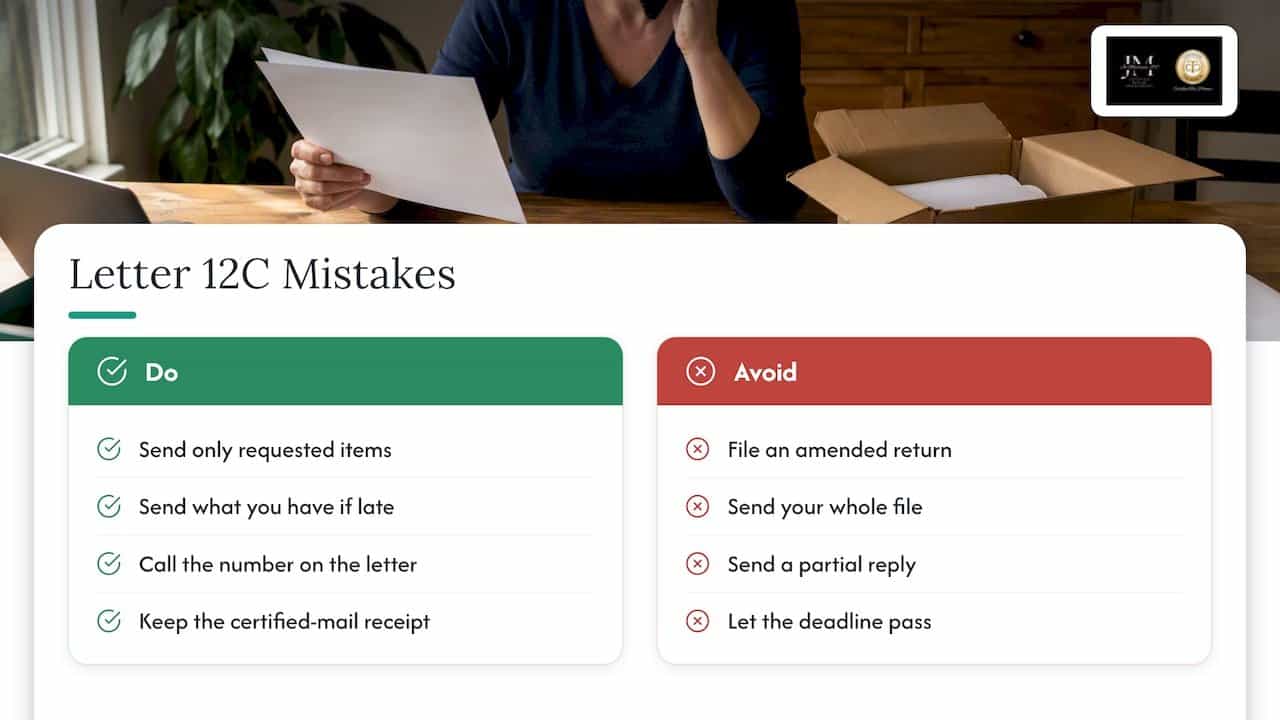
Filing an amended return. It feels logical to fix the problem with a 1040-X. The IRS says not to. An amended return can collide with the original that is already suspended.
Sending too much. People mail their whole file. Send what was requested, and nothing that wasn’t.
Sending too little. The opposite error: one form is sent when the letter asked for three items. A partial answer can lead to a second letter and another round of waiting.
Missing the 20 days. Life gets in the way. If you cannot meet the date, send what you have along with a short note, or call the number on the letter. Do not simply let the deadline pass.
Mailing without proof. If the IRS says it never received your reply, a certified mail receipt is the only thing that settles the question.
Ignoring the letter because the refund is small. A small refund is still your money, and an unanswered 12C can turn it into a balance due.
Our perspective: treat a 12C as a chance to get it right
After more than 45 years of working on IRS matters, we see Letter 12C differently than most taxpayers do. It is one of the friendlier letters the IRS sends. It tells you exactly what is missing and gives you a clear path to fix it. Compare that with a levy notice, where the options narrow quickly.
The danger is not the letter. The danger is the delay that follows when it is set aside in a pile of mail. We have seen simple 12C requests become balance due notices, and in some cases collection problems, because nobody answered the first letter. Once a return is adjusted without your input, you are correcting the IRS’s version of your return instead of finishing your own.
Our advice is plain. Answer it promptly, answer it completely, and keep proof. If the request touches on credits, income that does not match, or numbers you do not recognize, have a CPA read it before you reply. A careful response costs far less than an unwinding later.
— Joe
When it makes sense to get help
Most 12C letters are routine, and many people handle them alone. Bring in a professional when:
- The letter asks for something you cannot locate or do not understand.
- You disagree with the IRS’s figures and need to explain why.
- You have other unanswered notices, back taxes, or unfiled returns.
- The deadline has passed and you have heard nothing further.
- A refund you are counting on is large and the delay is causing hardship.
At Taxproblem, Joe Mastriano, CPA, handles IRS correspondence and represents clients before the IRS. We review the letter, tell you what is needed, and make sure the response matches your return. If your 12C is a sign of a bigger issue, we also handle audits, payment plans and Offers in Compromise. You can see the full range of what we do on our services page.

If you want someone to look at your letter, book a consultation with Joe. We offer an evaluation of your IRS situation so you know where you stand before you commit to anything. If your letter is one of several, our overview of IRS letters and notices and our guide on how to handle IRS notices are good places to start.
Preventing a 12C next year
Most 12C letters are avoidable. A few habits help:
- Wait for every form. W-2s, 1099s and 1095-A statements arrive on different schedules. File once you have them all.
- Attach everything. Check that each schedule and form referenced on your return is in the package or the e-file.
- Check every number. Social Security numbers and ITINs for you, your spouse and your dependents must match IRS records exactly.
- Reconcile marketplace coverage. If you received advance Premium Tax Credit payments, complete Form 8962 with your return.
- Keep records. Hold copies of everything you filed and everything you received.
If you have not filed in prior years, that is a separate matter and an important one. Our page on IRS delinquent returns explains how we bring taxpayers current.
FAQ
How long do I have to respond to IRS Letter 12C?
The IRS asks you to respond within 20 days. Check the date printed on your letter and count from there. If you cannot meet the deadline, respond as soon as you can or call the number on the notice, rather than waiting.
Do I need to file an amended return after getting a 12C?
No. The IRS and the Taxpayer Advocate Service both say not to file Form 1040-X in response to this letter. Send only the information requested, along with a copy of the letter.
How long until I get my refund after I reply?
The IRS says any refund due will be sent about 6 to 8 weeks after it receives your response. If your return is still unprocessed well beyond that, the Taxpayer Advocate Service says about 60 days is the general benchmark for resolving refunds after requested information is provided, and it can help if the delay continues.
What if I disagree with the letter?
You must still respond. Explain clearly what you believe is wrong and attach documents that support your position. Not answering allows the IRS to adjust your return without your input.
Is the 12C letter related to health insurance?
Sometimes. When advance payments of the Premium Tax Credit are involved, the IRS says you generally need to provide Form 1095-A and a completed Form 8962. Check your letter to see whether it asks for these.
Sources
- Understanding your Letter 12C, Internal Revenue Service
- Letter 12C, Taxpayer Advocate Service
- Internal Revenue Manual 21.3.1, Taxpayer Contacts Resulting from Notice Issuance
- Reconciling your advance payments of the Premium Tax Credit, Internal Revenue Service
- Held or Stopped Refunds, Taxpayer Advocate Service
- Why did the IRS send me a letter?, Intuit