
The IRS National Standards are fixed monthly allowances for food, housekeeping supplies, apparel, personal care and miscellaneous items. The IRS uses them, together with its housing, utilities and transportation standards, to decide how much of your income you need to live on when you owe back taxes. Whatever is left over is what the IRS expects you to pay toward the debt. For 2026, a single person is allowed $867 a month across the five National Standards categories, and a family of four is allowed $2,176.
This guide explains what the standards cover, shows the current amounts, and walks through how they shape payment plans and offers. It also covers what to do when your real costs are higher than the table says.
TL;DR
- The National Standards cover five categories: food, housekeeping supplies, apparel and services, personal care, and miscellaneous. They are one part of the IRS Collection Financial Standards.
- For the National Standards, you get the full allowance for your family size, with no questions about what you actually spend. Housing, utilities and car costs are different: you generally get the lesser of your actual cost or the standard.
- If your necessary expenses are higher than the standards, you can ask the IRS to allow actual amounts, but you must document why the standard is inadequate.
- The amounts change, so check the IRS tables for the current version before you fill out any financial statement.
Table of Contents
- What the IRS Collection Financial Standards are
- IRS National Standards for 2026
- Out-of-pocket health care
- Local Standards: housing, utilities and transportation
- How the standards shape payment plans and offers
- When your real expenses exceed the standards
- Our perspective on the standards
- Getting help with your financial statement
- A short checklist before you file
- FAQ
- Sources
What the IRS Collection Financial Standards are
When you cannot pay a tax bill in full, the IRS needs a way to judge what you can afford to pay each month. It uses the Collection Financial Standards to determine your ability to pay a delinquent tax liability. The current set took effect on June 29, 2026.
The standards are divided into groups:
- National Standards: food, housekeeping supplies, apparel and services, personal care, and miscellaneous. One amount applies everywhere in the country.
- Out-of-pocket health care: a separate flat allowance per person.
- Local Standards: housing and utilities, which vary by state, county and household size, plus transportation, which varies by region and metropolitan area.
Allowable expenses, in the IRS’s words, are those necessary to provide for the health and welfare of you and your family, or for the production of income. That test, “necessary,” is where most disputes with revenue officers start. A streaming bundle or private school tuition may feel essential to you. Under the standards, they usually are not.
If you are new to how collection works, our overview of the IRS collection process shows where these standards fit among notices, liens and levies.
IRS National Standards for 2026
The National Standards are based on the Bureau of Labor Statistics Consumer Expenditure Survey and apply nationwide. These are the 2026 amounts from the IRS table:
| Expense | One person | Two persons | Three persons | Four persons |
|---|---|---|---|---|
| Food | $496 | $893 | $1,073 | $1,278 |
| Housekeeping supplies | $44 | $85 | $94 | $95 |
| Apparel and services | $98 | $175 | $211 | $249 |
| Personal care products and services | $54 | $90 | $104 | $118 |
| Miscellaneous | $175 | $315 | $375 | $436 |
| Total | $867 | $1,558 | $1,857 | $2,176 |
For each person beyond four, the IRS table adds $397 to the four-person total.
These figures are monthly. They are revised periodically, so print nothing and save nothing for later: pull the current table from the IRS each time you prepare a financial statement.
What each category includes
The IRS defines each category broadly, which matters when you list your costs.
- Food covers groceries and also restaurant, take-out and delivery meals, including tips.
- Housekeeping supplies covers laundry and cleaning products, stationery, postage and similar items.
- Apparel and services covers clothing, plus services such as dry cleaning, laundry and repairs.
- Personal care covers hair care, oral hygiene, shaving needs and cosmetics, among other items.
- Miscellaneous is a catch-all for expenses not in any other category.
The miscellaneous allowance is more useful than it looks
The IRS says you can use the miscellaneous allowance for items such as credit card payments, bank fees, reading material and school supplies. It also says you can use it to pay for expenses that exceed the standards in other categories, unless the IRS has allowed a deviation. In practice, that means a $175 miscellaneous allowance for a single person is not just pocket money. It is a cushion you can apply to costs the other lines do not fully cover.
You get the full amount, whatever you spend
This is the most important point and the one most taxpayers miss. The IRS allows the total National Standards amount for your family size without questioning what you actually spend. If you spend $400 a month on food and personal care combined, you still get the full allowance for those categories. The same applies to the out-of-pocket health care allowance.
Out-of-pocket health care
Health care is handled separately from the five categories above. According to IRS Publication 1854, the allowance is $90 per person under 65 and $163 per person age 65 or older, effective April 21, 2025. It covers costs such as copays, prescriptions and similar medical spending that insurance does not pay.
Health insurance premiums are a different matter. They are generally treated as their own necessary expense, so list them separately. If you are 65 or older, our page on IRS help for seniors covers other protections worth knowing about.
Local Standards: housing, utilities and transportation
The National Standards are only part of the budget. The biggest items for most households, rent or mortgage and the car, fall under Local Standards.
Housing and utilities
Housing and utilities allowances are set by state and county, and the total depends on household size. Housing includes rent or mortgage payments, property taxes, insurance, maintenance, and utilities. The IRS generally allows the lesser of your actual expense or the local standard. So if your county standard is higher than your rent, you get your rent. If your rent is higher than the standard, you start with the standard.
Transportation
Transportation has three parts, per the IRS Local Standards for transportation:
- Ownership costs: the lesser of your car loan or lease payment or the standard, for up to two vehicles. With no payment, the allowance is $0.
- Operating costs: the lesser of what you actually spend or the standard for your region or metro area. This covers maintenance, repairs, insurance, fuel, registration, parking and tolls.
- Public transportation: a flat allowance if you do not own a car.
The 2026 transportation standards set national ownership costs at $703 for one car and $1,406 for two, and public transportation at $220. Operating costs differ by place. For one car, they run from $248 in Anchorage to $423 in Miami, with $417 in New York and $361 in Houston. Regional figures also apply outside the named metro areas, for example $291 across the South region.
Notice what the ownership rule means: a $703 allowance does not help a taxpayer who pays $450 a month on a loan. They get $450. It also means a paid-off car earns no ownership allowance, which surprises many people.
How the standards shape payment plans and offers
The standards are not trivia. They set the number that decides what you pay.
In a collection case, the IRS gathers your income and your expenses on a financial statement. It allows the standard or your actual cost, as described above, for each category. Income minus allowed expenses is your monthly disposable income. That is the figure the IRS looks to for an installment agreement, and it is the starting point for the same calculation in an Offer in Compromise.
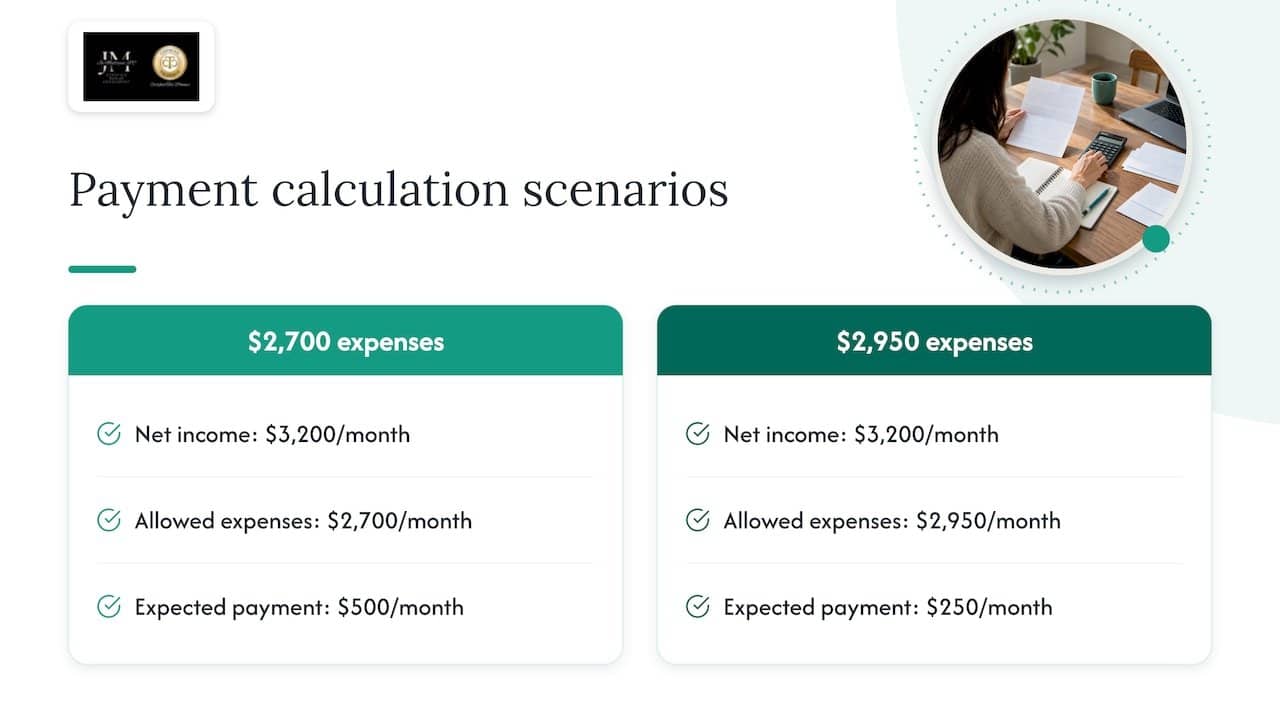
A small change in an allowed expense moves the payment dollar for dollar. Suppose a single filer has $3,200 in net monthly income. If the IRS allows $2,700 in expenses, the expected payment is $500. If it allows $2,950 because the filer documented a higher necessary cost, the expected payment falls to $250. Those figures are an illustration, not a prediction: your numbers will differ.
This is also why it pays to understand how the process works before you apply. If you are weighing do-it-yourself against professional help on a payment plan, this breakdown of IRS installment agreement costs and when to hire a CPA is a practical companion to the expense rules above.
For offers, the standards feed the calculation of what the IRS can reasonably collect from your income. Our guide to the IRS Offer in Compromise explains how that calculation combines with your assets. If your case rests on a different argument, such as whether the debt can ever be collected in full, see our page on doubt as to collectibility.
When your real expenses exceed the standards
The standards are a starting point, not a ceiling carved in stone. The IRS says you may document that the standard amounts are inadequate for your situation, and it may then allow your actual expenses.
Strong cases usually involve costs that are both necessary and hard to avoid:
- Housing costs in an area where the county standard is well below real rents.
- Ongoing medical care or caregiving that goes beyond the flat health allowance.
- Court-ordered payments such as child support.
- Costs of earning income, such as required tools, licenses or business travel.
What the IRS wants is proof. Bring leases, mortgage statements, medical bills, court orders and bank records. A revenue officer cannot allow what you cannot document. Explain in writing why each cost is necessary and why the lower standard does not work. Vague hardship stories rarely move the number. Specific paper does.
Pro tip: do not list the same cost in two places. If your credit card payments are covered by the miscellaneous allowance, putting them on a separate line can trigger a disallowance and make the whole statement look careless.
For taxpayers whose circumstances are severe, see our explainer on IRS hardship status and the broader overview of IRS hardship programs.
Our perspective on the standards
We have spent more than 45 years handling IRS cases, and the same pattern repeats. Taxpayers walk in having filled out a financial statement alone. They listed their real spending line by line, and in several categories they listed less than they were entitled to. Because the National Standards are allowed in full, understating food or personal care costs gives away money you never had to give up.
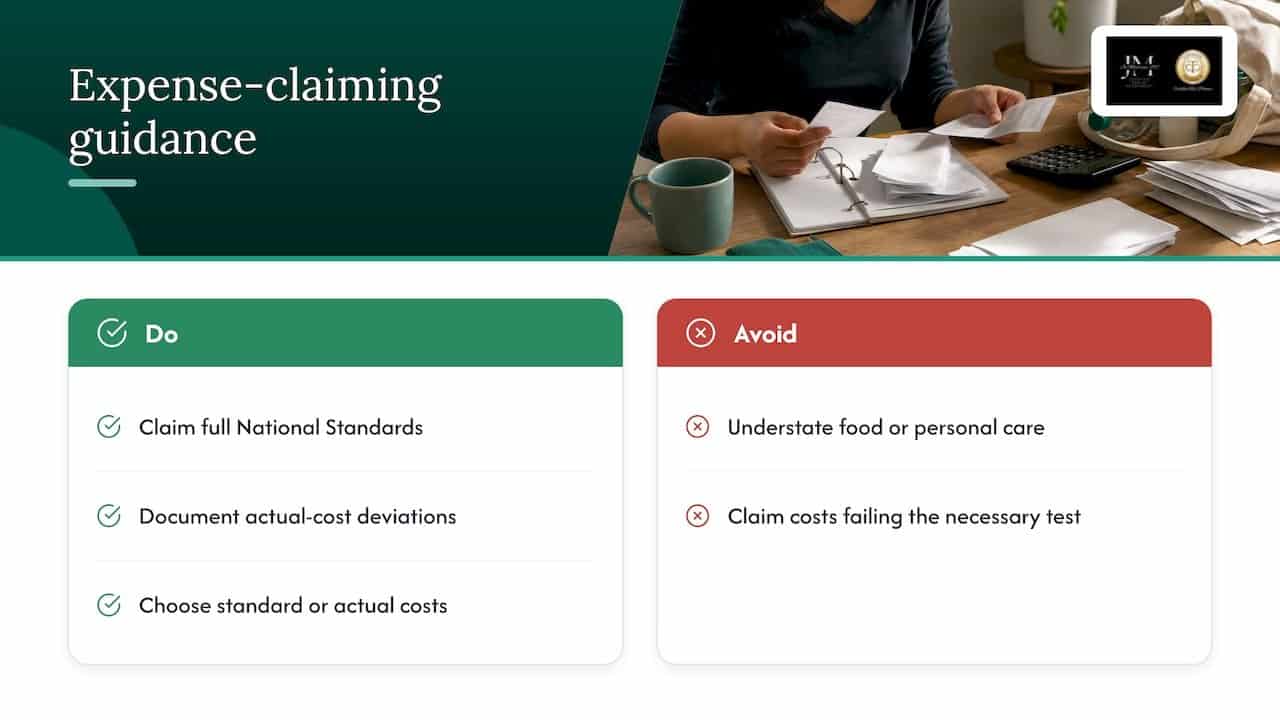
The opposite error is just as common. Others list large, valid-feeling costs that do not meet the necessary expense test and then lose credibility on the items that do. The skill is knowing which costs to claim as standard, which to claim as actual, and which to document as a deviation.
We also see that the standards are not the whole story. The right resolution depends on your income, assets, filing history and how long the IRS has to collect. Sometimes a payment plan is best. Sometimes an offer is. Sometimes the first step is filing missing returns. A number from a table does not tell you which. That takes a licensed professional who will look at your file and represent you directly.
— Joe
Getting help with your financial statement
If the IRS has asked for a financial statement, or you plan to ask for a payment plan or an Offer in Compromise, the way your expenses are presented can change the outcome. We are a CPA firm that represents individuals and business owners before the IRS, including negotiating payment plans and offers. If you have unfiled returns, we handle that too, through our IRS delinquent returns service.
You can start with a consultation with Joe, where we review your situation and explain your options. You can also see everything we do on our services page.
A short checklist before you file
- Pull the current IRS tables, not an old printout.
- Match your household size to the right column.
- Claim the full National Standards amount for your size.
- Enter the lesser of actual cost or standard for housing, utilities and car costs.
- Gather documents for any expense you want allowed above a standard.
- File all missing returns first. The IRS generally will not agree to a payment arrangement while required returns are still outstanding.
- Keep copies of everything you submit.
FAQ
Do the IRS National Standards change every year?
Yes, the IRS revises them periodically, and the 2026 set took effect on June 29, 2026. The figures follow Bureau of Labor Statistics survey data. Always check the IRS website for the current table before preparing a financial statement.
Does the IRS make me prove what I spend on food and clothing?
No. For the five National Standards categories you are allowed the full amount for your family size without questioning your actual spending. You still must document anything you claim above a standard, and the standard for housing, utilities and vehicles is generally the lesser of actual or standard.
Can I claim more than the IRS standards allow?
Possibly. If you can document that a necessary expense exceeds the standard, the IRS may allow the actual amount. Medical costs, court-ordered payments and unusually high local housing costs are typical examples. Without paperwork, the standard will usually apply.
Do the standards apply to Offers in Compromise as well as payment plans?
They are part of the ability-to-pay analysis the IRS uses for collection cases, which includes payment plans and offers. Offers also weigh your assets and the time left to collect, so the expense standards are only one input. A professional can run the full numbers before you apply.
Sources
- Collection financial standards, IRS
- National standards: Food, clothing and other items, IRS
- 2026 Allowable Living Expenses National Standards, IRS
- Publication 1854, IRS
- Local standards: Transportation, IRS
- 2026 Allowable Living Expenses Transportation Standards, IRS