
The best time to call the IRS is the moment the lines open at 7 a.m. in your own time zone, on a Wednesday, Thursday or Friday. The IRS says its phone lines are open Monday through Friday, 7 a.m. to 7 p.m. local time, and wait times are shorter Wednesday through Friday. Mondays and Tuesdays are the days to avoid. Below you will find the numbers to dial, what wait times look like across the year, how to get a live agent, and when a phone call is the wrong tool altogether.
TL;DR
- Call at 7 a.m. local time, Wednesday through Friday. Avoid Mondays and Tuesdays, and avoid the lunch hour if you can.
- Individuals call 800-829-1040. Businesses call 800-829-4933. Both lines run 7 a.m. to 7 p.m. local time, Monday through Friday.
- The IRS reports average waits of about 8 minutes in filing season and about 15 minutes from May through December. Some lines run longer.
- If the wait passes 15 minutes, you may be offered a callback. Take it.
- If the call is about a levy, an audit or a large balance, think about having a CPA make the call for you.
Table of Contents
- The numbers to dial and the hours they are open
- The best day and time to call
- How long will you wait?
- Use the callback option instead of holding
- How to reach a live agent faster
- When a phone call is the wrong choice
- What to say, and what not to say
- Our perspective
- When to hand the call to a CPA
- Common mistakes when calling the IRS
- FAQ
- Sources
The numbers to dial and the hours they are open
Start with the right number. Calling the wrong line wastes a wait that may already be long.
| Who is calling | Number | Hours |
|---|---|---|
| Individuals | 800-829-1040 | Mon to Fri, 7 a.m. to 7 p.m. local time |
| Businesses | 800-829-4933 | Mon to Fri, 7 a.m. to 7 p.m. local time |
Both numbers and the hours come from the IRS’s own Let us help you page. Check that page before you dial, because numbers and hours can change.
Two details trip people up:
- Time zone. The hours follow your local time. A caller in New York and a caller in California both reach the lines at 7 a.m. their time, so you are not competing with the whole country at one moment.
- Weekends. The phone lines are a weekday service. Calling Saturday or Sunday gets you nothing. Extended weekend hours have been offered in the past at the very end of a filing season, but do not plan around them.
If you received a letter, look at the top right corner and the body of the notice first. Many notices list a direct phone number for the department that sent it. That number usually gets you to someone who can see your file faster than the general line.
The best day and time to call
The IRS publishes guidance on this. Wait times are longer on Mondays and Tuesdays and shorter from Wednesday through Friday. That matches how most call centers behave: the weekend builds a backlog of questions and notices, and everyone rushes the phones on Monday morning.
Here is the order we would use:
- Wednesday, Thursday or Friday, at 7 a.m. local time. You are in line before the queue builds.
- Wednesday, Thursday or Friday, late afternoon. Call volume often eases late in the day, but the lines close at 7 p.m. Call too late and you may be told the queue is closed or you may be cut off mid-hold.
- Mid-morning on the same days. Acceptable, but expect a longer wait than at opening.
- Monday or Tuesday. Use only when a deadline forces your hand.
In practice, early morning calls also tend to reach agents who are fresh, with a full day to work your issue. An agent who has 20 minutes left in a shift is less likely to start a research task.
What about West Coast, Alaska and Hawaii callers?
Because hours follow your local clock, a 7 a.m. call from Los Angeles opens at the same local moment as one from Boston. Callers in Alaska and Hawaii follow their own local schedule rather than Eastern time, so confirm the current hours on the IRS page before you set an alarm.
How long will you wait?
The IRS gives two planning figures. Average waits can be about 8 minutes during filing season (January to April) and about 15 minutes after filing season (May to December), with some lines running longer.
Treat these as averages, not promises. Three things push your own wait above them:
- The topic. Questions about balances, payment plans and collection often route to separate queues with different staffing.
- The week. The days around a filing deadline, the first week after notices go out, and Mondays all run heavier.
- The hour. Late morning and lunchtime are busy because everyone else on a work break is calling too.
The IRS has been trying to cut these waits. Its commissioner reported that the agency hired more than 5,000 phone assistors and planned a conversational voice bot to send callers to the right agent. That helps simple questions. Complex cases such as a levy or an open audit still need a person with authority to act.
Use the callback option instead of holding
You do not always have to stay on the line. During high call volume, you may be offered a callback on most toll-free topics when the wait would exceed 15 minutes, provided a representative can reach you during regular business hours. The IRS also notes that it added a callback option to its main phone line so taxpayers do not have to stay on long holds.
If you take a callback:
- Answer calls from unknown numbers for the rest of that day, including any that show as blocked.
- Keep your documents within reach so you can start at once.
- Do not call back while waiting. A second call may cancel your place.
How to reach a live agent faster
The automated menu comes first. The first question is usually language, then a series of topic prompts. A few habits help:
- Listen for the topic that matches your reason for calling. Choosing a menu path that does not fit can send you to a queue that cannot help, and you start over.
- Answer clearly. If a voice system asks you to say a reason, use plain words, not full sentences.
- Call from a quiet place with a good signal. A dropped call means a new wait.
- Block out time. Plan for at least an hour so you are not forced to hang up when an agent finally picks up.
Expect an agent to ask for identity details before discussing your account. You will move faster if you have your SSN or ITIN, birth date, filing status, the return you are calling about, prior-year returns and any IRS correspondence ready.
Your pre-call checklist
- Social Security number or ITIN, and your date of birth
- Filing status and the tax year in question
- A copy of the return, plus the prior year’s return
- The IRS letter or notice, with the notice number (such as CP or LT followed by digits) in front of you
- A pen and paper for the agent’s name, ID number, date and what was agreed
- Any payment records, bank details or proof you already responded
Write down the agent’s name and badge number at the start of every call. If anything is promised, ask when you can expect to see it and what notice or letter will confirm it.
When a phone call is the wrong choice
Calling feels direct, but some tasks go faster or more safely another way. The IRS says its online tools save taxpayers time and money and reduce the need for calls and paper. For simple matters, such as checking a balance or viewing an account, an online account may spare you the hold completely.
A call is also a weak fit when:
- You are being audited. Anything you say on the phone can become part of the file. An examiner may ask open questions that are easy to answer wrongly. See what audit representation is and why it matters before you speak to an auditor.
- A levy or garnishment is active or threatened. Deadlines are short and your rights include written appeals. Our guide on how to fight the IRS and stop levies covers the options.
- You have years of unfiled returns. A phone agent cannot fix this in one call. The route is usually to file the missing returns in the right order and then negotiate. Our page on IRS delinquent returns explains how this works.
- You do not know what the notice means. Read it first. Our walkthrough of how to handle IRS notices step by step will help you decide whether a call is needed at all.
What to say, and what not to say
A short, prepared call goes better than an open conversation.
Do:
- State the tax year, the notice number and the one thing you need.
- Ask what the agent can see on your account before you explain anything.
- Ask for confirmation in writing when you request a payment arrangement, a hold or a correction.
- Ask for the next step and the date you can expect it.
Don’t:
- Guess at numbers. If you do not know, say you will verify and send the answer.
- Agree to a payment you cannot sustain just to end the call. A defaulted agreement can bring back collection.
- Volunteer information about other years or other issues.
- Argue. Agents handle thousands of calls, and a calm tone gets better service.
For more on dealing with the agency, our guide on how to communicate with the IRS goes further, and communicating with the IRS to avoid penalties explains why the timing and wording of contact matter.
Our perspective
After more than 45 years of working IRS cases, we have seen the same pattern many times. A taxpayer holds for an hour, gets through, and then talks themselves into trouble because they were rushed and nervous. The wait is not the real problem. The real problem is going into the conversation without knowing what the IRS can see, what you are entitled to ask for, and what you should not say.
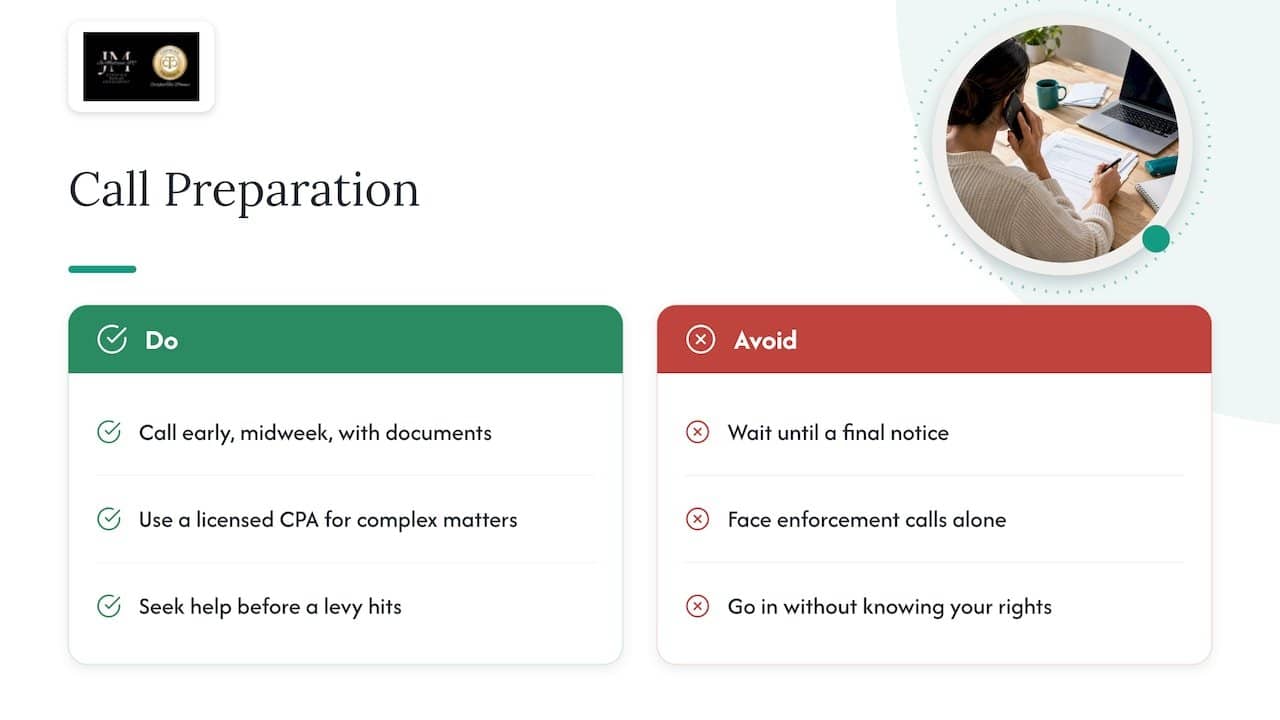
Our advice is simple. Call early, midweek, with your documents in hand, when the matter is routine. When the matter involves enforcement, an audit or a balance you cannot pay in full, think about who should be on the line. A licensed CPA who represents you can speak to the IRS for you, request holds on collection while a resolution is built, and keep you from making statements that cost you later. You are not required to take calls from the IRS alone.
We also encourage people not to wait until a letter says “final notice”. An early call, or an early conversation with a professional, leaves far more options than one made after a levy has hit your bank account.
— Joe
When to hand the call to a CPA
If your reason for calling is one of these, a phone queue may not be the best use of your day:
- An audit letter or an examiner asking for records
- A levy, lien or garnishment notice
- A balance you cannot pay in full, where you need an installment agreement or an Offer in Compromise
- Several years of missing returns
- Penalties you believe were assessed in error, which may qualify for abatement
Joe Mastriano, CPA, represents individuals and business owners before the IRS on exactly these issues. We offer free evaluations of your IRS situation and a consultation with Joe so you can learn where you stand before you commit to anything. You can also see the full list of services we provide.
Common mistakes when calling the IRS
- Calling on Monday morning. It is the single most reliable way to get a long hold.
- Calling in the last hour of the day. The queue may cut off before you reach an agent.
- Starting without your paperwork. Agents cannot discuss an account until they verify who you are.
- Ignoring the callback offer. A callback saves you the hold. Take it.
- Not keeping notes. Without the agent’s name, ID and date, a promise on a call is hard to prove later.
- Calling about a notice you have not read. Many letters include a deadline, a reply address and a direct number.
- Ignoring the deadline on the letter. Calling does not stop a deadline unless the agent confirms an extension and you get it in writing.
If you want to see how notices are structured and how to answer them, our IRS letters and notices page and the 2026 notice response guide walk through the common types.
FAQ
What is the best time of day to call the IRS?
Call at 7 a.m. in your own time zone, when the lines open. You will be in the queue before the daily rush. Late afternoon on a Wednesday to Friday can also work, but you risk running into the 7 p.m. close.
What is the best day to call the IRS?
The IRS says wait times are shorter from Wednesday through Friday and longer on Mondays and Tuesdays. Pick a Wednesday, Thursday or Friday when you can.
What number do I call to reach the IRS?
Individuals call 800-829-1040 and businesses call 800-829-4933, per the IRS contact page. If you received a notice, also check it for a number tied to that specific department, which may reach the right person faster.
How long are IRS phone wait times?
The IRS reports averages of about 8 minutes during filing season and about 15 minutes from May through December, with some lines longer. Your own wait depends on the day, the hour and the topic. If the wait exceeds 15 minutes you may be offered a callback.
Can someone call the IRS for me?
Yes, if you authorize a representative such as a CPA. With the proper authorization on file, the representative can speak to the IRS about your account, which is often the safest approach for audits, levies and large balances.
Sources
- Let us help you | Internal Revenue Service
- Publication 3744-B (4-2024) | Internal Revenue Service
- Prepared Remarks of IRS Commissioner Danny Werfel during Secretary Yellen’s visit to IRS Headquarters