
You can get the Form 2210 underpayment penalty waived, but only in narrow cases. The IRS generally does not waive it for reasonable cause alone. It will remove or reduce it for a casualty, disaster or other unusual circumstance, or when you retired after age 62 or became disabled and the shortfall had a reasonable cause. If you owe less than $1,000, or met a safe harbor, there is no penalty to waive. The rest of this guide shows how to tell which situation is yours and how to ask correctly.
We are a CPA practice that has worked on IRS problems for more than 45 years. Most waiver requests we see fail on framing, not facts: the wrong reason is given, or the right reason is given without the paperwork. The steps below fix that.
TL;DR
- The penalty applies when withholding plus timely estimated payments fall short of the smaller of 90% of this year’s tax or 100% of last year’s tax. It is figured separately for each quarterly due date.
- You owe nothing if your balance due after withholding and credits is under $1,000.
- Waiver grounds are narrow: casualty, disaster, unusual circumstances, or retirement after 62 or disability with reasonable cause. Lack of funds alone does not qualify.
- Request it on Form 2210 by checking box A or B and attaching a signed statement and documents.
- For the 2025 tax year, the IRS’s underpayment interest rate for the first quarter of 2026 was 7%, and that rate also applies to estimated-tax underpayments. It resets every quarter.
Table of Contents
- What the Form 2210 penalty actually is
- First check whether there is anything to waive
- The grounds the IRS accepts for a waiver
- How to request the waiver on Form 2210
- Where a CPA changes the outcome
- When hardship is the real issue
- Failure-to-deposit penalty abatement for businesses
- The automatic relief change coming
- A note on crypto and penalty relief
- Our perspective
- Get a CPA to review your penalty
- FAQ
- Sources
What the Form 2210 penalty actually is
Income tax in the United States is pay-as-you-go. The IRS expects you to pay as you earn, through withholding or estimated payments, usually in four installments. If you fall behind, the IRS charges interest-based underpayment penalty on the shortfall, and Form 2210 is the form that computes it.
For the 2025 tax year, the Form 2210 instructions say you generally owe the penalty if your total withholding plus timely estimated payments is less than the smaller of:
- 90% of your 2025 tax, or
- 100% of your 2024 tax (your 2024 return must cover a full 12 months).
The penalty is figured separately for each quarterly due date. That matters: you can pay enough by year end and still owe a penalty for an early quarter in which you paid too little.
The rate comes from the IRS’s quarterly interest rates. In IRB 2025-48, Rev. Rul. 2025-22 set the underpayment rate at 7% for the quarter beginning January 1, 2026, and stated that the same rate applies to estimated-tax underpayments. The IRS publishes a new rate each quarter, so check the current table when you compute your own figure.
First check whether there is anything to waive
Many people ask for a waiver when the penalty never applied. Run these tests first.
| Test | Result |
|---|---|
| You owe less than $1,000 after withholding and refundable credits | No penalty |
| You paid at least 90% of current-year tax | Safe harbor met |
| You paid at least 100% of prior-year tax | Safe harbor met |
| Your prior-year AGI was above the IRS’s high-income threshold | The prior-year safe harbor rises to 110% |
| You had no 2024 tax liability (for the 2025 return) | Exception applies |
The IRS page on underpayment of estimated tax lists these safe harbors and the 110% rule for higher earners. Farmers and fishers, household employers, estates and trusts have their own rules, described in the Form 2210 instructions.
If your income came unevenly, for example a large stock sale in December, you may not need a waiver at all. The annualized installment method (Schedule AI of Form 2210) lets you match the required payments to when you actually earned the income. It can shrink or erase the penalty with no hardship argument. For a closer look at how withholding and quarterly payments compare, see our piece on choosing withholding or Form 1040-ES and our guide to why quarterly payments matter.
The grounds the IRS accepts for a waiver
The IRS is stricter on this penalty than on most. It states that the estimated-tax penalty generally cannot be waived for reasonable cause. The law carves out two groups.
Casualty, disaster or unusual circumstances
The IRS may remove or reduce the penalty if the underpayment resulted from a casualty, a local disaster or another unusual circumstance, and charging it would be unfair. Think of a fire that destroyed your records and your home, or a flood that closed your business in the weeks before a payment date.

For federally declared disasters, the 2025 Form 2210 instructions say the IRS identifies taxpayers in covered counties or parishes and applies relief automatically, so you generally should not file Form 2210. There is an exception if you use the annualized income installment method, in which case the form is still required. If your records or your tax preparer’s office sit in a covered area but your home does not, the instructions direct you to call the IRS disaster hotline at 866-562-5227.
Retirement after 62 or disability
The penalty is waived in full or in part if the IRS determines you retired after reaching age 62, or became disabled, in the year of the return or the year before it, and the underpayment was due to reasonable cause and not willful neglect. For 2025 returns, that means retirement or disability in 2024 or 2025.
What does not qualify
The IRS’s reasonable cause guidance says lack of funds by itself generally does not qualify. Neither do reliance on a tax professional, mistakes or oversights, or not knowing the rule. If your honest story is “I did not realize my side income needed estimates,” the waiver route is weak, and the better tools are the annualized method, a corrected safe-harbor calculation, or a different payment structure going forward.
How to request the waiver on Form 2210
The 2025 instructions set out the mechanics. Follow them exactly.
- Complete the form. Check box A if you are claiming retirement or disability and complete page 1. Check box B if you are claiming casualty, disaster or unusual circumstances and complete the form through line 18.
- Enter the amount you want waived. Write it in parentheses next to line 19. If you want the whole penalty waived, enter the full amount. If you want part of it removed, enter that part.
- Attach a written statement. Explain why you did not meet the payment requirements and identify the time period involved. Keep it factual and dated.
- Attach proof. For retirement, include your retirement date and your age. For disability, the date you became disabled. For casualty or unusual circumstances, police and insurance reports or similar records.
- File it with the return. Include the form and attachments with your return, or send the statement to the address on the notice if the IRS has already billed you. The IRS says a written explanation signed under penalty of perjury should go to the address on the notice.
Pro tip: Write the statement as a timeline. State what happened, the date, how it stopped you from paying each quarter, and what you did once you could. Reviewers decide whether the facts fit one of the statutory grounds, so facts that map to the grounds do the work, not sympathy.
If the IRS denies the request, you still have options, including appeal rights. Our estimated tax penalty abatement guide covers what to do next.
Where a CPA changes the outcome
This is the part of the process where small drafting choices decide the result. A request that claims “hardship” when the law asks about casualty or unusual circumstances is read as a plain request for leniency. A request that picks the right ground but leaves out the time period leaves the reviewer to guess.
When we handle these requests, we start by checking whether the penalty is correctly computed in the first place, including whether the annualized method applies. Then we match your facts to the ground that fits and assemble the statement and records. Our Consultation with Joe is the place to start if you want that review, and our IRS penalty abatement help page explains how we handle penalty relief generally.
When hardship is the real issue
People searching for a hardship waiver are often not dealing with a Form 2210 problem alone. They owe tax, cannot pay it all and are being charged penalties on top. Those are separate problems with separate tools.
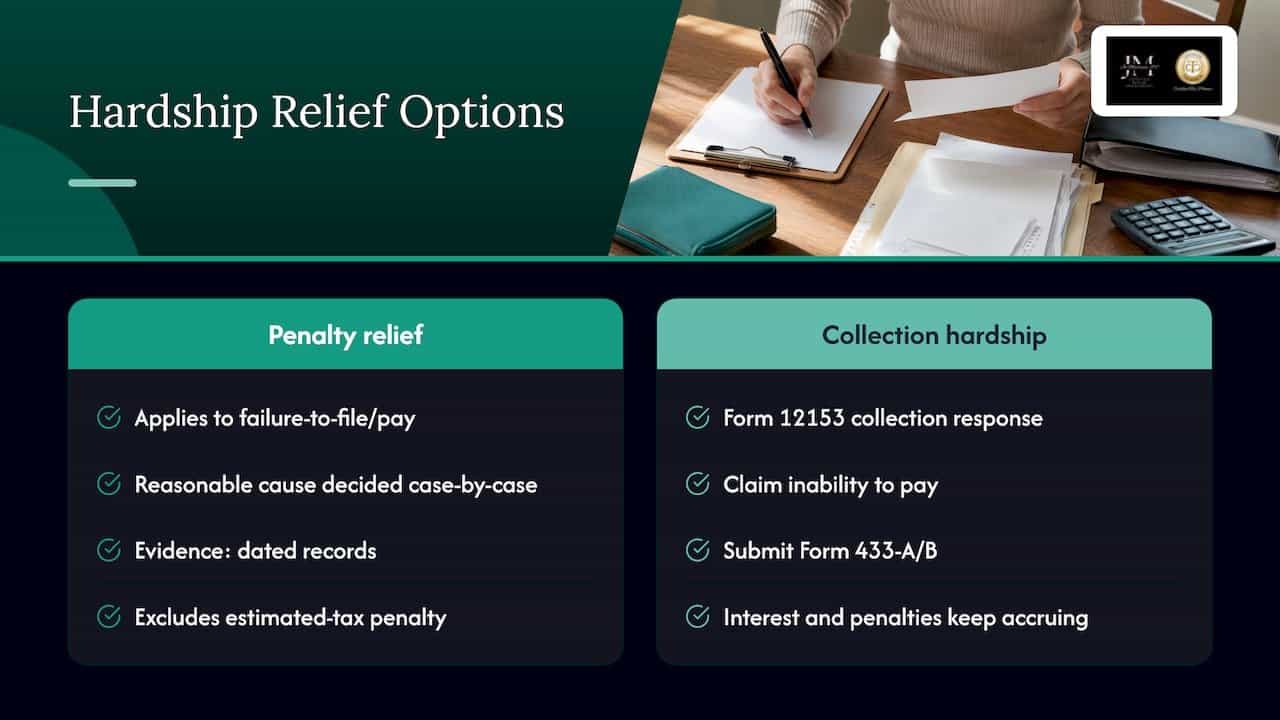
The IRS describes reasonable cause as decided case by case. Valid examples include fires and natural disasters, inability to get records, serious illness or death of you or an immediate family member, and system problems that delayed electronic filing or payment. Useful evidence includes hospital or court records, a doctor’s letter with dates, disaster documentation, correspondence, and receipts. This applies to penalties that allow reasonable cause, such as failure to file and failure to pay, not to the estimated-tax penalty itself.
If you respond to a collection notice, Form 12153 offers the option to claim you are currently unable to pay due to financial hardship, or to say you cannot pay in full and want a collection alternative. Form 433-A (individuals) or 433-B (businesses) can be submitted with the request. Interest and penalties continue to accrue on the unpaid balance while collection is on hold, which is why we treat a hardship claim as pressing pause, not delete.
If the underlying debt is the larger problem, our IRS Offer in Compromise service and installment agreement pages explain the paths to resolving the balance.
Failure-to-deposit penalty abatement for businesses
Business owners often confuse the two penalties. Form 2210 is for individuals, estates and trusts and covers estimated income tax. The failure-to-deposit penalty under IRC 6656 hits employers who do not deposit payroll and other taxes on time. It uses a different relief path.
Per the IRS page on administrative penalty relief, failure-to-deposit penalties are eligible for First Time Abate relief regardless of amount. To qualify:
- You filed the same type of return on time for the prior three years or 12 quarters.
- You have no penalties assessed in that period, other than estimated-tax penalties, or any earlier penalty was removed for reasonable cause or IRS error.
- For businesses, you do not have four or more prior failure-to-deposit waivers and no penalty for avoiding the electronic payment system (EFTPS).
You can call the number on the notice, or send a written statement or Form 843. You do not need to say the words “First Time Abate” or attach supporting documents to ask. Our page on CP 210 and CP 220 notices walks through what the letters mean, and 7 penalty abatement options for small businesses covers the wider menu.
The automatic relief change coming
The IRS announced in its e-News for Small Business, Issue 2026-15 (July 15, 2026) that an Automatic Penalty Relief program (AEP) would launch in summer 2026. It automatically provides failure-to-file, failure-to-pay and failure-to-deposit relief to taxpayers with a timely filing and payment history for the prior three years or 12 consecutive quarters. It applies to eligible 2025 tax-year returns, 2026 quarterly returns and future periods. First Time Abate is being phased out, and AEP is to fully replace it for eligible returns due on or after January 1, 2027. Those who do not qualify may still request reasonable-cause relief.
Two points for this topic. First, the announced program covers failure-to-file, failure-to-pay and failure-to-deposit penalties, not the estimated-tax penalty on Form 2210, so the waiver grounds above still govern that one. Second, how automatic penalty waivers work depends on your recent filing record, so a clean three-year history is worth protecting. Our guide on failure-to-file penalty abatement with three clean years covers that side.
A note on crypto and penalty relief
If your underpayment came from crypto gains, the Form 2210 rules above are the same: gains are income, and estimated payments cover them. The IRS’s recent digital-asset relief, such as Notice 2025-3, targets decentralized-finance brokers’ reporting and backup-withholding duties, not individual taxpayers’ estimated-tax penalties. If crypto sales created a large shortfall, the annualized installment method is the first thing to test.
Our perspective
Over four decades of IRS work, I have watched the same pattern: people wait until the bill arrives, then ask for mercy on a ground the law does not recognize. The estimated-tax penalty is one of the least forgiving, which is exactly why the first hour of work matters.
We start by recomputing the penalty. Often the annualized method or a safe harbor removes it entirely, and no waiver is needed. When a waiver is the right route, we match your facts to casualty, unusual circumstances, retirement or disability, and build the statement and records around that ground.
And because we represent clients before the IRS, we can see the larger picture: unfiled returns, installment agreements, Offers in Compromise, abatement of other penalties. A penalty request is rarely the only issue, and we handle it as one part of getting you current and protected.
Joe
Get a CPA to review your penalty
If you have a Form 2210 penalty, a failure-to-deposit notice or a balance you cannot pay, our practice handles IRS representation, penalty abatement, delinquent returns, installment agreements and Offers in Compromise. We offer free evaluations to review your IRS situation.

Start with our services overview, or book a Consultation with Joe. If your penalty came with years of unfiled returns, our IRS delinquent returns service is built for that.
FAQ
Can I get the Form 2210 penalty waived just because I cannot afford it?
Not on that basis alone. The IRS says lack of funds by itself generally does not count as reasonable cause, and the estimated-tax penalty generally cannot be waived for reasonable cause anyway. Waiver rests on casualty, disaster or unusual circumstances, or retirement after 62 or disability with reasonable cause. If you cannot pay the tax itself, a payment plan or other collection alternative is the right tool.
Do I always need to file Form 2210?
No. If you owe less than $1,000 after withholding and credits or met a safe harbor, no penalty applies. The IRS can also calculate the penalty and bill you. You file the form yourself to claim a waiver, to use the annualized installment method, or to show an exception.
How do I request a waiver of the underpayment penalty?
Check box A (retirement or disability) or box B (casualty, disaster or unusual circumstances) on Form 2210, enter the amount to waive in parentheses next to line 19, and attach a statement and supporting records. For retirement or disability, include dates and age. For casualty, include police or insurance reports.
Is failure-to-deposit abatement the same as a Form 2210 waiver?
No. Failure-to-deposit penalties hit employers who miss tax deposits and can qualify for First Time Abate if the filing history is clean. Form 2210 covers estimated income tax for individuals, estates and trusts, and its waiver grounds are narrower.
Does the 7% rate mean my penalty is 7%?
Not exactly. The IRS’s rate for the first quarter of 2026 was 7%, and it applies to each underpaid installment for the time it stayed unpaid, with the rate set each quarter. The penalty depends on the amount and the number of days, so your Form 2210 worksheet gives the real figure.
Sources
- Instructions for Form 2210 (2025), IRS
- Topic no. 306, Penalty for underpayment of estimated tax, IRS
- Underpayment of estimated tax by individuals penalty, IRS
- IRB 2025-48, IRS
- Penalty relief for reasonable cause, IRS
- Form 12153 (Rev. 7-2022), IRS
- Administrative penalty relief, IRS
- e-News for Small Business Issue 2026-15, IRS
- Notice 2025-3, IRS