
You can often reduce or remove an IRS accuracy-related penalty, but you have to win it on facts and paperwork, not by asking nicely. The strongest routes are proving the IRS did not follow its own approval rules, showing you had reasonable cause and acted in good faith, or showing you had substantial authority or disclosed the position on your return. Each has a different burden of proof and a different deadline, so the order in which you respond matters.
This guide is for individuals and business owners who received a notice adding this penalty to an audit bill. It explains what the penalty is, how to check the IRS’s math and process, which defenses work, and what to do if relief is denied.
TL;DR
- The accuracy-related penalty is generally 20% of the underpayment tied to negligence or a substantial understatement, and interest runs on it too (IRS).
- Check the notice first: the penalty needs written supervisory approval, and the notice must name the penalty, the Code section and the computation.
- Reasonable cause and good faith is the main defense. Relying on a competent preparer you gave complete information to can qualify.
- Request relief by phone or in writing with Form 843, and if it is denied, you generally have appeal rights.
- Do not let the response deadline on your notice pass while you gather records.
Table of Contents
- What the accuracy-related penalty is
- Step one: check whether the IRS assessed it properly
- Step two: choose the defense that fits your facts
- Step three: gather the evidence
- Step four: respond to the IRS
- If the IRS says no
- What changed recently
- Common mistakes that cost taxpayers the penalty fight
- Our perspective
- Get a CPA to review your notice
- FAQ
- Sources
What the accuracy-related penalty is
The IRS can charge this penalty when you underpay the tax that should have been shown on your return. The two most common triggers are negligence or disregard of the rules, and a substantial understatement of income tax. In both cases the penalty is 20% of the affected underpayment, and the IRS also charges interest on the penalty itself (IRS: Accuracy-related penalty).
Negligence is a failure to make a reasonable attempt to comply, such as not keeping records or deducting items without support. Disregard means ignoring rules or regulations. A substantial understatement is a numbers test.
When an understatement counts as substantial
Per the IRS, for an individual the understatement is substantial when it exceeds the greater of 10% of the tax that should have been shown or $5,000. If you claimed the Section 199A qualified business income deduction, the test drops to the greater of 5% of the tax or $5,000. Corporations other than S corporations and personal holding companies use a different test: the lesser of 10% of the tax (or $10,000 if greater) or $10,000,000 (IRS).
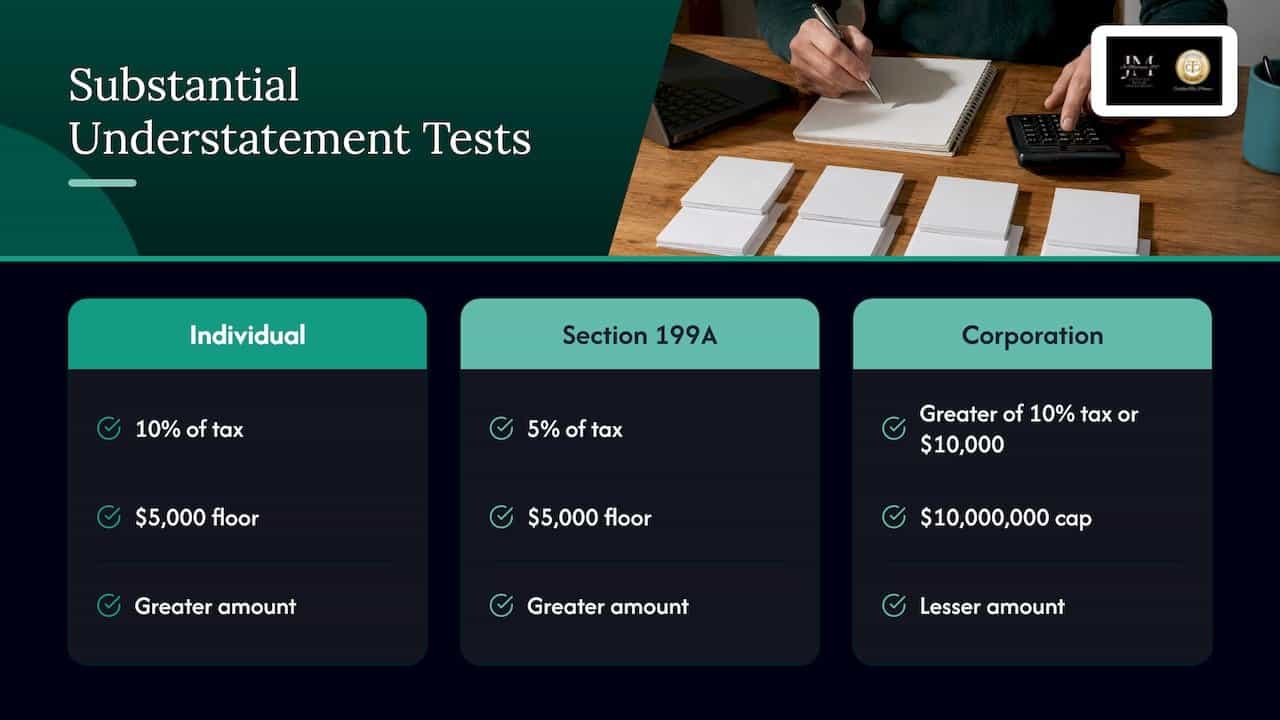
Worked example. An audit finds you should have reported $60,000 of tax, and you reported $48,000. The understatement is $12,000. Ten percent of $60,000 is $6,000, and $5,000 is smaller, so the threshold is $6,000. Your $12,000 exceeds it, so the substantial understatement penalty can apply: 20% of $12,000 is $2,400, plus interest running on that amount.
The 40% rate and what the penalty does not cover
The IRS Internal Revenue Manual, its internal handbook, says the rate rises to 40% for gross valuation misstatements, certain undisclosed noneconomic substance transactions and undisclosed foreign financial asset understatements. It also says the penalty applies only to returns you filed, and not to a portion already subject to the civil fraud penalty (IRM 8.17.7). Penalties do not stack: the maximum on any portion of an underpayment is 20%, or 40% in the specified cases, even if more than one kind of misconduct is alleged (IRM 20.1.5).
If you never filed, this penalty is not the issue. Overdue returns raise a different set of penalties, and we cover that on our IRS delinquent returns page.
Step one: check whether the IRS assessed it properly
Before you argue about your own conduct, test the IRS’s process. Two checks cost nothing.
1. The computation and labeling. Under 26 U.S.C. § 6751, each penalty notice must include the name of the penalty, the Code section and a computation. If your notice says only “penalty” with a dollar figure, that is a gap worth documenting. Recalculate the 20% against the underpayment figure the IRS used. A penalty applied to the wrong base, or to an adjustment you already conceded was not an error, is an easy reduction.
2. Supervisory approval. The same statute says most penalties cannot be assessed unless the initial determination is personally approved in writing by the immediate supervisor of the person who made it. There are exceptions, including penalties calculated automatically by electronic means. In an examination, the IRS bears the initial burden of producing evidence that the penalty is appropriate for an individual, and Tax Court decisions such as Graev v. Commissioner turned on that burden.
The timing rules changed recently. Final regulations on supervisory approval took effect December 23, 2024, and apply to penalties assessed on or after that date (Federal Register). Under IRS interim guidance issued August 13, 2025, approval must be obtained on or before the date the pre-assessment notice is mailed, and a copy of the written approval must be attached to statutory notices of deficiency that assert penalties requiring it (IRS Interim Guidance SBSE-04-0825-0038). The IRS handbook also says penalty issues require supervisory review before they are asserted (IRM 20.1.5).
Whether approval was timely and valid in your case depends on dates in your file. A procedural defect is a strong argument, but it is a technical one: have a professional read the examination file before you rely on it.
Step two: choose the defense that fits your facts
There are three recognized ways to defeat the penalty on the merits. You can use more than one.
| Defense | What you must show | Typical fit |
|---|---|---|
| Reasonable cause and good faith | You made a real effort to report correctly and acted in good faith | Honest mistakes, complex issues, reliance on a preparer |
| Substantial authority | A weighty legal basis supported your return position | Aggressive but supportable positions |
| Adequate disclosure | You disclosed the position (Form 8275) and had a reasonable basis | Gray-area items you flagged on the return |
The Tax Court noted in Graev that the taxpayer carries the burden of proving reasonable cause, substantial authority or adequate disclosure with a reasonable basis (Graev v. Commissioner). That is why documents decide these cases.
Reasonable cause and good faith
The Code gives a reasonable cause and good faith exception, judged case by case under Treasury Regulation 1.6664-4. The IRS says your effort to report the proper tax is generally the most important factor, along with your experience, knowledge and education, and whether you relied on a tax advisor (IRM 20.1.5). On its relief page the IRS lists the same factors: the effort you made, how complex the issue was, your knowledge of tax law and the steps you took to get help (IRS: Penalty relief for reasonable cause).
The exception does not apply to underpayments from transactions lacking economic substance, to disallowances under IRC 170(h)(7), or to gross valuation overstatements of charitable deduction property (IRM 20.1.5).
For a deeper look at how the IRS weighs these factors, see our guide to reasonable cause for IRS penalties.
When a preparer made the mistake
Many accuracy penalties come from a return someone else prepared. The IRS considers whether you gave the advisor all the information needed and whether the advisor was competent and experienced (IRS). In Graev, the Tax Court described reliance on a competent, experienced CPA as capable of establishing reasonable cause and good faith when the taxpayer supplied all necessary information and the error resulted from the preparer’s mistakes.
That makes your organizer, emails and source documents the center of the case. If you handed your preparer a complete set and they misapplied the rule, show it. If you left out facts, this defense weakens.
Substantial authority and disclosure
If you took a legal position with weighty support, such as regulations, court decisions or published guidance, the understatement for penalty purposes can be reduced by that item. If you disclosed the item on Form 8275 and had a reasonable basis, the substantial understatement penalty may not apply. Both need to be established from the return and the law at the time you filed, so they are most useful where the audit is a genuine disagreement about how a rule applies, not a missing-records problem.
Step three: gather the evidence
The IRS asks for documentation that matches the reason you give. For penalty relief generally, it points to proof of timely filing, such as a copy of the return, or proof of timely payment, such as both sides of a cancelled check. It lists qualifying circumstances including death, serious illness or unavoidable absence, fire or natural disaster, inability to obtain records, a mistake, and erroneous advice. If none fit, you submit a detailed account of the facts and circumstances (IRS: Penalty appeal).
For an accuracy-related penalty, build a file with:
- The return as filed and the audit report showing each adjustment
- Your records for each adjusted item (receipts, mileage logs, 1099s, K-1s, loan documents)
- Communications with your preparer or advisor, plus what information you supplied
- A dated timeline of what you knew and did when you prepared the return
- Anything that shows the issue was complex or that guidance was unclear
Write the narrative in plain facts. State what happened, what you did to get it right, and why the error was not carelessness. Avoid pleading hardship: hardship may matter for payment, but the penalty defense is about your conduct.
Step four: respond to the IRS
Start with the deadline printed on your notice. If it is an audit report or proposed adjustment letter, a late response can cost you rights.
- Respond to the proposed adjustment. During an examination, raise the penalty defense in writing with your documents. Ask for the penalty approval form and the computation if they are not in your file.
- Request relief on an assessed penalty. The IRS says you can ask for reasonable-cause relief by calling the toll-free number on your notice with your documentation ready. If the IRS cannot approve it by phone, you can request it in writing using Form 843, Claim for Refund and Request for Abatement. If you qualify for first-time abatement instead, the IRS applies that relief (IRS). First-time abatement is aimed at certain filing and payment penalties, so it rarely helps with this one. Our Form 843 guide walks through what goes on the form.
- Expect interest to follow the penalty. When a penalty is reduced or removed, the IRS automatically reduces or removes the related interest (IRS: Penalty relief).
- Keep copies and proof of delivery for everything you send.
If the IRS says no
A denial is not the end. Under Topic 151, a taxpayer who receives a report or letter explaining a proposed or taken action generally has the right to ask for a conference with an Appeals or Settlement Officer, and penalties are among the items that can be appealed. If you cannot reach agreement there, certain actions can be taken to the courts (IRS Topic 151).
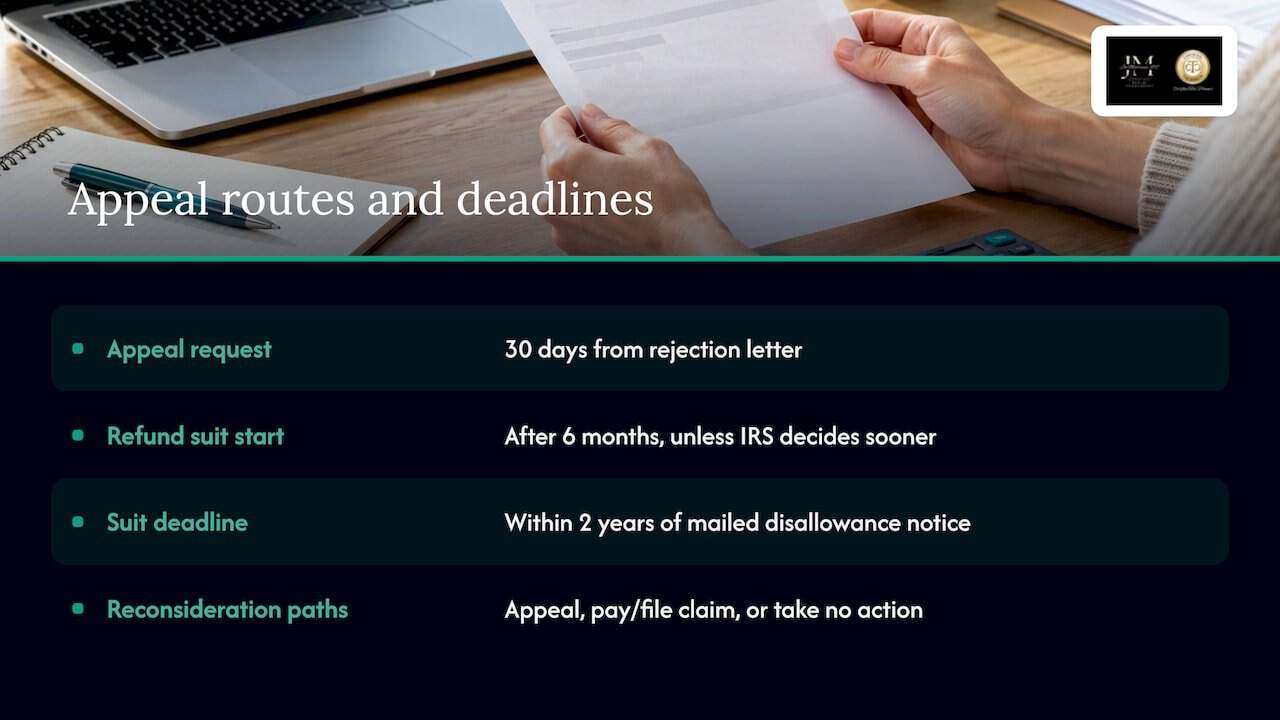
The IRS’s own penalty appeal page gives a 30-day window from the date of a rejection letter to request an Appeals conference for failure-to-file and failure-to-pay penalty denials (IRS: Penalty appeal). Read your own letter for the exact deadline and the appeal instructions, because the clock for an audit-related penalty is set by the notice you received, not by a general rule.
IRS Publication 3598 also lays out other paths after a reconsideration outcome you disagree with: request an Appeals conference, pay in full and file a formal claim, or take no action and receive a bill (Publication 3598). If you pay and sue for a refund, the Code sets time limits. A refund suit generally cannot start until six months after the claim is filed unless the IRS decides sooner, and cannot start more than two years after the notice of disallowance is mailed (26 U.S.C. § 6532). Our guide to navigating IRS appeals explains how an Appeals conference works.
Paying while you fight
If you owe the balance and need time, Publication 3598 describes an installment agreement (interest, continuing penalties and a user fee apply), an Offer in Compromise on Form 656 where the IRS may accept less than the full amount, and a temporary delay of collection if you cannot pay, during which the debt keeps growing and the IRS may file a Notice of Federal Tax Lien (Publication 3598). Disputing a penalty and arranging payment can run in parallel. See our pages on installment agreements and the Offer in Compromise.
What changed recently
Two updates are worth knowing. The supervisory approval rules above took effect December 23, 2024. And the IRS penalty handbook, in its June 3, 2026 revision, added a new accuracy-related penalty provision for substantial understatement tied to disallowed applicable energy credits, enacted by the One, Big, Beautiful Bill Act, and added another penalty subject to the 40% rate under the no-stacking rule (IRM 20.1.5). If your audit involved energy credits, ask whether the 20% or a higher rate was applied and under which provision.
Common mistakes that cost taxpayers the penalty fight
- Waiting for the bill. Arguments are easier to make during the audit, when the IRS is still deciding whether to assert the penalty.
- Arguing the tax and the penalty as one issue. You can owe the tax and still not owe the penalty.
- Sending a story without documents. The burden to prove reasonable cause is yours.
- Blaming the preparer without showing what you gave them.
- Missing the appeal window in the denial letter.
Pro tip: Think of a penalty request as pressing pause on a dispute you can still win, not deleting a bill. Keep every deadline on the calendar while the request is pending.
Our perspective
Most accuracy penalties I see start as ordinary errors: a deduction taken in good faith, a form misread, a return prepared by someone who did not know the rule. The penalty then feels like a punishment for being honest and wrong.
What I try to do from the first conversation is separate three questions. Is the tax adjustment right? Is the penalty computed and approved the way the law requires? And do the facts show reasonable cause? Answering them in that order often changes the number on the notice.
After more than 45 years handling IRS cases, I prefer to deal with each client directly. A penalty response is only as good as the facts behind it, and the person writing the narrative should know your file. Where a prior preparer or a large national firm got it wrong, I can correct the record before the IRS.
Joe
Get a CPA to review your notice
We handle audit representation, penalty abatement and Appeals matters, and we also set up installment agreements and Offers in Compromise when a balance remains. Our free evaluation reviews your IRS situation so you know where you stand before a deadline passes. You can read about audit representation, see our IRS penalty abatement help page, or book a consultation with Joe.

Bring the notice, the audit report and the return as filed. Those three documents tell us what the IRS is asserting and how much time you have. Our services page lists everything we do.
FAQ
Is the accuracy-related penalty always 20%?
No. The usual rate for negligence and substantial understatement is 20%, but the IRS handbook sets a 40% rate for gross valuation misstatements, certain undisclosed noneconomic substance transactions and undisclosed foreign financial asset understatements. The penalties do not stack on the same portion of the underpayment (IRM 20.1.5).
Does first-time abatement remove it?
First-time abatement is a filing and payment penalty tool and generally does not fit this penalty. For accuracy-related penalties the IRS looks at reasonable cause and good faith, so build your case around your efforts, the complexity of the issue and any advisor you relied on.
Can I remove the penalty if my tax preparer made the error?
Possibly. The IRS considers whether you gave your advisor all the information needed and whether the advisor was competent and experienced. Your documents showing what you supplied are the key evidence.
Does the IRS charge interest on the penalty?
Yes. The IRS charges interest on penalties, and if a penalty is reduced or removed, the related interest is automatically reduced or removed with it (IRS).
What if I cannot afford to pay while I dispute the penalty?
You can ask about a payment arrangement in parallel with the dispute. Interest and continuing penalties may still accrue under an installment agreement, so a professional should compare the options against your balance before you commit.
Sources
- IRS: Accuracy-related penalty
- IRM 8.17.7, Penalties/Additions to Tax in Computations
- IRM 20.1.5, Return Related Penalties
- 26 U.S.C. § 6751, Procedural requirements
- Graev v. Commissioner, 147 T.C. No. 16
- Federal Register: Rules for Supervisory Approval of Penalties
- IRS Interim Guidance SBSE-04-0825-0038
- IRS: Penalty relief for reasonable cause
- IRS: Penalty relief
- IRS: Penalty appeal
- IRS Topic no. 151, Your appeal rights
- IRS Publication 3598
- 26 U.S.C. § 6532, Periods of limitation on suits