
If you filed a joint return, you and your former spouse can each be held responsible for the whole tax bill, whatever your divorce decree says. The IRS is not a party to your divorce. The way out is not the decree. It is a specific IRS relief request, a payment arrangement, or both, filed on time and backed by the right facts. As CPAs who have handled IRS cases for over 45 years, we walk you through each option below.
TL;DR
- A decree that assigns a joint-return tax debt to your ex does not stop the IRS from collecting from you. Under IRS Publication 504, you are jointly and individually responsible for tax, interest and penalties on a joint return for a year ending before the divorce.
- Three IRS relief types exist: innocent spouse relief, separation of liability and equitable relief. All start with Form 8857, and several carry strict deadlines.
- If the IRS is already sending bills or levy notices, act on the notice deadlines. A pending Form 8857 pauses collection for that year, and a current payment plan blocks new levies.
- Business payroll tax debt, including the Trust Fund Recovery Penalty, is treated differently. Innocent spouse relief does not cover it.
- Unfiled returns make every one of these problems harder. Get them filed first.
Table of Contents
- Why a divorce decree does not bind the IRS
- Which tax years and debts are at risk
- The three kinds of IRS relief for a former spouse’s tax debt
- Deadlines that decide the outcome
- If the IRS is already collecting
- Injured spouse is not innocent spouse
- A step-by-step plan
- When the debt comes from an S corporation
- After the divorce: protect your fresh start
- How we help with divorce-related tax debt
- Our perspective
- FAQ
- Sources
Why a divorce decree does not bind the IRS
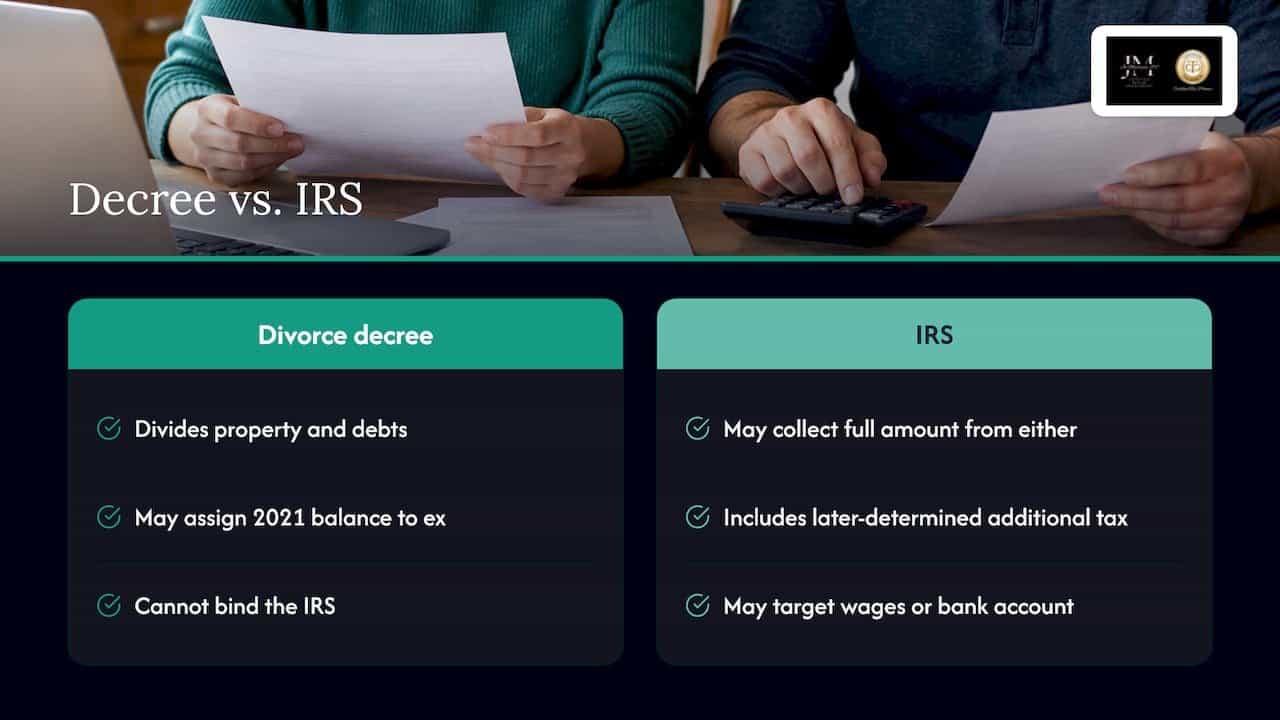
A divorce court divides property and debts between you and your spouse. The IRS is a third-party creditor, and it is not bound by that division. When you signed a joint return, you each took on what the tax law calls joint and several liability: the IRS may collect the full amount from either of you.
Publication 504 says this applies even if the decree states that your former spouse will be responsible for amounts due on previously filed joint returns. The Form 8857 instructions add that it covers not just the tax shown on the return but any additional tax the IRS later determines is due, even when the cause was your spouse’s income, deductions or credits.
That is why a common divorce scenario goes wrong. Your agreement says your ex pays the 2021 balance. Your ex stops paying. The IRS sends the next notice to you, and your wages or bank account can be the target.
What the decree still does for you
The decree is not worthless. If your ex pays nothing and you are forced to pay, you may have a claim against them in state court under the agreement. It can also help your case for one kind of IRS relief. For equitable relief, IRS Publication 971 says the legal obligation factor weighs in favor of relief when your former spouse has the sole legal obligation to pay the liability under a divorce decree or agreement. So the language you negotiate matters, even though it cannot bind the IRS.
Which tax years and debts are at risk
The exposure comes from joint returns. Tax debt from a year you filed separately generally stays with the person who filed it. Three situations tend to catch divorcing taxpayers:
- A balance due on a joint return that was never paid. Both of you owe it.
- An audit that raises tax on an old joint return. The additional tax is also joint, even if the extra income was your spouse’s.
- Unfiled returns from the marriage. The IRS can require delinquent returns to be filed, and under IRM 4.23.12, all taxes, penalties and interest are immediately due once the return is processed. Delinquency procedures are normally enforced for a six-year period.
If you are behind on filing, our IRS delinquent returns service is built for exactly this: getting the returns filed correctly so the real balance, and your real exposure, becomes clear.
The three kinds of IRS relief for a former spouse’s tax debt
The IRS offers three routes. You request all of them on Form 8857, and the IRS decides which, if any, you qualify for. Our guide to Form 8857 instructions covers the form itself line by line.
| Innocent spouse relief | Separation of liability | Equitable relief | |
|---|---|---|---|
| What it does | Removes your responsibility for understated tax caused by your spouse’s errors | Divides the additional tax between you and your spouse by each person’s income and assets | Relieves you when it would be unfair to hold you responsible for understated or unpaid tax |
| Marital status | Any | Divorced, legally separated, widowed, or living apart for the 12 months before you file | Any |
| Request deadline | Within 2 years of the IRS notice of audit or tax due | Within 2 years of the IRS notice of audit or tax due | While the IRS can still collect, generally 10 years; refunds have shorter limits |
| Refunds of tax already paid | Possible in some cases | No | Possible if requested in time |
Sources for the table: the IRS pages on innocent spouse relief, separation of liability relief and equitable relief, plus Publication 504.
Innocent spouse relief
This fits a joint return with understated tax caused by errors you did not know about. It applies only to taxes tied to your spouse’s income from employment or self-employment. You cannot use it for tax on your own income, household employment taxes, business taxes, or trust fund recovery penalties. Our explainer on what innocent spouse relief is shows how the IRS looks at what you knew.
Separation of liability
If you are divorced or have lived apart for the full 12 months before filing, the IRS can split the additional tax so you owe only your share. It cannot refund anything you already paid. You are ineligible if you knew about the understated tax, transferred assets to avoid tax or commit fraud, signed an offer in compromise or closing agreement covering the same taxes, or a court has finally denied relief.
Equitable relief
This is the catch-all. It can cover understated tax and, importantly, tax that was reported but never paid. Publication 971 says equitable relief generally requires that you do not qualify for the other two. The IRS weighs several factors, including who held the legal obligation under the decree and whether you knew or had reason to know your ex would not pay. Knowing your ex would not pay is neutral on that factor, not automatically fatal. A decree that puts the obligation on you weighs against relief.
Deadlines that decide the outcome
Timing is where most people lose options.
- Two years from your first IRS notice of audit or tax due for innocent spouse relief and separation of liability.
- Generally ten years from the date the tax was assessed for equitable relief, as long as the IRS can still collect. To claim a refund under equitable relief, you must ask within 3 years of filing the return or 2 years of paying the tax, whichever is later.
- Up to 6 months or longer for the IRS to review a Form 8857 request, according to the IRS.
Filing Form 8857 does stop collection from you for that year while the request is pending, but interest and penalties keep accruing. Under the Form 8857 instructions, the 10-year collection period is extended by the time the request was pending plus 60 days.
Do not wait for the divorce to be final to start gathering paperwork. Copies of the joint returns, IRS notices, the separation agreement and anything showing who handled the money will all matter.
If the IRS is already collecting
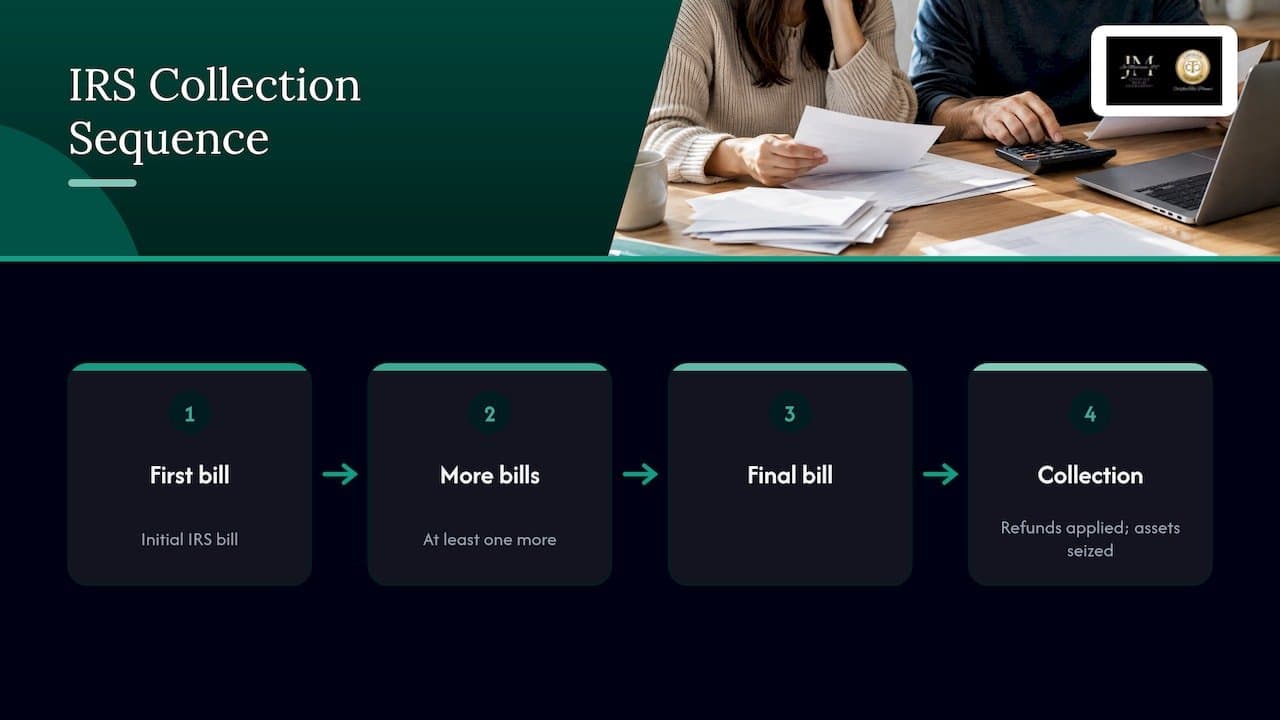
Collection follows a predictable path. According to IRS Publication 594, the IRS sends a bill, then at least one more, and after a final bill it can begin collection actions, from applying future refunds to seizing assets.
Levies and wage garnishment
A levy is a legal seizure of property, including wages, bank accounts, retirement accounts and Social Security payments. The IRS usually sends a Final Notice of Intent to Levy and Notice of Your Right to a Hearing at least 30 days before seizing. If you get one, read it the day it arrives, because the hearing request has a deadline. Our page on Notice CP 297 explains what it says. For a bank levy, the account holder has 21 days to resolve ownership disputes before the bank sends the money, which matters if you have a joint account with your ex.
The IRS cannot issue a new levy while you have a current or pending payment plan, an Offer in Compromise or an agreed economic hardship. That is the practical purpose of arranging one quickly. Think of it as pressing pause, not delete.
Liens
If the IRS files a Notice of Federal Tax Lien, you receive a notice of your right to a Collection Due Process hearing within five business days of the first filing, and you have 30 days after the determination to seek Tax Court review. A lien attached to joint property can complicate selling a house in the divorce, so tell your divorce attorney the moment you see one.
Payment options while relief is pending
If you cannot pay in full, an installment agreement lets you pay over time. A reduced-balance settlement through an Offer in Compromise is another route when you cannot realistically pay the full debt. Notices such as CP 14 arrive first, and replying early keeps your options open. You can browse all of these in our IRS letters and notices library.
Injured spouse is not innocent spouse
People mix these up. If your joint refund was taken to pay your ex’s past-due federal tax, state income tax, child support or a federal nontax debt like a student loan, you may be an injured spouse and can seek your share of the refund. Publication 504 treats this as a separate process from an innocent spouse request, which uses Form 8857. The first recovers a refund. The second removes liability.
A step-by-step plan
- Pull your IRS records. Get account transcripts for every joint year so you know the true balance, what was assessed and which notices went out. A CPA can read these for you and flag years you did not know about.
- File anything that is missing. Unfiled returns block relief and invite substitute returns that overstate what you owe.
- Match your facts to a relief type. Did you know about the error? Is the debt understated tax or unpaid reported tax? Are you divorced or apart for 12 months? The answers point to innocent spouse, separation or equitable relief.
- Check your deadlines. The two-year clock runs from the IRS notice, not from the divorce date.
- File Form 8857 with a clear, documented narrative. The IRS weighs what you knew, your finances and the decree. Vague answers hurt.
- Stop the collection pressure. Set up a payment arrangement or respond to the levy notice while the request is reviewed.
- Put the right language in your divorce documents. Require your ex to pay and indemnify you, and keep copies of every payment.
Steps 1, 3 and 5 are where self-filed requests most often stall: a missed year on the transcript, the wrong relief type, or a narrative that does not match the IRS factors. We handle all three, and represent you before the IRS and other authorities so that you are not the one answering its questions.
When the debt comes from an S corporation
If you or your ex owned an S corporation, payroll tax debt is a separate problem, and divorce does not change it. Under the IRS guidance on the Trust Fund Recovery Penalty, the penalty can be assessed against any responsible person who willfully fails to collect or pay over withheld income and Social Security and Medicare taxes. That can include an officer, a shareholder, or someone with authority over the company’s funds. Each responsible person is jointly and severally liable for the full unpaid trust fund amount plus interest, though the IRS collects it only once.
The IRS looks at who signs and files Form 941, controls payroll and disbursements, makes federal tax deposits, hires and fires, and decides which creditors get paid, as listed in IRM 5.7.3. Paying other creditors while payroll taxes go unpaid is treated as an indication of willfulness.
Two consequences for divorcing owners:
- Innocent spouse relief does not cover it. The IRS excludes business taxes and trust fund recovery penalties. Your responsibility depends on your role in the company, not your marriage.
- Your decree and the company’s books should agree. If one of you keeps the company, the decree should say who handles filing and deposits, and whether the other is removed as an officer or signer.
If you receive a TFRP letter and disagree, the IRS notice CP15B explains your options, including a refund suit. If you agree, you can pay what you can and arrange installments. Either way, respond within the deadline on the letter, and bring in a CPA before you answer, because what you write about your role can be used in the responsibility decision. Missing payroll returns should also be filed promptly.
After the divorce: protect your fresh start
Once the IRS side is settled, build habits that keep you out of this position. File separately if you remarry and cannot vouch for your spouse’s reporting. Keep your own copies of every return you sign. Update your address with the IRS so notices reach you. Divorce changes more than finances, and some people look to rebuild socially too, for example through events for divorced Muslims. Whatever your next chapter looks like, closing out old tax years first keeps it uncluttered.
How we help with divorce-related tax debt
We are Joe Mastriano, CPA, and we handle IRS cases for individuals and business owners, including audit representation, negotiating installment agreements and Offers in Compromise, delinquent returns, and representation before the IRS and other authorities. Many divorce-related cases involve more than one of these at once. You can see the full list on our services page, read about innocent spouse relief, or start with a consultation with Joe to review your IRS situation.

Our perspective
After more than 45 years of IRS cases, we see the same pattern: people trust the paper they signed in divorce court and learn too late that the IRS never agreed to it. The fix is rarely dramatic. It is a careful look at which years are joint, which relief type fits your facts, and which deadline is closest.
We believe this work should be done by the CPA who knows your file. That is why we engage directly with each client, correct mistakes made earlier by less experienced preparers, and look for tax-saving strategies that fit your situation. When collection is active, our aim is to pause it first, through a payment arrangement or a pending relief request, and then resolve the underlying debt on solid footing.
If you are divorcing and joint tax debt is in the picture, bring us in before the decree is final. The wording can still be improved, and your IRS options are widest when nothing has been missed yet.
Joe
FAQ
Can my ex-spouse be the only one the IRS collects from if the decree says so?
No. The IRS is not bound by your decree. For a joint return, you are each responsible for the full amount, so the IRS can pursue either of you. The decree may give you a right to repayment from your ex in state court, and it can help an equitable relief request.
How long do I have to ask for innocent spouse relief?
For innocent spouse relief and separation of liability, you generally must ask within 2 years of receiving an IRS notice of an audit or tax due caused by the error. Equitable relief can be requested for as long as the IRS can collect the tax, which is generally 10 years. All three use Form 8857.
Does filing Form 8857 stop wage garnishment?
While a Form 8857 request is pending, the IRS cannot collect from you for that year, though interest and penalties continue to accrue. Collection for other years is not covered, so check each year on your IRS account. A pending payment plan or Offer in Compromise also blocks new levies.
Can I get relief from my S corporation’s payroll tax debt through innocent spouse relief?
No. The IRS excludes business taxes and trust fund recovery penalties from innocent spouse and equitable relief. Your exposure depends on whether you were a responsible person who willfully failed to pay the withheld taxes. A CPA should review your role before you reply to any TFRP letter.
What if my ex’s debts took my share of our joint refund?
You may qualify as an injured spouse and can request your share of the refund. This is separate from innocent spouse relief, which removes responsibility for tax owed. The two requests answer different problems.
Sources
- IRS Publication 504 (2025), Divorced or Separated Individuals
- Instructions for Form 8857 (Rev. June 2021)
- Instructions for Form 8857, IRS web edition
- Innocent spouse relief, IRS
- Separation of liability relief, IRS
- Equitable relief, IRS
- IRS Publication 971 (Rev. December 2021)
- IRS Publication 594 (Rev. 1-2026)
- IRM 4.23.12, Delinquent Return Procedures
- Employment taxes and the Trust Fund Recovery Penalty, IRS
- IRM 5.7.3, Establishing Responsibility and Willfulness
- IRS Notice CP15B