
A charitable contributions audit is a documentation exam. The IRS is not asking whether you are generous. It is asking whether each gift went to a qualified organization, was paid in the right year, and can be proven with the right paper. Most of these audits are won or lost on records, and the records you can still gather, and how you present them, matter more than anything you say in the first letter. If you have received a notice, we recommend having a CPA who handles IRS cases represent you before you answer.
TL;DR
- The IRS tests three things on a charitable deduction: a qualified recipient, payment before year end, and proof that fits the gift type.
- Cash needs a bank record or written communication. Gifts of $250 or more need a written acknowledgment from the charity. Noncash gifts over $500 need Form 8283, and over $5,000 generally need a qualified appraisal.
- Starting in 2026, nonitemizers can deduct limited cash gifts, and itemizers face a 0.5% floor, so returns for 2026 look different from earlier years.
- Hobby-loss and QBI deduction audits follow the same pattern: the IRS wants records that prove the facts behind the deduction.
- Do not send records piecemeal. Organize them, answer exactly what was asked, and consider professional representation early.
Table of Contents
- What the IRS is actually testing
- The documentation rules, gift by gift
- What changed for 2026
- How the IRS finds and examines these deductions
- How to respond to a charitable contributions audit
- Hobby loss and QBI audits: the same logic
- Preventing the next audit problem
- Where we can help
- Our perspective
- FAQ
- Sources
What the IRS is actually testing
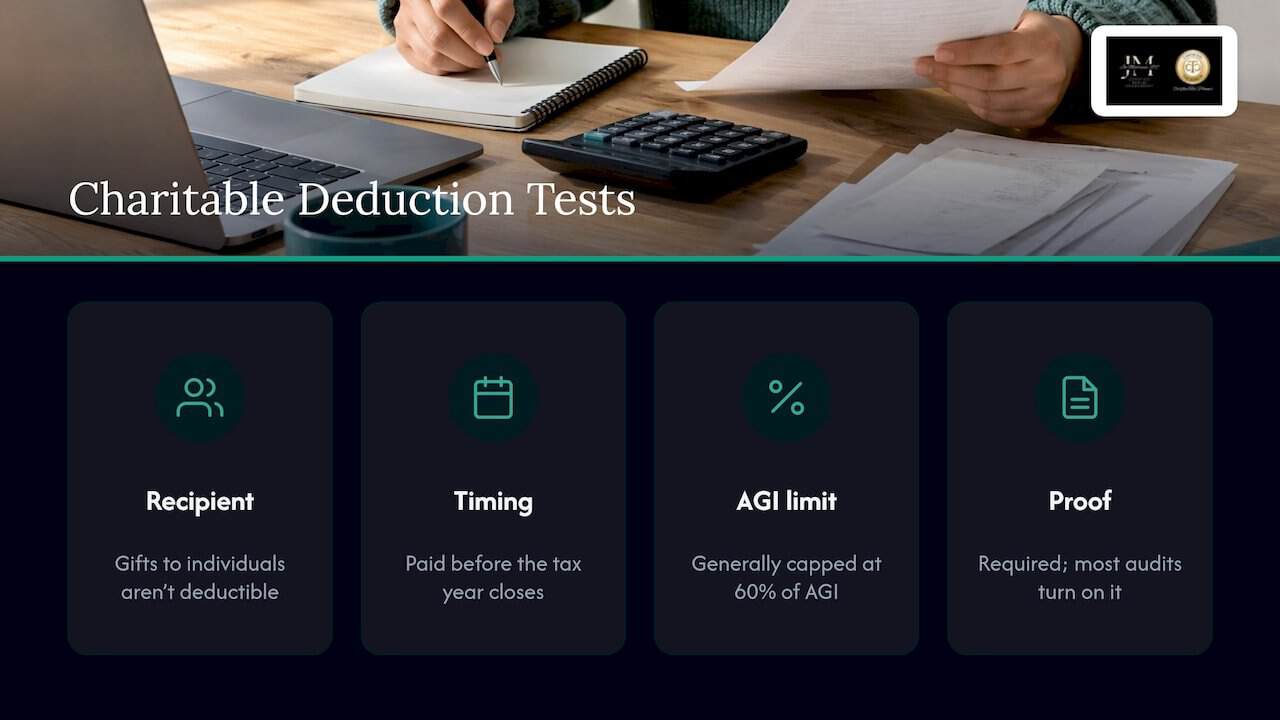
Every charitable deduction has to pass a short series of tests. If one fails, the deduction can be reduced or disallowed, and penalties and interest can follow.
1. The recipient must qualify. According to Publication 526 (2025), deductible contributions must be made to qualified organizations, which include certain amateur sports organizations. Gifts to individuals are not deductible, no matter how deserving the person. That rules out crowdfunding for a neighbor, money handed to a relative in need, or a gift to a person you know only online.
2. The gift must be paid in the tax year. The IRS says a contribution must be actually paid in cash or other property before the close of the tax year, whether you use the cash or accrual method. A pledge you have not yet fulfilled on December 31 is not a deduction for that year.
3. The amount must fit the limits. Per Publication 526, the deduction generally cannot exceed 60% of your adjusted gross income (AGI, the income figure at the bottom of page 1 of your Form 1040), though 20%, 30% or 50% limits can apply in some cases. Those lower limits depend on the type of property and the type of organization.
4. You must be able to prove it. This is where most audits turn, and it gets its own section below.
The documentation rules, gift by gift
The IRS’s Topic No. 506 sets out the proof required. Here it is in one view.
| Gift | What you need |
|---|---|
| Cash of any amount | A bank record or written communication showing the organization’s name, the amount and the date |
| Any gift of $250 or more | A contemporaneous written acknowledgment (CWA) from the charity |
| Noncash deduction over $500 | Form 8283 filed with your return |
| Noncash deduction over $5,000 | Form 8283, Section B, and a qualified appraisal |
Notice what “cash” means for audit purposes. A coin tossed in a bucket cannot be documented, and the rules reflect that. A check, card payment or payroll deduction leaves a trail. A loose-bill gift usually does not, so it is the first thing an examiner may disallow.
The written acknowledgment
The word that trips people up is “contemporaneous.” The letter has to exist by the time you file, and it has to say the right things. Per the IRS page on written acknowledgments, it must contain:
- the organization’s name;
- the amount of cash, or a description (not the value) of noncash property;
- a statement that no goods or services were provided, if that is true;
- a description and good-faith value estimate of any goods or services that were provided;
- a statement that any benefits consisted entirely of intangible religious benefits, if that applies.
A bank statement alone does not satisfy the $250 rule. Many people discover this only in an audit, when the charity’s year-end letter is missing or incomplete. If you are in that spot, ask the charity for a corrected acknowledgment now, and have it describe the gift as it was actually made.
Pro tip: If you received a dinner, a ticket or merchandise in exchange for a gift, only the amount above the value of what you received is deductible. A letter that leaves the benefit out is a letter that may not hold up.
Noncash gifts: the Goodwill-bag problem
Clothing and household goods drive many examinations because the numbers are easy to inflate and hard to prove. Used items must generally be in good condition, and you should record what you gave, when you gave it and a reasonable basis for the value. A drop-off receipt with no description of the items does not prove a $1,800 deduction. A photo, an itemized list and a receipt do much better.

Once your noncash deduction passes $500, you file Form 8283. Section A generally covers deductions through $5,000. Section B covers deductions over $5,000 and requires a qualified appraisal.
Appraisals: where good intentions fail
The Form 8283 instructions (December 2025) are specific about the appraisal. It must be:
- prepared by a qualified appraiser, following USPAP principles and Treasury Regulation §1.170A-17(a)-(b);
- signed and dated no earlier than 60 days before the contribution;
- received before the due date, including extensions, of the return that first claims the deduction.
The instructions also say an appraisal is not qualified if the donor fails to disclose, or misrepresents, facts that would cause a reasonable person to expect a misstated value. In an audit, a late appraisal or an appraisal dated after the return was filed is a common reason a large deduction collapses, even when the gift itself was real.
For conservation easements, IRS Publication 5464 (Rev. 9-2026) states that contributions must be properly substantiated, and that when there is no substantial record of comparable sales, value is generally determined by the before-and-after method. These are the most technical charitable audits, and they are not a do-it-yourself matter.
What changed for 2026
Two changes affect how 2026 returns, and any exam of them, will look.
Nonitemizer deduction. Beginning with tax year 2026, Topic No. 506 states that nonitemizers may deduct up to $1,000 ($2,000 if filing jointly) of cash contributions to certain qualified organizations. Itemizers continue to deduct charitable contributions on Schedule A. Because this deduction is limited to cash gifts to certain organizations, the type of recipient matters more than before, and so does the record of each payment.
A floor for itemizers. A Spring 2026 supplement to the law-school text Taxation of Individual Income says that, effective in 2026, itemized charitable contributions are deductible only to the extent they exceed 0.5% of the contribution base, generally AGI. With a $200,000 base, the floor is $1,000. In practice, the first slice of your giving may produce no deduction, so the dollars that count are the ones above the floor, and those are the ones an examiner will scrutinize.
There is no single public dollar amount that makes the IRS audit a return for charitable giving. The amounts that matter to you are the documentation thresholds above: $250, $500 and $5,000. Giving that is large relative to your income, noncash gifts with weak support and deductions that look out of line with prior years are what draw questions, so build the file before the notice arrives.
How the IRS finds and examines these deductions
The IRS can compare your Schedule A and Form 8283 against your income, your prior returns and the information on the return itself. An exam may be a letter asking for specific records (a correspondence audit), a request to meet at an IRS office, or a field visit. The notice tells you which years and which items are in question.
For charitable items, expect requests for:
- bank statements, canceled checks or card records for each gift;
- acknowledgment letters from each charity;
- for noncash gifts, descriptions, dates acquired, cost or basis, and photos;
- Form 8283 and the signed appraisal for large property gifts;
- proof the recipient was a qualified organization on the date of the gift.
Our guides on audit documentation requirements and the role of documentation in IRS audits walk through how to organize this material so the examiner can follow it.
How to respond to a charitable contributions audit
- Read the notice and note the deadline. It names the tax year, the items under review and the date your response is due. Missing it can turn a documentation question into a proposed assessment.
- Do not guess and do not send everything. Answer what is asked. Extra paper can open new questions. Our IRS audit response guide covers the sequence in more detail.
- Match each deduction to a record. Build a simple schedule: date, recipient, amount, type of gift, and the document that proves it. Gaps are visible immediately.
- Fix what can be fixed. A charity can often issue a proper acknowledgment. A bank can supply statements. A qualified appraiser cannot backdate an appraisal, so do not try.
- Be consistent. Anything you tell the IRS must match your return and your records. Inconsistency does more harm than a missing receipt.
- Decide who speaks for you. You can authorize a representative, and then the IRS deals with the representative instead of with you. Audit representation means the CPA answers the examiner, which spares you the stress of unplanned calls.
If the exam ends with a disallowance you disagree with, you have options, including an appeal and, in some cases, an audit reconsideration when new records come to light after the exam closes.
Hobby loss and QBI audits: the same logic
You may have landed here because of a related exam. The principle is the same: the IRS wants records that prove the facts behind the deduction.
Hobby loss. If an activity loses money year after year, the IRS may ask whether you run it to make a profit or for enjoyment. If it is a hobby, the losses generally cannot offset your other income. The question turns on facts: whether you operate in a businesslike way, keep complete books, have a separate account, adjust your methods when you lose money, spend real time on it, and have expertise or advice. A business plan, a bookkeeping system and a record of changes you made to improve results are the evidence that carries weight.
QBI deduction. The qualified business income deduction is available to many owners of pass-through businesses (sole proprietorships, partnerships, S corporations). In an exam, the IRS looks at whether the income comes from a qualifying trade or business, whether the income and deductions are correct, and whether the numbers on your return agree with your books. Clean books are your best defense. Our small business audit checklist shows what to have ready.
If either of these is the reason you are reading, the steps above apply: match every number to a record, answer only what is asked, and get representation early.
Preventing the next audit problem
The best time to fix a charitable file is before you file. A short routine:
- Save the acknowledgment letter the day it arrives, and check it against the list above.
- Pay by check, card or bank transfer, not cash.
- Photograph noncash donations and keep an itemized list.
- Check that the organization qualifies using the IRS’s Tax Exempt Organization Search tool on IRS.gov before you give.
- Schedule any appraisal early enough that it is signed within the 60-day window and in hand before your return is due.
- File Form 8283 whenever noncash deductions exceed $500.
Our tax compliance checklist and guide to financial documents for an IRS audit cover the wider paper trail.
Where we can help
Joe Mastriano, CPA, brings more than 45 years of experience handling IRS cases. Our services include audit representation and representation before the IRS and other authorities. We also prepare returns for all IRS filing entities, domestic and foreign, which means the charitable schedules and forms are built with an audit in mind from the start.

If you have an audit notice, start with a free evaluation of your IRS situation, then see our full list of services or book a consultation with Joe. Fees are explained on that page.
Our perspective
Charitable audits are rarely about bad people. They are about good people with incomplete paper: a letter that never came, an appraisal that arrived late, a bag of clothes valued from memory.
What we have built our practice around is direct engagement. When you hire us, a licensed CPA deals with the IRS for you, and you are not left to explain a return alone. Our approach is to organize the record, answer only the question asked, and correct the problems that earlier preparers or large national firms may have left behind.
If your return has a gap, the fix is usually a plan, not panic. Think of an audit notice as pressing pause, not delete: you have time to gather proof, and the work you do early shapes the outcome.
Joe
FAQ
What are the IRS rules for charitable contributions?
The gift must go to a qualified organization, be paid before the end of the tax year, and fall within the AGI limits, generally 60% for cash gifts to public charities, with lower limits in some cases. You also need the right proof for the gift type. Publication 526 and Topic No. 506 set out the details.
What is the charity audit threshold for 2026?
There is no published dollar amount that triggers an audit. The thresholds that matter are for paperwork: a written acknowledgment at $250, Form 8283 above $500 in noncash gifts, and a qualified appraisal above $5,000. Exceeding those without proof is what exposes a deduction.
How does the IRS know if I give a gift?
You tell the IRS on your return, on Schedule A and, for noncash gifts, on Form 8283. The IRS can then ask for the bank records and charity letters behind those entries. Keeping them organized makes any later request routine.
Can I deduct a gift to a person or a crowdfunding page?
No. Per Publication 526, deductible gifts must go to qualified organizations, and gifts to individuals are not deductible. Check the organization’s status before you give.
Should I hire someone for a charitable contributions audit?
If the amounts are large, the gifts are noncash, or an appraisal is involved, representation is worth considering. A CPA can speak with the examiner for you and present the records in order. Our IRS representation page explains how that works.
Sources
- Publication 526 (2025), Charitable Contributions
- IRS: Charitable contribution deductions
- IRS Topic No. 506, Charitable contributions
- IRS: Charitable contributions, written acknowledgments
- Instructions for Form 8283 (Rev. December 2025)
- IRS Publication 5464 (Rev. 9-2026)
- Taxation of Individual Income, 2026 supplement