
An IRS Appeals conference is an informal meeting with an Appeals officer who did not work your case and who can settle it without a trial. You get one by sending a written protest within the deadline on your IRS letter, usually 30 days. How well you prepare for it largely decides whether you leave with a reduced bill, a full reversal, or a Notice of Deficiency. We handle this kind of representation as a CPA firm, and the pages below show what we would want any taxpayer to know before walking in.
TL;DR
- An Appeals conference is an informal settlement meeting with the IRS Independent Office of Appeals, which is separate from the division that proposed the change.
- Your request is a written protest mailed to the address on your appeal-rights letter, generally within 30 days. Miss that window and your options narrow quickly.
- Prepare issue by issue: what you disagree with, why, and the documents that prove it. New evidence the examiner never saw can send the case back.
- If you do not settle, you can still go to court, and in most cases the U.S. Tax Court lets you do it before paying.
Table of Contents
- What an Appeals conference is
- How to request the conference
- What happens after you file
- How to prepare for the conference
- What the conference looks like
- Possible outcomes
- When to bring in a CPA
- Our perspective
- Get your appeal in front of a CPA
- FAQ
- Sources
What an Appeals conference is
The IRS Independent Office of Appeals is the only level of administrative appeal inside the IRS. It is independent of the IRS division that proposed the change to your tax, and it settles disputes by weighing both sides’ arguments and applying tax law, including court decisions, to your facts, according to IRS Publication 3498. The Taxpayer First Act, enacted July 1, 2019, renamed the office and wrote its mission into law: resolve federal tax controversies fairly and impartially, without litigation, as IRS guidance on Appeals explains.
Think of it as pressing pause on a decision, not deleting it. The proposed assessment, penalty or collection action goes in front of someone with authority to settle it on the merits and on the risk each side faces if the case went to court.
Disputes you can bring
The IRS lists many matters that can be appealed, not only audit adjustments:
- Examination changes to income, deductions or credits
- Penalties
- Denial of interest abatement
- Trust fund recovery penalties
- Liens and levies
- Rejection of an Offer in Compromise
Collection appeals, such as those over liens, levies, seizures and installment agreements, follow special procedures described in IRS Publication 1660. Your argument must rest on tax law. Appeals does not accept moral, religious, political or constitutional objections, per Publication 3498.
If your dispute is an audit result, our guide to IRS audit appeals walks through that path. If the IRS rejected an offer, see offer appeals.
How to request the conference
The request is not a phone call and it does not go to Appeals directly. You file a written protest and mail it to the IRS address on the letter that explains your appeal rights, within the time limit in that letter, generally 30 days from its date, per the IRS page on preparing a request for Appeals. A 30-day letter often arrives as a notice such as CP 525, and the clock starts on the date printed on it, not the day you open it.
Formal protest or small case request
Which document you file depends on the size of the dispute:
| Situation | What you file |
|---|---|
| Proposed change over $25,000 for any tax period | Formal written protest |
| Employee plan, exempt organization, partnership or S corporation case, any amount | Formal written protest |
| Examination case with $25,000 or less in additional tax and penalty per period | Small case request: Form 12203 or a brief written statement |
These thresholds come from IRS Publication 3498 and the IRS request page. The amount counts the total tax and penalties per tax period, so a multi-year audit can cross the line in one year and not another.
What the protest must contain
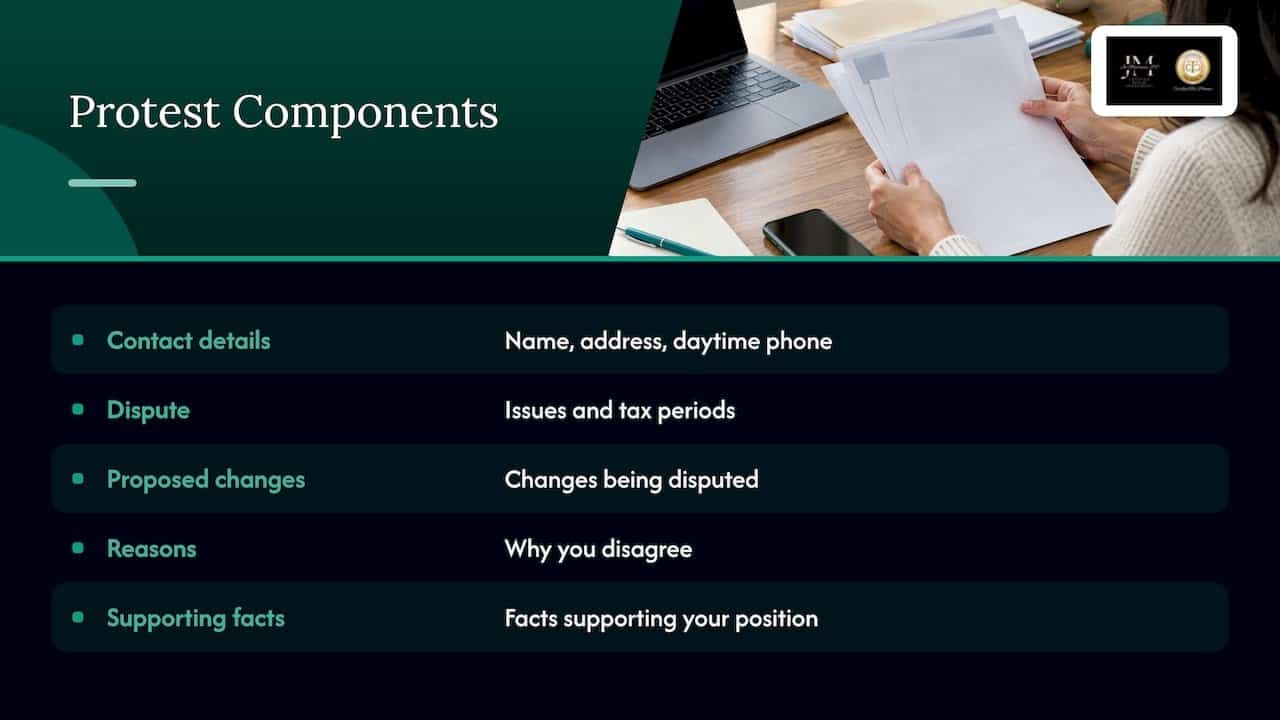
The IRS asks for your name, address and daytime phone number, the issues and tax periods in dispute, the proposed changes, your reasons for disagreeing, and the supporting facts (IRS). This is where cases are quietly won or lost. A protest that says “I disagree” gives Appeals nothing. A protest that takes each adjustment in turn, states the fact the examiner missed and attaches the proof sets up the whole conference.
We write protests for clients as part of audit representation, because the protest is the first and often most persuasive thing the Appeals officer reads.
Check the statute of limitations
Generally, at least 365 days must remain on the assessment statute expiration date when Appeals receives your case. If not, Appeals will ask you to extend it (Publication 3498). Agreeing to an extension is a real decision, since it gives the IRS more time to assess. Our guide to the IRS statute of limitations explains what that clock means for you before you sign anything.
What happens after you file
Once Appeals receives the case, an Appeals officer contacts you by letter and proposes a conference date. If more than 120 days pass with no word, you can contact the IRS office you last worked with for a status update, according to the IRS newsroom. Waiting times vary widely; our IRS appeal timeline guide sets out the ranges we see in practice.
Phone, video, mail or in person
The conference may be held by phone, in person, by mail or by video, and you can choose the type (IRS). Every Appeals case is eligible for a video conference if you ask, and Appeals will not hold one unless you agree. The officer emails a Teams link, and if the technology fails the conference can switch to traditional means (IRS).
How to prepare for the conference
You or your authorized representative must be ready to discuss every disputed issue and why you disagree with each, per IRS Publication 5. Use this routine.
- List each issue separately. Give every adjustment its own page: the IRS position, your position, the law or fact that supports you, and the dollar effect.
- Put your evidence in the file early. Appeals will not raise new issues or reopen agreed ones, except in potential fraud cases. But if you hand over new information the original IRS office never reviewed, Appeals may return the case to that office (IRS newsroom). That is a delay you can avoid by giving the examiner the documents during the audit, or by making sure the protest contains them.
- Know the difference between a new issue and a new argument. Under IRM 8.6.1, a new issue is a matter not raised during the IRS’s earlier consideration and disputed by you. A new theory or alternative argument is not a new issue, and Appeals may consider new theories when it evaluates the risk of litigation. It will not develop new evidence for you.
- Decide who speaks. You may represent yourself or appoint an attorney, CPA or enrolled agent authorized to practice before Appeals. If your representative attends without you, they need a properly completed power of attorney, Form 2848, before they can receive confidential information (Publication 5). A person without those credentials can attend only as a witness.
- Set a realistic settlement range. Appeals weighs hazards of litigation, so decide in advance what outcome you would accept and which concessions you would trade.
The weakest point in self-preparation is step 5. Taxpayers tend to argue who is right and skip the question Appeals is actually asking: how likely is each side to win in court? Our CPA representation is built around answering that question with the right documents, and we appear before the IRS for you so you do not have to face the officer alone.
What the conference looks like
IRS instructions describe the conference as informal, held to encourage frank discussion and mutual understanding, with the Appeals officer expected to be prepared and to focus on the merits, not ideological arguments (IRM 8.6.1). The officer reviews the facts, the law and the information from both sides, then explains the reasons for the decision and your options (IRS).
In practice, expect this order:
- The officer summarizes the issues as they understand them.
- You or your representative present each issue, starting with your strongest.
- The officer asks questions and may request more documents, usually with a target date.
- The two sides discuss settlement, often by proposing a split of the disputed amount.
Keep the tone factual. Appeals officers are not auditors and are not there to trap you, but they will not move on arguments that lack support.
Recent changes to know about
The IRS issued final regulations on January 15, 2025, under section 7803(e) of the Internal Revenue Code. They set procedural and timing rules that must be met before Appeals considers a case and exclude some categories of issues. Under interim guidance dated March 11, 2026, an Appeals employee who is considering a position inconsistent with an IRS position must discuss the case with their Appeals Technical Manager before discussing a settlement offer with you (IRS guidance). Rules like these change, so confirm the current procedure for your case on the IRS Appeals pages or with your representative.
Possible outcomes
An appeal usually ends one of three ways, according to the IRS:
- The IRS position is upheld, when the facts and law support it.
- The decision goes your way, when the facts and law support you or courts have ruled similarly.
- A compromise is proposed, when the facts or law are unclear, and you may pay part of the amount in dispute.
Because Appeals can settle a not fully developed case on factual hazards, a partial win is common when your documents are good but not complete (IRM 8.6.1).
If you do not reach an agreement
When no agreement is reached, Appeals sends a Notice of Deficiency. After you receive it, you may petition the U.S. Tax Court before paying the amount due, or proceed in the U.S. Court of Federal Claims or a U.S. District Court (IRS Form 12203). The district court appeal process differs from Tax Court, mainly because you generally pay first and then sue for a refund. Each route has its own deadlines, so act on the notice as soon as it arrives. Our overview of how to appeal an IRS decision covers the next stages.
When to bring in a CPA
You can go to Appeals alone. Bring in a professional when the amount is large, when several tax years are involved, when the protest must be formal, or when a levy or lien is already in motion. The IRS itself permits a CPA to represent you, and a representative with the right power of attorney can speak for you so you do not need to sit through the call. If you want a second look at your letter before the deadline passes, our walkthrough on how to navigate IRS appeals is a good place to start.
Our perspective
Most people come to us with a 30-day letter and a sinking feeling. They think the IRS has already decided. It has not. Appeals is where a different set of eyes looks at your file, and that is exactly why the protest and the evidence matter so much.
In more than 45 years of handling IRS cases, the pattern we see is consistent: the taxpayers who do best are the ones who treat the conference as a negotiation grounded in documents, not a complaint session. We build the protest, organize the proof, and represent you directly before the IRS, so the officer hears your case argued by a licensed CPA.
Larger national firms and less qualified preparers sometimes leave earlier mistakes in the file. We start by reading what is already there and correcting it, then we work with you personally, not through a call center.
Joe
Get your appeal in front of a CPA
If you hold a 30-day letter, a Notice of Deficiency, or a rejected offer, our team represents individuals and business owners before the IRS and other authorities, including audit representation and Offer in Compromise work. Our free evaluation reviews your IRS situation, and you can book a consultation with Joe or see everything we handle on our services page.

If the underlying problem is unfiled returns or a balance you cannot pay, we also handle delinquent returns and Offers in Compromise.
FAQ
How long do I have to request an Appeals conference?
Generally 30 days from the date of the letter explaining your appeal rights, with the exact limit stated in that letter. You mail the protest to the IRS address shown on the letter, not directly to Appeals. Treat the date on the letter as the start, not the day it reached you.
Do I need a lawyer for an IRS Appeals conference?
No. You may represent yourself or appoint an attorney, CPA or enrolled agent authorized to practice before the IRS. A representative who attends without you needs a completed Form 2848 power of attorney. A CPA who handles IRS cases can prepare the protest and speak for you.
Can I bring new evidence to Appeals?
You can, but Appeals may return the case to the original IRS office if you submit information that office has not reviewed. That adds time. The best approach is to include your evidence in the protest or give it to the examiner earlier.
What if I disagree with the Appeals decision?
If no agreement is reached, you receive a Notice of Deficiency. You can then petition the U.S. Tax Court without paying first, or go to the U.S. Court of Federal Claims or a U.S. District Court. Each court has its own filing deadline, so check the notice right away.
Sources
- IRS Publication 3498, The Examination Process and Appeals
- IRS Topic no. 151, Your appeal rights
- IRS, Preparing a Request for Appeals
- IRS Publication 5, Your Appeal Rights
- IRS newsroom, how to request help with the IRS Independent Office of Appeals
- IRS, Appeals expands access to video conferences
- IRM 8.6.1, Conference and Issue Resolution
- IRS Form 12203
- IRS Appeals guidance memorandum AP-08-0326-0006