
The IRS generally has 10 years from the date a tax is assessed to collect it, including the penalties and interest on it. The IRS calls the end of that window the Collection Statute Expiration Date, or CSED. The rule is real, but it is not a countdown you can sit out. Several events pause or extend the clock, every tax year has its own date, and the IRS can act hard in the years before that date arrives. Knowing your exact CSED is the starting point for deciding how to resolve what you owe.
The source of the rule is 26 U.S. Code § 6502, and the IRS’s own page on the time it can collect tax confirms it. Below, I explain how it works in plain terms, what stops the clock, and how to read your own account.
TL;DR
- The IRS generally has 10 years from the date of assessment, not from the date you filed or the date the tax was due, to collect a tax debt.
- Each assessment has its own CSED, so each tax year you owe has its own separate clock.
- Requests such as an installment agreement, an Offer in Compromise, a Collection Due Process hearing or bankruptcy pause the clock, so your date can move later.
- Your account transcript shows your CSED. Get it before you decide on a strategy.
- When a collection period ends, the IRS may no longer start collection actions on that debt, with a few narrow exceptions.
Table of Contents
- What the 10-year rule actually says
- When the clock starts, and why every year has its own
- What pauses or extends the 10 years
- A payment plan and the clock
- What happens when the collection period ends
- How to find your CSED
- Common mistakes with the 10-year rule
- Putting your CSED to work
- Get your CSED reviewed by a CPA
- Our perspective on the 10-year rule
- FAQ
- Sources
What the 10-year rule actually says
Under IRC § 6502(a), a tax that was assessed within the normal limitation period can be collected by levy or by a court proceeding only if the levy is made or the proceeding begins within 10 years after the assessment. A levy is the legal seizure of property, such as money in a bank account. A wage garnishment is a continuing levy on your paycheck.
The Taxpayer Advocate Service describes the CSED as the end of the collection period, normally ten years from the date of assessment. The IRS Internal Revenue Manual, section 5.1.19 adds that when the collection statute expires, the government’s right to pursue collection of that liability ends.
Two points are easy to miss:
- The clock runs from assessment. An assessment is the IRS’s formal recording of a tax liability on its books. It is not the filing date, and it is not the due date. If you want to understand how a tax gets assessed in the first place, our IRS tax assessment process guide walks through it.
- The rule covers more than the tax. The collection period applies to the tax and to the associated penalties and interest.
When the clock starts, and why every year has its own
An IRS account can hold many assessments. According to the IRS, these include assessments from original returns, amended returns, Substitute for Return filings, audits and civil penalties. The IRS manual states that each tax assessment has its own CSED. The Taxpayer Advocate Service’s April 2026 tax tip lists the same categories.
That means your debts do not expire together. Here is a simplified example, with made-up dates, to show the pattern:
| Tax year | What happened | Assessment date | Baseline CSED (before any pauses) |
|---|---|---|---|
| 2017 | Return filed on time, balance unpaid | June 2018 | June 2028 |
| 2019 | Return filed late, balance unpaid | March 2022 | March 2032 |
| 2021 | IRS audit adds tax later | September 2024 | September 2034 |
In this example the 2017 debt could end in 2028 while the 2021 debt stays collectible until 2034. The same year can even carry two clocks: the original balance and a later audit assessment each start their own.
Unfiled returns change the picture
If you never filed, the IRS generally cannot collect a tax it has not assessed. That does not make unfiled years safe. The IRS can prepare a Substitute for Return, which assesses tax without your deductions and credits, and that assessment starts a collection clock. Overdue returns also usually produce penalties. If you are behind, our page on IRS delinquent returns explains how we help bring filings current.
What pauses or extends the 10 years
The IRS distinguishes two things. When the law prohibits collection, the CSED is generally suspended, which means the clock pauses. When the law permits added time, the CSED is extended. The Taxpayer Advocate Service explains that during a suspension the IRS is stopped from collecting, while during an extension it keeps its authority to collect. Both delay your CSED.
The IRS lists these common events:
| Event | Effect on the collection clock |
|---|---|
| Pending installment agreement request | Suspended while the IRS reviews it |
| Installment agreement withdrawn, rejected or termination proposed | An extra 30 days added |
| Appeal of a rejected or terminated installment agreement | Suspended until the appeal is final |
| Offer in Compromise | Suspended while under review, plus 30 days if rejected |
| Collection Due Process (CDP) hearing request | Suspended until final determination; extended so at least 90 days remain |
| Bankruptcy | Suspended from the petition until discharge, dismissal or closure, plus 6 months |
| Innocent Spouse Relief request | Suspended for the requesting spouse |
| Living outside the U.S. continuously for at least 6 months | Suspended during that time |
A few details matter in practice.
Bankruptcy. Publication 594 (Rev. 1-2026) says that when an automatic stay applies, the IRS suspends collection for the stay period plus 6 months.
Living abroad. The IRS manual states that the period is suspended while you are outside the United States for at least six continuous months, and that it will not expire before a minimum of six months after you return. If you have lived overseas, see our page on expatriate taxes, because this can move your date considerably.
Innocent Spouse Relief. Per Publication 594, collection is suspended from the date of the request until 90 days after a Notice of Determination, or, if a timely Tax Court petition is filed, until 60 days after the Tax Court’s final decision. The Taxpayer Advocate Service notes this affects only the requesting spouse’s collection period.
Overlapping events. The IRS manual says overlapping suspensions run concurrently. Two events at once do not stack into double the time.
Pressing pause, not delete
Think of each of these requests as pressing pause on the clock. The 10 years do not restart. The time the IRS was barred from collecting is simply added to the end. When you plan a resolution, the useful question is not only “what will this cost me” but “how will this change my CSED.”
A payment plan and the clock
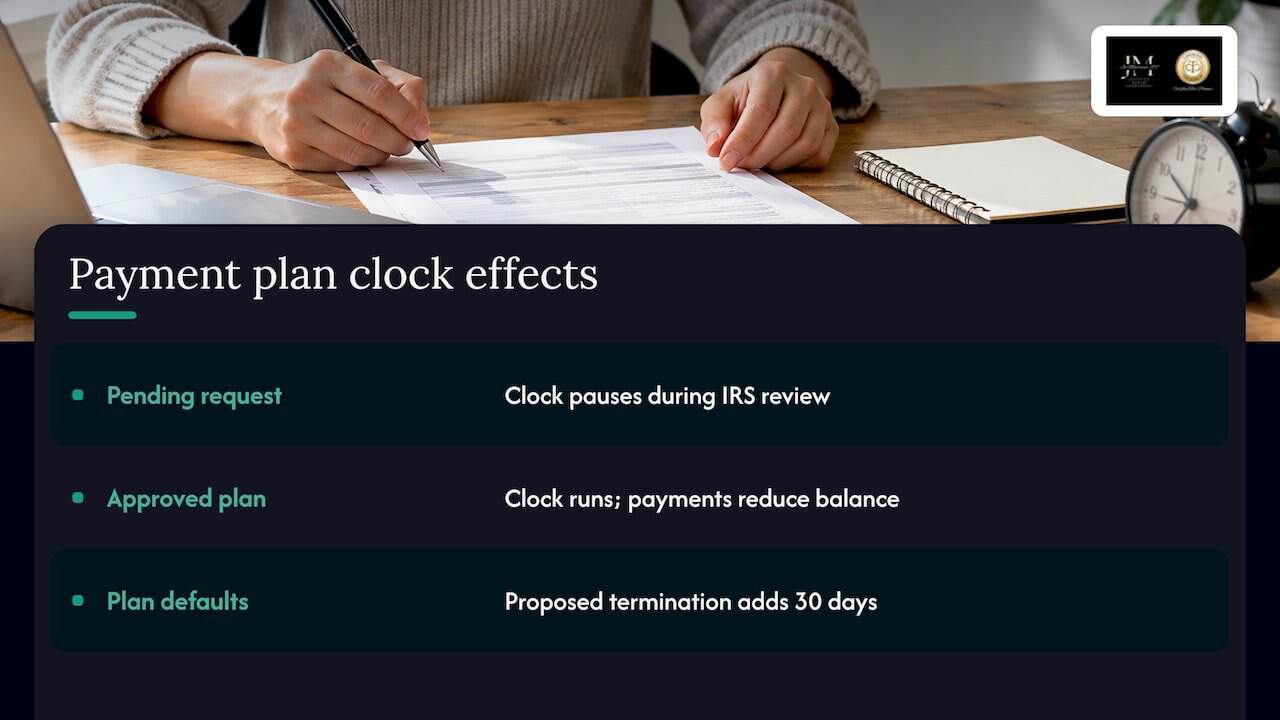
People often ask whether an installment agreement stops the 10 years. A pending request pauses the clock while the IRS reviews it. Once the agreement is approved and in place, the clock keeps running, and payments reduce the balance as it does. This is why the structure of an agreement matters. A plan that is set up well and then kept current gives you a predictable end point. A plan that defaults can lead to a proposed termination, which adds 30 days and puts levy risk back on the table.
We set up and maintain installment agreements built to last, so that you are not caught by a default notice. Choosing the right payment amount and keeping filings current are the two habits that protect an agreement.
What happens when the collection period ends
According to the Taxpayer Advocate Service’s April 2026 tip, once a collection period ends, the IRS may no longer begin administrative or court actions to collect the remaining debt for that period. Three qualifications are worth knowing:
- Levies already in place. If the IRS placed a levy on a fixed and determinable right to future income before the CSED, it may continue to receive those payments after the CSED.
- Payments after the CSED. If you paid after the CSED expired, you may request a refund of any amount overpaid after the CSED but before the Refund Statute Expiration Date. The IRS may also send a letter about payments made beyond the collection period.
- The date can move. Because of the suspensions above, the date on which you think a debt ends may not be the date the IRS has.
Note what the rule does not do. It does not erase the fact that you filed or did not file, and it does not stop the IRS from acting before the CSED. For many people the first ten years are exactly when liens, levies and garnishments happen.
How to find your CSED
You do not have to guess. Follow these steps, which come from the IRS’s own instructions.
- Get an account transcript for each tax year. You can request it through your IRS Online Account, with Form 4506-T, or by calling 800-908-9946.
- Open the Transactions section. Look for the three-digit transaction code and its date. That entry generally reflects the CSED plus any time added by law.
- Note the assessment dates. Write down each year’s assessment and its matching CSED. Remember that one year can show more than one assessment.
- Compare against the events in your history. Did you request an installment agreement, submit an offer, file for bankruptcy, request a CDP hearing or live abroad? Each can explain why a date is later than a simple ten-year count.
- Ask the IRS to explain its math. You can call the number on your latest notice, and the IRS can explain how it calculated the date. The Taxpayer Advocate Service notes that the earliest CSED for each tax period appears on the account transcript.
The IRS’s 2024 best-practices guide for responding to collection notices treats confirming that the collection period has not expired as a core check before you respond to a collection notice. If you have received a letter, our page on IRS letters and notices explains what the common ones mean and how to answer them.
Pro tip: Read every date on the transcript against the notice you hold. A transcript that is hard to interpret is common, because the codes are written for IRS systems, not for taxpayers.
Common mistakes with the 10-year rule
- Counting from the wrong date. The clock starts at assessment, not the return due date.
- Treating all years as one clock. Each assessment is separate, and a late audit assessment can open a new period for a year you thought was closed.
- Ignoring paused time. Requests you made years ago may have moved your date.
- Waiting out the clock while the IRS acts. Levies, liens and garnishments can happen in the years before expiration. A levy placed on future income before the CSED can continue afterward.
- Missing a notice deadline. If you receive a notice of intent to levy, you have a limited window to request a CDP hearing. Our guide to the IRS collection hold request explains how a hold works.
- Stopping at the date. The date matters, but your goal is resolving the debt on terms you can live with, and sometimes that means working with the IRS well before the CSED.
Putting your CSED to work
Once you have the dates, you can choose a path with real numbers behind it.
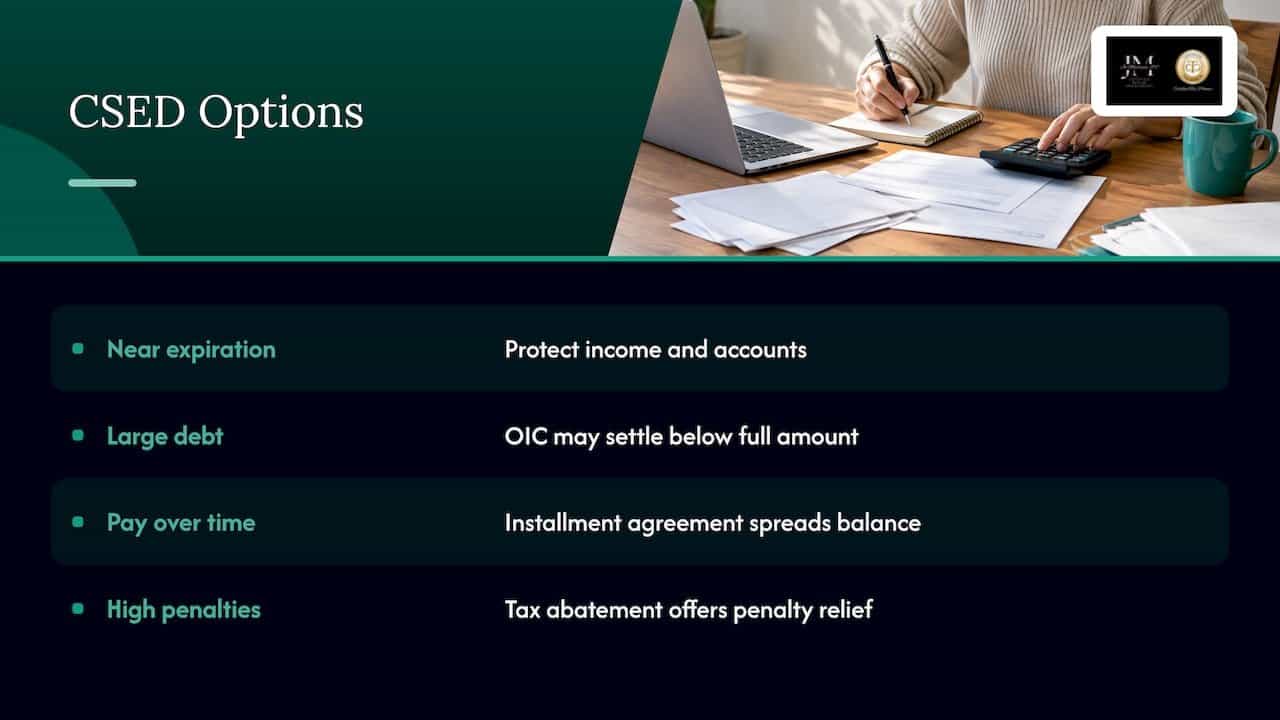
If a debt is a few years from expiring, the question is how to protect your income and accounts until then. If the debt is large and your ability to pay is limited, an Offer in Compromise may settle it for less than the full amount. Our overview of OIC qualifications explains the basics. If you can pay over time, a properly structured installment agreement spreads the balance. If penalties are a large part of what you owe, our guide to tax abatement covers relief for IRS penalties.
For a broader look at limits on how long the IRS has to assess and collect, see our IRS statute of limitations guide.
Get your CSED reviewed by a CPA
Reading a transcript correctly is where many people stall. At Taxproblem, Joe Mastriano, CPA, brings more than 45 years of experience handling IRS cases, including representation before the IRS, Offers in Compromise, payment plans and delinquent returns. You deal directly with a licensed CPA, not a call center. A consultation with Joe is the place to start: we look at your IRS situation, including your assessment dates and collection history.

Book through our consultation with Joe page, or see the full list of what we do on our services page.
Our perspective on the 10-year rule
After more than 45 years working IRS cases, I can tell you that the 10-year rule is one of the most misunderstood parts of tax collection. Clients arrive believing a debt will simply vanish in a decade. Sometimes the date is close. More often the date is later than they think, because years of requests, appeals and other events have paused it.
What I want you to take from this is that the date is information, not a plan. It tells you how long the IRS has, and it tells you what each option will cost in time. We start every case by pulling the transcripts, listing each assessment and its CSED, and mapping what has already paused the clock. Only then do we choose between an Offer in Compromise, an installment agreement set up to hold, penalty abatement or an appeal.
The people who do best are the ones who act early, with numbers in hand and a licensed CPA speaking to the IRS for them. If you are behind on returns, that is the first thing we fix. If you have a notice in front of you, bring it to us before the deadline on it passes.
Joe
FAQ
Does the IRS forgive my tax debt after 10 years?
The debt is not forgiven in a formal sense, but the IRS generally loses the right to begin collection actions once the collection period for that assessment ends. The period is set by IRC § 6502. Because events can pause the clock, confirm your date on your account transcript.
Does the 10-year clock start when I file my return?
No. It starts on the date the tax is assessed. The IRS explains that one account can hold several assessments, such as original-return, amended-return, audit and penalty assessments, each with its own CSED.
Does an installment agreement stop the 10-year clock?
A pending request pauses the clock while the IRS reviews it. After the agreement is approved, the clock continues to run. A rejected request, or a proposed termination after default, adds 30 days, per the IRS.
How do I find my CSED?
Request an account transcript through IRS Online Account, Form 4506-T or 800-908-9946, then read the Transactions section for the three-digit code and date. The IRS says that entry generally reflects the CSED plus time added by law, and you can call the number on your notice to ask how it was calculated.
Can I get a refund if I paid after the CSED?
Possibly. The Taxpayer Advocate Service says you may request a refund of amounts overpaid after the CSED but before the Refund Statute Expiration Date.
Sources
- Time IRS can collect tax, Internal Revenue Service
- Collection Statute Expiration Date (CSED), Taxpayer Advocate Service
- 26 U.S. Code § 6502, Collection after assessment
- IRM 5.1.19, Collection Statute Expiration
- How Long the IRS Can Collect Your Taxes (CSED Explained), Taxpayer Advocate Service, April 2026
- Publication 594 (Rev. 1-2026)
- Best Practices for Responding to IRS Collection Notices, 2024