
An IRS offer in compromise package has three core parts: Form 656, a financial statement (Form 433-A (OIC) for individuals or Form 433-B (OIC) for businesses), and the $205 application fee, unless you meet the low-income certification. Behind those forms sit copies of the records that prove every number you report. This guide walks through each item, what the IRS looks for, and where applicants most often go wrong.
TL;DR
- Submit Form 656 and the right financial statement: Form 433-A (OIC) for individuals, Form 433-B (OIC) for corporations and most LLCs, with the $205 fee unless you qualify as low-income.
- Back up your figures with copies, never originals: three recent months of bank statements for individuals (six for businesses), pay stubs, and loan statements.
- Before you file, make sure every required return is filed and your estimated payments or federal tax deposits are current. Otherwise the IRS can return the offer.
- If the IRS rejects the offer, you generally have 30 days to appeal with Form 13711.
- Mismatched numbers cause more trouble than low numbers. Every figure on the forms should tie to a document.
Table of Contents
- What the IRS is really asking for
- The core forms in your offer package
- Supporting documents checklist
- How the IRS reads your documents
- Before you file: compliance comes first
- Our perspective: where document packages fail
- Step by step: assembling your package
- After you submit: the timeline and your rights
- When to get help with your offer
- FAQ
- Sources
What the IRS is really asking for
An offer in compromise (OIC) is an agreement that settles your tax liabilities for less than the full amount owed. The IRS describes it in exactly those terms. It is not a discount you apply for. As the Taxpayer Advocate Service explains, submitting an offer starts a formal evaluation of your finances and ability to pay. It does not guarantee acceptance.
That is why the paperwork is heavy. The IRS is not judging your story first. It is judging your disclosure. Your forms say what you can pay, and your documents prove it. When the two agree, the examiner has little to dispute. When they conflict, the offer stalls or comes back.
For a wider view of the program, see our complete guide to the IRS offer in compromise and our page on how we handle offers.
The core forms in your offer package
The IRS publishes everything in one booklet, Form 656-B (Rev. 4-2026). It contains instructions, Form 656 itself, and the removable financial statements.
| Item | Who files it | What it does |
|---|---|---|
| Form 656, Offer in Compromise | Everyone | States the offer amount, the tax periods covered, your payment terms and your signature |
| Form 433-A (OIC) | Individuals, including self-employed people | Collection information statement: income, expenses, assets, debts |
| Form 433-B (OIC) | Corporations, partnerships and LLCs classified as such | Same statement for the business |
| Application fee | Everyone except low-income certified filers | $205, nonrefundable |
| Supporting documents | Everyone | Copies that prove each figure |
The IRS says to submit the offer on Form 656 or an acceptable printed photocopy of it. Do not retype or rework the form. Missing signatures and blank fields are among the simplest ways to have a package sent back.
Which financial statement do you use?
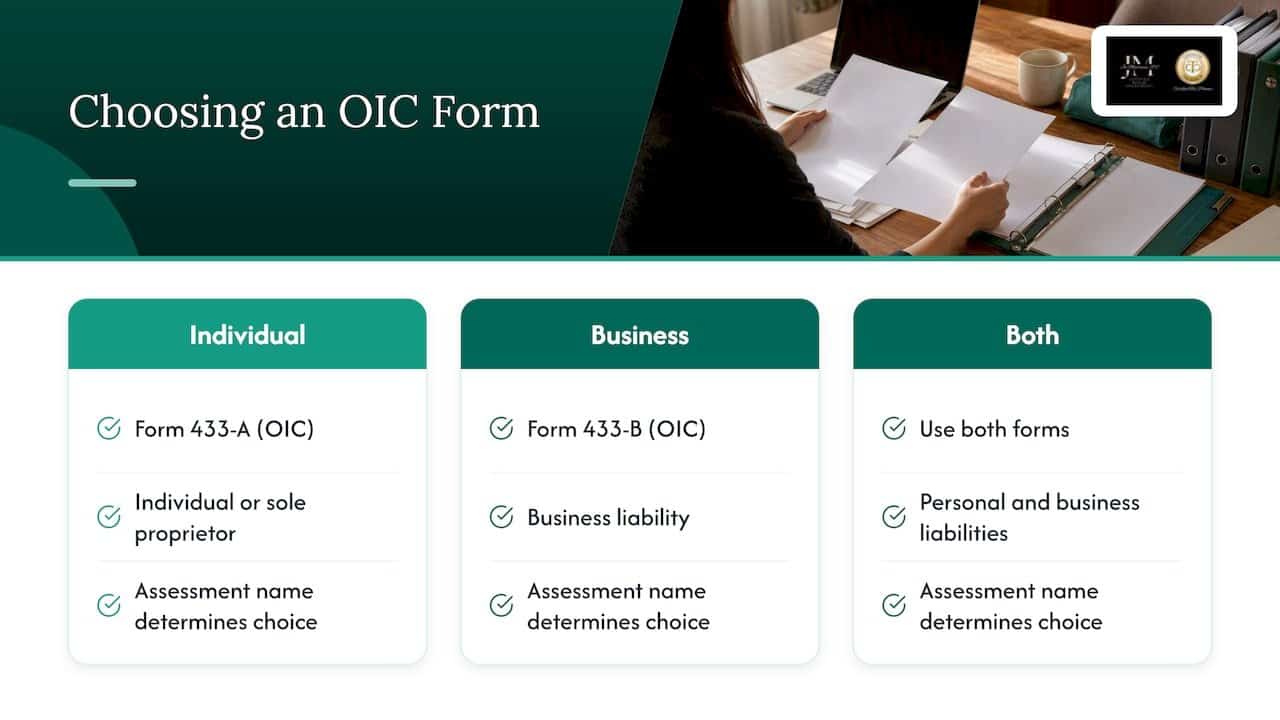
If you are an individual, including a sole proprietor, you complete Form 433-A (OIC). If the liability belongs to a business, you complete Form 433-B (OIC), which the IRS instructs corporations, partnerships and LLCs classified as corporations (as well as other LLCs) to use. Some owners need both: one for a personal liability and one for a business debt. Which form fits depends on whose name is on the assessment. If you are unsure, ask before filing, because the wrong statement means starting over. Our Form 433 guide explains the differences section by section.
Supporting documents checklist
The forms are only the claim. These records are the evidence. Based on the IRS’s own guidance, Form 433-A (OIC) and 433-B (OIC) packages typically include the following.
For individuals
- Bank statements: the three most recent months, every page, for every account.
- Pay stubs: recent stubs for each job, or income records if you are self-employed.
- Loan statements: showing the monthly payment and the current balance on mortgages, car loans and other debts.
- Proof of special circumstances: medical bills, documentation of a disability, or anything else that justifies a lower offer.
Add in practice: your most recent tax return, statements for retirement and investment accounts, a current property valuation, and a vehicle valuation. Each of these supports a number on the form.
For businesses
- Bank statements: the six most recent months.
- Profit and loss statement and balance sheet that match the figures on Form 433-B (OIC).
- Loan and lease statements: equipment, vehicles and credit lines.
- Accounts receivable and payroll records, where they apply.
Pro tip: send copies only. The IRS states that original documents should never be mailed. Keep a full duplicate of the whole package, including the tracking receipt, so you can answer any follow-up quickly.
How the IRS reads your documents
Knowing what the examiner checks helps you prepare before you file.
Bank statements are checked for patterns
Examiners look for unexplained deposits and transfers. The IRS manual on income-producing assets and financial analysis notes that cash on hand may be reduced by $1,000 before it is counted. Large balances can still raise questions about why the money is needed. If you moved funds between accounts or received a one-time deposit, add a short written explanation with the statement. Silence invites the worst assumption.
Asset equity is not always counted in full
Asset values are generally calculated using quick sale value. Even then, the IRS manual on effective tax administration says the full equity may be left out of the offer amount if you can document that it is genuinely needed for reasonable basic living expenses or medical bills. Having equity does not mean it will automatically be counted in full, but you must justify it in writing with records. Our page on effective tax administration offers covers that type in detail.
Business owners and payroll service failures
One narrow exception is worth knowing. If a payroll service provider embezzled your tax deposits, the same IRS manual describes a path to submit an offer without full Form 433-B (OIC) statements. The offer must equal the remaining tax balance, excluding penalties and interest, and you must show you acted responsibly. It is rare, but if it describes you, raise it before you file.
Before you file: compliance comes first
Documents cannot fix a compliance gap. As of October 2026, IRS eligibility guidance generally requires you to be current on all filing and payment requirements and not in an open bankruptcy proceeding. Check these items:
- Every required return is filed. Unfiled returns are the most common reason offers are returned. If you are behind, start with delinquent return filing.
- Estimated tax payments for the current year are made.
- If you have employees, federal tax deposits are current.
- You are not in an open bankruptcy case.
The obligation continues after you file. According to the IRS offer in compromise FAQs, if you fall out of compliance while the offer is pending, the IRS may return it. A returned offer ends the application without appeal rights, and you start again. The IRS also offers a pre-qualifier tool that gives an early read on whether you may qualify.
Our perspective: where document packages fail
After more than 45 years of handling IRS cases, we see the same pattern. Most rejected or returned offers did not fail because the taxpayer could pay in full. They failed because the package was incomplete, internally inconsistent, or built by someone who treated it as a form-filling exercise.
Three habits separate packages that move forward from those that stall:
- Reconcile first, write second. Before a single field is completed, we lay bank statements beside pay stubs and loan statements. Income that appears in one place and not another is the first thing an examiner will find.
- Explain what looks odd. A transfer between accounts or a one-time deposit is harmless with a note and damaging without one.
- Treat the offer amount as a calculation, not a guess. An offer is built from your equity in assets and your future income less allowable expenses. A figure picked because it sounds affordable invites rejection.
We also correct packages that someone else prepared. Where a previous preparer or a large national firm submitted weak numbers, a careful rebuild from source documents often changes the outcome. An offer is a negotiation based on honest disclosure, and a CPA who represents you directly can handle the examiner’s questions as they arise.
— Joe
Step by step: assembling your package
- Confirm eligibility. Filing, payments and bankruptcy status, as above.
- Download the current booklet. Use Form 656-B (Rev. 4-2026) so you are not working from an outdated version.
- Gather statements. Three months of bank statements for individuals, six for businesses, every page.
- Collect income and debt proof. Pay stubs, profit and loss statements, loan statements.
- Complete Form 433-A (OIC) or 433-B (OIC). Every number should match a document. Leave no blanks. Write “0” or “N/A” where it applies.
- Complete Form 656. Name the tax periods and choose your payment option carefully.
- Add the fee or the low-income certification.
- Copy everything and send it. Keep a duplicate set and proof of delivery.
Our offer in compromise timeline article explains what to expect after you send it.
After you submit: the timeline and your rights
The IRS generally has up to 24 months from the day it receives your offer to accept, reject, return, or receive a withdrawal. The Taxpayer Advocate Service says the offer is deemed accepted if no decision is made in that window. That period does not include time spent in an appeal. Track your dates, because you may need them.
If the IRS rejects your offer
You generally have 30 days from the date on the rejection letter to appeal using Form 13711. The IRS appeals page advises you to list each item you disagree with and explain why, checking your original figures against the IRS’s own Asset/Equity and Income/Expense tables that arrive with the denial. Documents that you did not send the first time can matter here. Learn more about offer appeals, and why offers fail in our guide to rejections.
When to get help with your offer
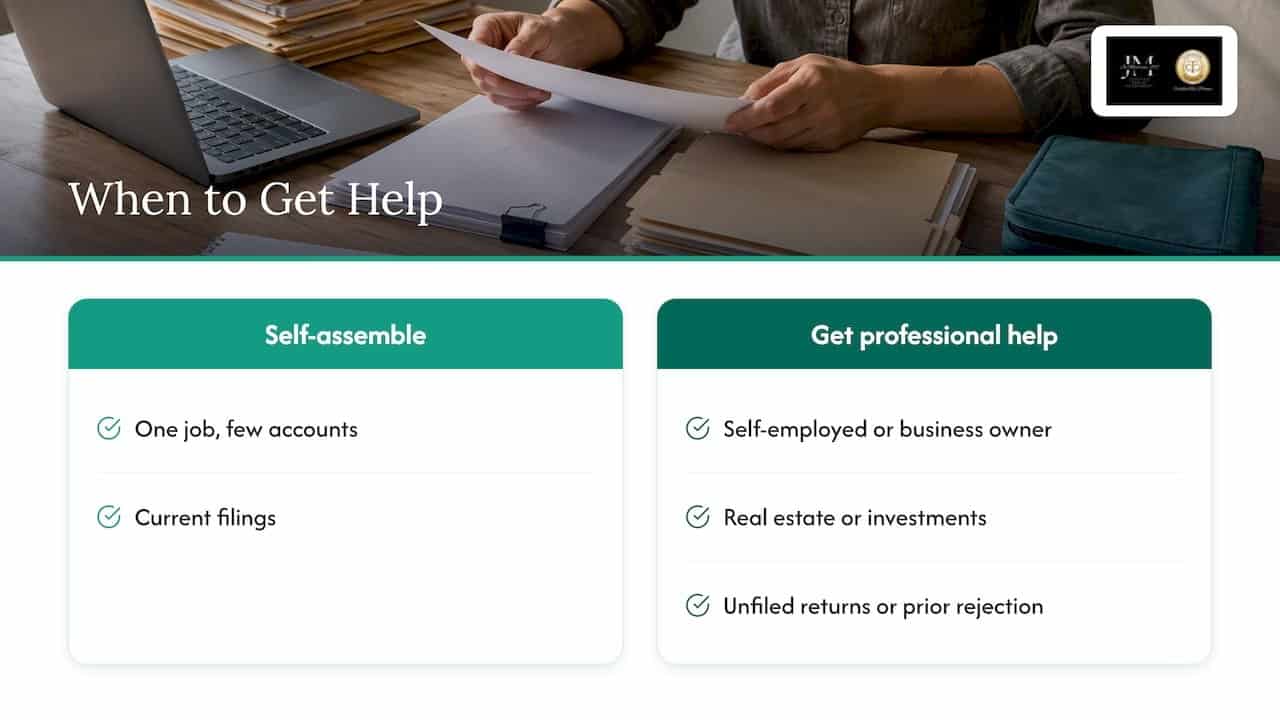
If your situation is simple, one job, a few accounts, current filings, you may be able to assemble the package yourself. Get professional help if you are self-employed, own a business, hold real estate or investments, have unfiled returns, or have already received a rejection. These are the cases where small errors cost the most.
We are a CPA practice led by Joe Mastriano, and we represent clients before the IRS. We can review your situation and tell you whether an offer, an installment agreement or another route fits best. Start with a consultation with Joe, or read about our offer in compromise service. If an offer is not realistic, we also set up installment agreements.
FAQ
What documents do I need for an offer in compromise?
You need Form 656, a completed Form 433-A (OIC) or 433-B (OIC), and the $205 application fee unless you qualify as low-income. You also need copies of recent bank statements, pay stubs and loan statements, plus proof of any special circumstances. Never mail originals.
What is the fee for an IRS offer in compromise?
The application fee is $205, unless you meet the low-income certification. The IRS also expects an initial payment with the application, which depends on the payment option you choose on Form 656. Our own fees for representation are discussed during a consultation.
How many bank statements does the IRS want?
For Form 433-A (OIC), the three most recent months of complete statements. For Form 433-B (OIC), the six most recent months. Include every page and every account, even those with low balances.
Can the IRS reject my offer if my documents are incomplete?
Yes. Incomplete packages may be returned, and a return generally carries no appeal rights. A rejection, by contrast, can be appealed with Form 13711 within 30 days of the letter. Check the package carefully before you send it.
Sources
- Offer in compromise, IRS
- Topic no. 204, Offers in compromise, IRS
- Offer in compromise FAQs, IRS
- Form 656-B (Rev. 4-2026), IRS
- Form 433-B (OIC), IRS
- Offer in compromise disagreed items, IRS Appeals
- IRM 5.8.11 Effective Tax Administration, IRS
- Streamline Offer Examiner Procedures, IRS
- Offer in Compromise, Taxpayer Advocate Service