
The Taxpayer Advocate Service (TAS) and the IRS Independent Office of Appeals are not two doors to the same room. Appeals is where you argue that the IRS got your case wrong. TAS is where you go when the IRS system has stalled, or when an IRS action is about to cause serious harm. Pick the wrong one and you can lose weeks you do not have, or worse, lose legal rights you cannot get back.
This guide explains what each one does, how to choose, and how the two can work together on the same case.
TL;DR
- Appeals decides the merits: whether the IRS’s audit change, penalty, or collection action is correct. It is also the administrative step that usually opens the door to U.S. Tax Court.
- TAS fixes problems with the IRS process: delays, ignored responses, and immediate threats such as a levy. It cannot overrule an Appeals decision or replace an appeal.
- Deadlines in your IRS letter come first. Collection Due Process (CDP) requests are generally due within 30 days, and missing that date costs you the right to go to Tax Court.
- You can use both, in sequence or in parallel, when a deadline is looming and the IRS is not responding.
Table of Contents
- The core difference in one table
- What IRS Appeals actually does
- What the Taxpayer Advocate Service actually does
- Which one fits your situation?
- Using both without hurting your case
- Common mistakes we see
- Our perspective
- Get your deadline and your route checked
- FAQ
- Sources
The core difference in one table
| IRS Independent Office of Appeals | Taxpayer Advocate Service | |
|---|---|---|
| Main job | Reviews whether the IRS’s position is correct on the facts and law | Helps when an IRS process has failed or you face significant harm |
| Best for | Audit disagreements, penalties, CDP levy and lien hearings, Offer in Compromise rejections | Stalled cases, missed response dates, an imminent levy, a system error |
| How you start | Written protest, Form 12203, Form 12153 for CDP | Form 911, Request for Taxpayer Advocate Service Assistance |
| Preserves Tax Court rights? | Yes, in many disputes it is the required step | No |
| Can change the merits of your tax position? | Yes, through settlement or a determination | No, it works the process, not the law |
| Typical speed | Slow: months to more than a year | Often a couple of weeks to a couple of months once accepted |
The speed row deserves a caveat. The IRS reported that as of April 2025 the average non-docketed cycle time for a CDP appeal was 289 days, and an Offer in Compromise appeal averaged 255 days. Those are averages, and your case can run shorter or longer.
What IRS Appeals actually does
Appeals is separate from the IRS office that proposed the adjustment or started the collection action. Publication 1660 describes it as independent of the Collection office that initiated the action, and it handles many collection disputes. It also hears audit disagreements, penalty assessments, and rejected offers.
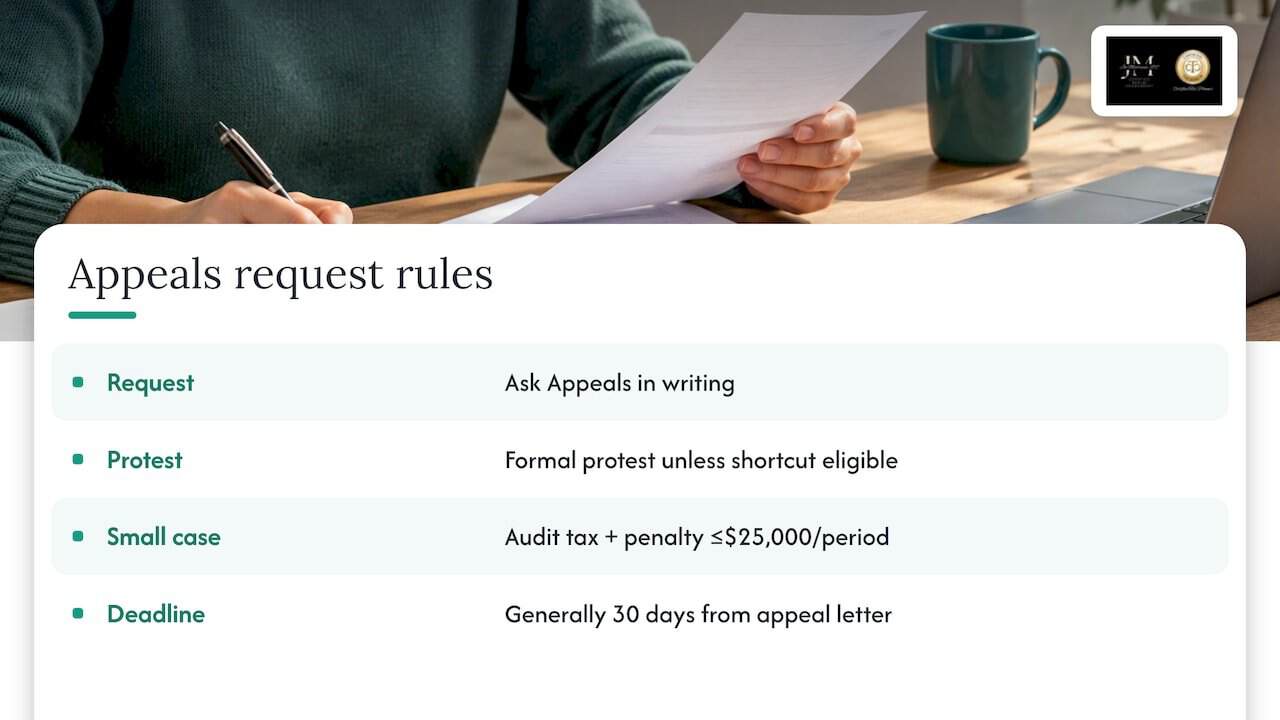
You ask for Appeals in writing. The IRS says it requires a formal written protest unless you qualify for the Small Case Request procedure, which applies when the total additional tax and penalty from an audit is $25,000 or less for each tax period. Employee plans, exempt organizations, S corporations and partnerships are not eligible for that shortcut. The deadline is stated in the letter offering you appeal rights, and it is generally 30 days from the date of that letter.
Why Appeals matters for your legal rights
For many disputes, Appeals is the administrative step that comes before a petition to the U.S. Tax Court. The Tax Court takes petitions in response to an IRS notice of deficiency, notice of determination, or notice of certification. Those notices carry their own filing windows, and they are the reason we tell clients to read every date on every letter before doing anything else.
Raise everything at the hearing
If you attend an Appeals hearing, especially a CDP hearing, put every issue and every piece of evidence on the table there. Publication 1660 warns that issues you do not raise may be barred if you later go to court. Appeals also keeps jurisdiction over its own determinations. If you win but the IRS does not implement the result correctly, you go back to Appeals, not to TAS or the Tax Court.
Set realistic expectations
The National Taxpayer Advocate has been blunt about Appeals. Its 2022 report to Congress described the average case spending more than a year in Appeals’ inventory, and the 2025 report says taxpayers and tax professionals continue to raise concerns about Appeals’ independence. That does not mean Appeals is a waste of time. It means you should go in with a documented, well-argued file, expect a marathon, and not count on a collaborative negotiation.
What the Taxpayer Advocate Service actually does
TAS is an independent organization inside the IRS. Its role is to help when you have tried to resolve a problem through normal channels and it is still not fixed, or when an IRS action threatens real harm.
The IRS’s TAS case criteria in the Internal Revenue Manual cover situations such as an immediate threat of adverse action, a delay of more than 30 days beyond a promised response date, or an IRS system that failed to work as intended. TAS’s own request page says a delay must be more than 30 days past regular processing time to qualify as a system issue, and that if you do not hear from TAS within 30 days of submitting Form 911, you should contact the TAS office where you filed.
Two limits matter:
- TAS is not an appeal. It cannot overrule a formal Appeals decision, and it cannot stand in for the administrative appeal itself.
- TAS generally expects you to have tried normal channels first. A Form 911 filed when what you really need is an Appeals review is likely to be turned away.
For more background in plain language, see our pages on Taxpayer Advocate Service help and what taxpayer advocacy does for you.
Which one fits your situation?
You disagree with an audit result
This is an Appeals matter. You are arguing the facts and the law, and TAS cannot decide who is right. Respond by the date in your letter, file the protest or Small Case Request, and attach documentation. If your issue is a reporting question, for example how capital gains and losses flow through Form 8949 and Schedule D, it helps to understand how those forms and the $3,000 loss limit work before you build your argument.
If the audit has already closed and you have new evidence, a different route may fit. Read about audit reconsideration and IRS reconsideration.
You received a levy or lien notice
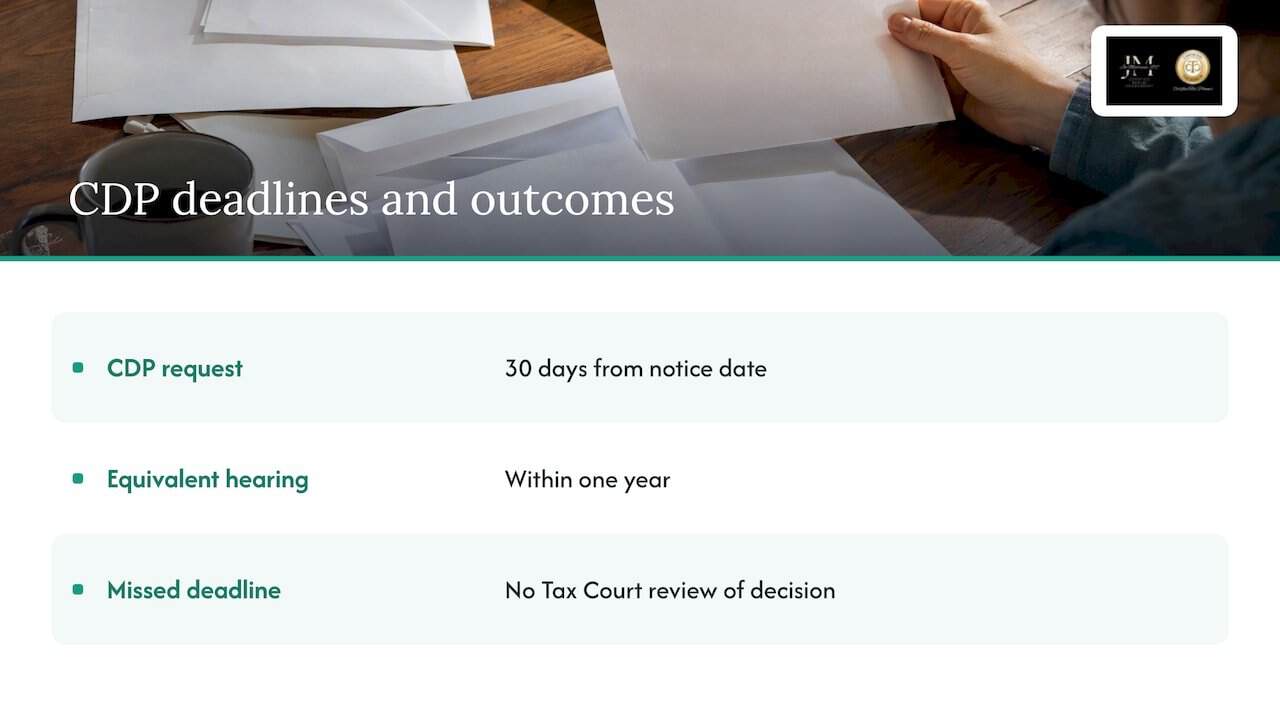
Start with the deadline. The IRS must issue a formal Notice of Intent to Levy and Your Right to a Hearing before it can levy on most assets, and the CDP FAQs explain that a final notice advises you of your right to a hearing. You generally have 30 days from the date of the notice to request a CDP hearing on Form 12153. If you miss it, you may still get an equivalent hearing within one year, but you lose the right to seek Tax Court review of the decision.
In a CDP hearing you can propose collection alternatives such as an installment agreement or an Offer in Compromise, and you can raise other issues the law allows. Our guide to what to do when the IRS threatens a levy walks through the first steps.
If the levy is days away and Appeals cannot act in time, TAS may be able to help with an immediate threat. That is the classic case for using both.
Your refund, response, or account fix is stuck
This is TAS territory. If the IRS promised a reply and the date passed by more than 30 days, or you have received interim letters with no real action, you may have a system issue. Try the normal channel first and document your attempts, then consider Form 911.
Keep the refund clock in mind. Under IRC section 6511(a), a refund claim must be filed within the later of three years from the date you filed the return or two years from the date you paid the tax. The National Taxpayer Advocate explains this deadline as strict, and the IRS has no authority to extend it even for a valid claim. Waiting on a stuck case while that date passes is how people lose refunds.
Your Offer in Compromise was rejected
An appeal is the right tool, because you are disputing the decision on the merits. Our pages on the Offer in Compromise and the types of offers explain what the IRS looks at.
You cannot tell which one you need
Use this order of questions:
- Is there a deadline on a letter? Protect it first.
- Am I disputing what the IRS decided, or how slowly or wrongly it handled my case?
- Is there an immediate threat, such as a levy that will hit wages or accounts this week?
- Have I already tried the normal channel and documented the attempt?
Disputing a decision points to Appeals. A broken process or an imminent threat points to TAS. A real deadline plus a real threat usually means working both tracks.
Using both without hurting your case
The two are not mutually exclusive. A workable pattern looks like this:
- File the protest or CDP request on time so your Tax Court rights are intact.
- If an enforcement action is imminent and your hearing has not been scheduled, submit Form 911 for the immediate threat.
- If your Appeals case sits idle well past a reasonable time, TAS can sometimes help move the process, though it cannot decide the outcome.
The mistake to avoid is treating TAS as a way to skip the appeal. It will not preserve your court rights, and it will not change the legal result.
Common mistakes we see
- Missing the 30-day window because the letter looked like a routine notice.
- Filing Form 911 for a disagreement. TAS works on process failures and harm, not on who is right about the tax.
- Holding evidence back for court. Issues and evidence not raised at Appeals may not be available later.
- Attaching other forms or notices to Form 911. TAS’s own instructions say to include the form and leave out other IRS forms or notices.
- Assuming silence means nothing is happening. Collection can continue while you wait, unless a hearing or other protection applies.
Our perspective
We have handled IRS matters for more than 45 years, and the same pattern repeats. People come to us after calling the wrong office, filing the wrong form, or waiting for an IRS reply that was never coming. The IRS does not tell you which door fits your problem. It tells you your deadline, and the deadline is what matters.
Our view is simple. Protect the legal right first, which usually means a timely appeal request. Then use every tool that applies. Appeals is a formal process, and the National Taxpayer Advocate’s own reports say the wait can be long and the independence questioned. That is not a reason to skip it. It is a reason to arrive with a clean file, a clear legal argument, and a backup plan for collection while you wait. TAS is a useful pressure valve when something breaks, but we never rely on it as the main plan.
We also work from the facts, not from a script. A licensed CPA looking at your actual notices can tell you in one conversation which deadline is real and which route fits, and that is often the most valuable hour of the whole case. Our overview of common IRS tax problems and how to respond shows how we sort these situations.
— Joe
Get your deadline and your route checked
If you hold an IRS letter and are unsure whether to appeal, call TAS, or both, we can review it with you. Our IRS representation services cover audits, appeals, levy releases, installment agreements and Offers in Compromise. You can start with a consultation with Joe, and you can read more about our approach on the Taxproblem site. Have the letter, its date, and any earlier IRS correspondence ready.
FAQ
How long does an IRS appeal take?
It varies widely. The IRS reported that as of April 2025 the average non-docketed CDP appeal took 289 days and an Offer in Compromise appeal 255 days. The National Taxpayer Advocate has also reported cases sitting in Appeals for more than a year. Plan for months, not weeks.
Should I use the Taxpayer Advocate Service?
Use it if you face an immediate threat such as a levy, if the IRS is more than 30 days past a promised response or processing time, or if a system problem has blocked your case. Do not use it to argue that the IRS’s tax determination is wrong. That belongs in Appeals.
Can TAS overturn an Appeals decision?
No. TAS cannot overrule a formal Appeals decision or take the place of the administrative appeal. If you disagree with an Appeals determination, your next step may be a petition to the Tax Court, and that has its own deadline stated in the notice.
What is the 3 year rule for the IRS?
The phrase usually refers to refund claims. Under IRC section 6511(a), you must claim a refund within three years of filing the return or two years of paying the tax, whichever is later. The IRS cannot waive that deadline, so do not let a pending dispute run past it.
Sources
- IRM 13.1.7, Taxpayer Advocate Service case criteria
- Preparing a Request for Appeals, IRS
- Collection Due Process FAQs, IRS
- Publication 1660, Collection Appeal Rights
- Submit a request for assistance, Taxpayer Advocate Service
- 2022 Annual Report to Congress, Appeals section
- 2025 National Taxpayer Advocate Report Card
- Claims for refunds, National Taxpayer Advocate blog
- Starting a case, United States Tax Court