
Most Offers in Compromise take between six months and a year to resolve, though a straightforward case can close in about six months while a complex one can stretch toward the 24-month statutory deadline before deemed acceptance applies. The safest move while you wait is simple: stay current on every filing and payment, and answer IRS requests the moment they arrive. Missing either one is the single biggest reason offers stall or get returned.
TL;DR:
- Simple offers with full documentation and no unfiled returns typically resolve within six months, while complex cases can take up to 24 months or more.
- The 24-month deemed-acceptance rule applies if the IRS does not accept, reject, or return a complete offer within that period, unless part of the debt is in judicial proceedings.
- Responding promptly to IRS requests and ensuring all returns and payments are current can significantly shorten the processing time and prevent delays.
- Filing errors, incomplete submissions, or unfiled returns are common causes of delays or automatic returns, which are preventable with careful preparation.
- Rejected offers can be appealed within 30 days, but the appeal process usually adds several months, and the 24-month clock does not consistently run through appeals.
Table of Contents
- How long an offer in compromise typically takes
- The step-by-step path from submission to decision
- What actually speeds up or slows down your case
- Understanding the 24-month deemed acceptance rule
- If your offer is rejected: what the appeal adds to your timeline
- The delays you can prevent before you ever submit
- What acceptance triggers: monitoring, payments, and the five-year rule
- A practitioner’s checklist for avoiding avoidable delays
- When it makes sense to handle your own offer
- How Taxproblem helps you avoid the delays that cost the most time
- Where these timeline rules come from
- Sources
- FAQ
How long an offer in compromise typically takes
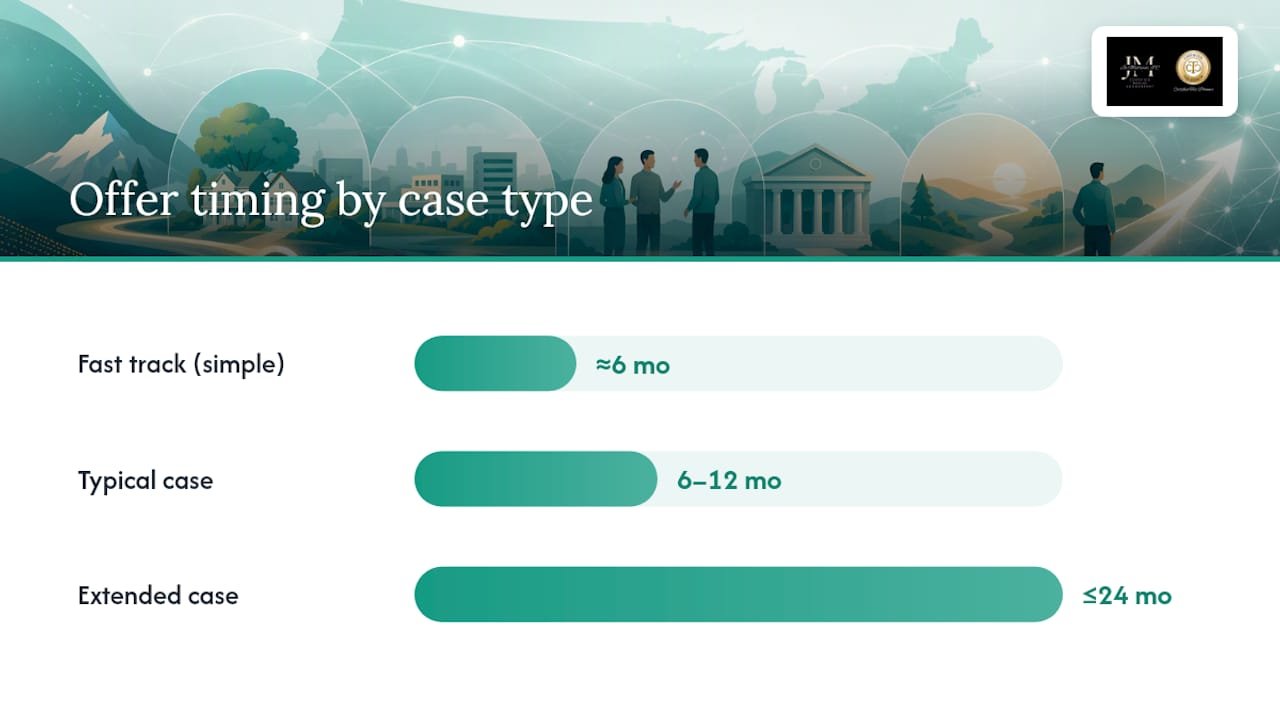
Your timeline depends heavily on which category your case falls into. A clean, well-documented offer with no unfiled returns and a modest asset picture often clears in around six months. A typical case, one with a few complications such as self-employment income or multiple tax years, usually runs six to twelve months. A complex case involving business assets, trust-fund liabilities, or a request for supplemental documentation can take up to 24 months, sometimes longer if it moves to Appeals.
The IRS Offer in Compromise FAQ page confirms that a complete offer investigation can take up to 24 months, and that an offer is deemed accepted if the IRS does not make a determination within that 24-month window after the correct centralized offer unit receives the application. That statutory backstop, created under IRC Section 7122(f), exists precisely because offers used to sit in inventory indefinitely.
- Fast track (about 6 months): simple financials, full filing compliance, no supplemental requests.
- Typical range (6 to 12 months): moderate documentation needs, one or two rounds of information requests.
- Extended cases (up to 24 months or more): business assets, multiple modules, or an Appeals detour.
The 24-month deemed-acceptance rule under IRC Section 7122(f) means the IRS cannot sit on a complete offer forever. If the agency has not made a decision by the 24-month mark from the date the correct offer unit received it, the law treats the offer as accepted, though the clock pauses if part of the debt is tied up in judicial proceedings.
Your payment option and filing history tend to predict speed better than anything else. Offers backed by full compliance and clean documentation move through screening quickly, while cases with unfiled returns almost always lose time at the front end.
The step-by-step path from submission to decision
An Offer in Compromise moves through four distinct phases, and knowing which one your case sits in tells you what to expect next.
- Submission. You file Form 656 along with Form 433-A(OIC) for individuals or Form 433-B(OIC) for businesses, the $205 application fee unless you qualify for the low-income waiver, and an initial payment tied to your chosen payment option.
- Receipt and acknowledgment. The centralized offer unit logs the date it receives your paperwork, since that date starts the 24-month clock. You typically get an acknowledgment letter confirming your offer is under review.
- Screening. Examiners check for completeness and filing compliance before the case ever reaches an investigator. An offer missing required forms, fees, or tax returns gets returned, not rejected, meaning you lose your appeal rights but can refile once the issue is fixed.
- Investigation. A Certified Offer in Compromise (COIC) or Field Offer in Compromise (FOIC) examiner verifies your income, assets, and expenses, often requesting bank statements, pay stubs, or asset valuations.
- Decision. The examiner accepts, rejects, or returns the offer. Acceptance moves you into monitoring. Rejection opens a 30-day appeal window. A return simply means you start over once the missing piece is corrected.
The Form 656-B booklet spells out exactly which documents and fees trigger a return when absent, and it is worth reading before you submit rather than after. Our own breakdown of why the IRS rejects offers in compromise covers the most common triggers in more depth.
Pro Tip: Photocopy your entire submission package before mailing it, including proof of the initial payment, so you have a clear record of exactly what the IRS received and when.
What actually speeds up or slows down your case
You control more of this timeline than most taxpayers assume. The IRS’s own workload is the one variable you cannot influence, but everything else on this list is within your reach.
- Documentation quality: incomplete or inconsistent entries on Form 433-A(OIC) or Form 433-B(OIC) trigger supplemental requests that add weeks or months.
- Payment option: lump-sum offers generally move differently than periodic payment offers, and TIPRA rules require partial payments to continue while a periodic offer is pending.
- Filing compliance: unfiled returns are one of the most common reasons offers get returned before an examiner ever looks at the numbers.
- Case complexity: multiple business entities, trust-fund recovery penalty issues, or a referral to the Department of Justice all add review layers.
- IRS inventory levels: examiner caseloads and current backlog affect how quickly a case moves, and this is entirely outside your control.
Understanding the 24-month deemed acceptance rule
The 24-month rule works as a safety valve, not a promise of quick resolution. The clock starts on the date the correct centralized offer unit receives your complete application, and if the IRS has not accepted, rejected, or returned your offer by that date, the law deems it accepted automatically.
- The rule is statutory under IRC Section 7122(f), not a matter of IRS discretion.
- The clock pauses for any portion of the tax debt currently in dispute in judicial proceedings.
- A returned offer does not count toward the 24 months in the same way, since a return effectively restarts the process once refiled.
A complete offer investigation can take up to 24 months before deemed acceptance applies, per the IRS Offer in Compromise FAQ, which is the clearest signal that patience, paired with prompt responses to any request, matters more than pushing for speed.
Keep your acknowledgment letter and any dated correspondence in one file. If you approach the 24-month mark with no word from the IRS, that documentation is what proves your receipt date and supports a deemed-acceptance argument.
If your offer is rejected: what the appeal adds to your timeline
A rejection is not the end of the road, but it does add real time to your case. You have 30 days from the date of the rejection letter to file an appeal, typically using Form 13711 or a written protest that meets the same requirements.
- Appeals generally issues Letter 5576 within 30 days of receiving your case, confirming who is assigned and how to reach them, per IRM 8.23.3.
- Appeals cycle times for OIC cases have averaged around 255 days in fiscal year 2025, which realistically adds several months to your total timeline.
- Collection activity generally stays paused while your case is in Appeals, similar to how it pauses during the original investigation.
- The 24-month deemed-acceptance clock does not simply keep running through Appeals in the same straightforward way it does during the initial review, so an appealed case should not be measured against that deadline the same way.
Our guide to the OIC appeals process walks through how representation can help you avoid missing the 30-day window, which is the single most common way taxpayers lose their appeal rights entirely.
The delays you can prevent before you ever submit
Most avoidable delays trace back to the same handful of mistakes, and fixing them before you file is far faster than fixing them after a return letter arrives.
- File every past-due return first. An offer submitted with unfiled years is almost guaranteed to come back.
- Match every number on Form 433-A(OIC) or 433-B(OIC) to your bank statements and pay stubs. Discrepancies are the top cause of supplemental information requests.
- Include the correct fee or waiver documentation. A missing $205 fee, or missing low-income certification, is an automatic return.
- Track every IRS letter by date and respond within the deadline given. Silence is read as abandonment of the offer.
- Pause and fix known problems before mailing anything. Refiling after a return costs more time than a short delay upfront.
Pro Tip: Set a calendar reminder the day you mail your offer for every deadline the IRS gives you afterward. Late responses to information requests are one of the fastest ways to lose months of progress.
What acceptance triggers: monitoring, payments, and the five-year rule
Acceptance is not the finish line. Every accepted offer enters Monitoring of Offers in Compromise (MOIC), and the IRS tracks your compliance for five years from acceptance.
- Lump-sum offers require payment in five or fewer installments within five months of acceptance, while periodic offers follow a longer schedule tied to the offer terms.
- The IRS suspends the collection statute of limitations (CSED) during the offer’s pendency, using transaction codes such as TC 480, 780, 781, and 782 to mark the suspension and later reinstatement, per IRM 5.19.7.
- Refunds during the offer’s pending period, and in some cases afterward, may be applied against the settled debt rather than issued to you.
Accepted offers are monitored through a mandatory five-year compliance period, according to IRM 5.19.7, and defaulting during that window, whether by missing a payment or failing to file a return, can reinstate the full original liability. Our page on offer in compromise requirements after acceptance covers what MOIC actually checks year to year.
A practitioner’s checklist for avoiding avoidable delays
Forty-five years of handling IRS cases teaches you that most delay is self-inflicted, and most of it is preventable with a short checklist before you file.
- Confirm every required return is filed and every estimated payment for the current year is current.
- Cross-check every Form 433 entry against source documents before mailing anything.
- Respond to Additional Requested Information (ARI) requests within days, not weeks, since slow responses are what push cases toward a return.
- Keep a dated log of every IRS letter and every response you send, in case a dispute over timing arises later.
Pro Tip: If an examiner requests supplemental documentation, treat the deadline on that letter as final. A quick, complete response almost always avoids a return, while a partial or late one often does not.
Representation matters most at exactly this point, since a case that gets a fast, complete answer to an information request tends to avoid Appeals altogether, which is where the real time gets added.
When it makes sense to handle your own offer
A simple case, one clean tax year, straightforward wages, no business assets, often moves fine without help. If your numbers are easy to document and you can respond to IRS letters within days, filing your own Form 656 is reasonable.
The warning signs are just as clear: unfiled returns stacking up, a business with multiple entities, trust-fund recovery penalty exposure, or a prior offer that was rejected. Those cases benefit from experienced representation because the cost of a mistake, a return or an Appeals detour, is measured in months, not days.
Every case we take on is handled with the same confidentiality and direct attention, since a taxpayer’s situation is never generic even when the forms look the same.
— Joe
How Taxproblem helps you avoid the delays that cost the most time
The offers that move fastest through the IRS are the ones submitted complete, documented, and filed by someone who answers every information request within days, not weeks. That is the specific advantage of working with Joe Mastriano, CPA and the team at Taxproblem: direct engagement on your case, unique tax-saving strategies built around your actual numbers, and the experience to catch the documentation gaps that turn into returned offers before they happen.

A consultation with Joe covers your filing history, your asset picture, and which payment option fits your situation, so you walk in knowing what the IRS will ask for before they ask for it. If you are weighing whether to file your Offer in Compromise yourself or want an experienced CPA managing the timeline for you, book a consultation and bring your last three years of returns and a summary of your assets and income.
Where these timeline rules come from
Every rule in this article traces back to the IRS Offer in Compromise FAQs, Form 656 and Form 656-B instructions, IRM 8.23.3, IRM 5.19.7, and reporting from the Taxpayer Advocate Service.
This article is general information, not a substitute for advice from a qualified financial advisor. Consult a qualified financial professional about your own circumstances before acting on anything here.
Sources
- Offer in compromise FAQs | Internal Revenue Service
- National Taxpayer Advocate reports on Offers in Compromise (TAS)
FAQ
How long does it take for the IRS to approve an offer in compromise?
Most offers resolve in six to twelve months, though a complete investigation can take up to 24 months, according to the IRS Offer in Compromise FAQ. Simple cases with clean documentation and full filing compliance tend to move toward the faster end of that range.
What is the success rate of an offer in compromise?
Acceptance rates vary by case complexity and filing compliance, and the Taxpayer Advocate Service has tracked program-level trends in returns and acceptances over time. A well-documented offer with accurate financial disclosures generally has a stronger chance of moving forward than one missing required forms or fees.
What is the IRS 7 year rule for offers in compromise?
This term is not an official IRS rule tied to the Offer in Compromise program, and the IRS’s own OIC guidance does not define such a specific rule. Definitions vary informally online, so taxpayers should rely on the official IRS OIC FAQ rather than an unofficial label.
What is the $600 rule for offers in compromise?
There is no such specific dollar rule within the official IRS Offer in Compromise program guidance. Taxpayers may be thinking of unrelated IRS reporting thresholds for other programs, so it is worth confirming any specific figure against the IRS’s own OIC FAQ page rather than assuming it applies here.
Does the 24-month clock ever pause during an offer in compromise?
Yes. The clock pauses for any portion of the tax debt currently tied up in judicial proceedings, per the IRS Offer in Compromise FAQ. Outside that specific exception, the 24-month period runs from the date the correct centralized offer unit receives your complete application.