
Yes, many failure-to-file penalties can be removed or prevented. If you have a clean recent filing history, the applicable route is likely the automatic exemption from penalty or First-Time Abate; otherwise, reasonable-cause abatement applies. Your first move is to verify the IRS notice and file any missing returns before requesting relief.
TL;DR:
- Automatic exemption from penalties largely applies if you have at least three years of timely filing or 12 consecutive quarters.
- Penalties accrue monthly with a cap of 25 percent on failure-to-file, and the IRS reduces the penalty when both failure-to-file and failure-to-pay apply simultaneously.
- Requesting relief is easiest when you verify your notice, file missing returns, and collect supporting documentation before submitting Form 843 or calling the IRS.
- Reasonable cause relief requires documented events like disasters or serious illness, supported by a clear timeline showing the obstacles and your efforts to comply.
- Paying or arranging payment before requesting abatement improves your chances, as an updated account helps substantiate your case and reduces interest accrual.
Table of Contents
- What the failure-to-file penalty is and how the IRS calculates it
- AEP vs. First-Time Abate: what changed in 2026 and what it means for your case
- Reasonable cause: what the IRS looks for and how to document it
- Step-by-step request process: phone relief, written request, and Form 843
- Timing and limits: how far back you can pursue abatement or a paid-penalty refund
- What abatement changes financially: interest, payment plans, and account reconciliation
- Practitioner perspective: building a request the IRS can verify quickly
- When to hire a tax resolution CPA and how Taxproblem can help
- IRS forms and official pages to cite or attach
- Sources
- FAQ
What the failure-to-file penalty is and how the IRS calculates it
The failure-to-file penalty is generally 5% of the unpaid tax for each month or partial month the return is late, capped at 25% of the unpaid balance. When both the failure-to-file and failure-to-pay penalties apply in the same month, the IRS reduces the failure-to-file penalty by the failure-to-pay amount for that month, so you are not charged the full weight of both at once.
These charges show up on your IRS notice with a specific penalty code and tax period, and the same figures carry over to your account transcript. Before you request anything, pull the notice and match it against your transcript.
- The penalty accrues monthly, not daily, so filing even one day into a new month costs you a full month’s charge.
- The 25% cap applies to the failure-to-file penalty alone, not to combined penalties and interest.
- Notice numbers and penalty codes identify exactly which charge you are disputing.
AEP vs. First-Time Abate: what changed in 2026 and what it means for your case
The IRS began phasing in the Automatic Exemption from Penalty (AEP) starting Summer 2026, a program that replaces First-Time Abate for many future original returns. Eligibility requires three prior years of timely compliance, or 12 consecutive quarters of timely filing for quarterly filers, and the exemption applies automatically without a request.
Roughly three prior years of clean filing history, or 12 consecutive quarters for quarterly filers, triggers automatic relief under AEP, meaning eligible taxpayers no longer need to call or write in for a first-time penalty removal.
First-Time Abate still exists during the transition for returns that fall outside AEP’s automatic scope, and you may need to request it directly. Before assuming either program applies to you:
- Check your transcript for AEP-related codes or a CP95/CP195B notice showing the penalty was already removed.
- If no automatic relief appears and you otherwise qualify, request First-Time Abate by phone or in writing.
- If neither AEP nor FTA applies because of your filing history, move directly to a reasonable-cause claim.
Reasonable cause: what the IRS looks for and how to document it
The IRS grants reasonable-cause relief when you exercised ordinary care and prudence but were still unable to file on time. Recognized examples include a house fire, a natural disaster, the death or serious illness of the taxpayer or an immediate family member, an inability to obtain necessary records, unavoidable absence, or documented IRS or e-file system problems.
Inability to pay is not, by itself, a reasonable cause for failing to file, and simple forgetfulness rarely succeeds either. If either applies to your situation, pair it with a specific, documented event that actually prevented filing, such as a hospitalization that coincided with the deadline.
Build your case as a chronology rather than a general explanation:
- List the filing deadline and the date you actually filed, side by side.
- Identify the specific event that prevented timely filing and the exact dates it occurred.
- Note what you did to try to comply anyway, such as requesting records or attempting to e-file.
- State when the obstacle ended and how quickly you filed afterward.
- Attach dated evidence for each step: medical records, disaster declarations, or mail and e-file confirmations.
Pro Tip: A one-paragraph explanation rarely works as well as a dated timeline; the IRS is matching your story against your account history, so specifics beat generalities every time.
Step-by-step request process: phone relief, written request, and Form 843
Start by confirming the notice number, penalty code, and tax period, and file any missing returns first, since the Taxpayer Advocate Service recommends starting with the notice because it identifies the exact penalty and the correct contact route.
- Call the IRS number on the notice and request First-Time Abate if your filing history supports it; some accounts qualify for immediate phone relief.
- If phone relief is denied or unavailable, submit a written request or Form 843, the formal claim for refund or abatement.
- On Form 843, identify the tax period and penalty code, then use line 7 to write a clear, dated chronology of what happened and attach your supporting evidence.
- File a separate Form 843 for each tax period or type of penalty, as the instructions require.
If the IRS denies your request, you have options.
- Request reconsideration with additional documentation if you have new evidence.
- File a formal appeal through the IRS Independent Office of Appeals.
- Ask a tax professional to review the denial letter for procedural errors before you resubmit.
For readers who want sample language for line 7, our Form 843 templates walk through the exact structure that tends to move faster through IRS review.
Timing and limits: how far back you can pursue abatement or a paid-penalty refund
If you already paid the penalty and want it refunded, Form 843 generally requires filing within three years after the original return was filed or two years after the tax was paid, whichever is later. Waiting too long can close that window entirely, so do not delay once you decide to pursue a refund claim.
- Unpaid, still-assessed penalties can often be abated regardless of how much time has passed, since no refund deadline applies.
- Ongoing collection activity on an unpaid balance changes the urgency, since interest and enforcement continue while you prepare your request.
- Statutory exceptions such as timely mailing, erroneous written IRS advice, or disaster relief provisions can extend or alter these deadlines in specific cases.
What abatement changes financially: interest, payment plans, and account reconciliation
Removing the failure-to-file penalty does not automatically erase interest. The IRS generally continues charging interest on the unpaid balance and only adjusts it when the underlying penalty removal changes the account through recalculation.
- Interest keeps accruing on any remaining unpaid tax while your abatement request is pending.
- Setting up an installment agreement or paying down what you can before requesting relief limits how much interest builds up in the meantime.
- Filing all missing returns and correcting your account first gives the IRS an accurate balance to work from, which tends to produce cleaner outcomes.
Pro Tip: Pay or arrange payment before you request abatement, not after; a corrected, current account gives your reasonable-cause explanation far more credibility.
Practitioner perspective: building a request the IRS can verify quickly
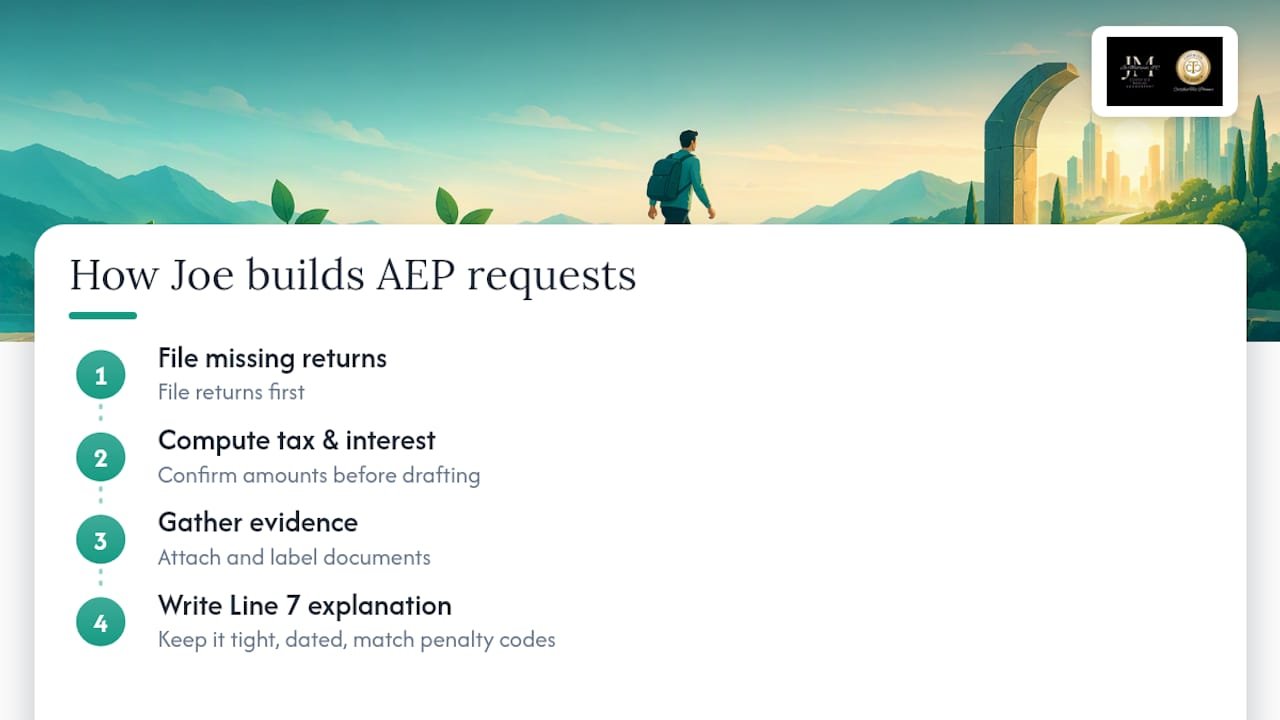
After decades of preparing these requests, Joe Mastriano organizes every case the same way: file the missing returns first, compute the tax and interest owed, then gather evidence before writing a single word of explanation. That order matters because a chronology written before the numbers are settled tends to contradict the transcript later.
Joe recommends keeping the line 7 explanation tight, dated, and matched directly to the transcript’s penalty codes and tax periods, with attachments labeled so an IRS examiner can verify each claim in under a minute.
Joe Mastriano
When to hire a tax resolution CPA and how Taxproblem can help
To handle a failure-to-file penalty yourself works fine when the facts are simple and your filing history is clean. It gets harder once you are missing several years of returns, facing a trust fund recovery issue, or dealing with repeated penalties the IRS has already flagged on your account.

Taxproblem prepares missing returns, drafts Form 843 with a chronology built to match your transcript, and represents you directly in IRS communications and appeals when a request is denied. We also negotiate payment plans or an Offer in Compromise when the underlying tax debt, not just the penalty, needs a broader resolution. If your history includes unfiled years, start with our IRS Delinquent Returns service before requesting abatement. When you are ready to talk through your specific notice and account, schedule a consultation with Joe and get a clear read on which relief path fits your case.
IRS forms and official pages to cite or attach
Keep Form 843 instructions, the reasonable cause guidance, and your notice on hand. Each document ties your explanation directly to what the IRS expects to see on review.

This article is general information, not a substitute for advice from a qualified financial advisor. Consult a qualified financial professional about your own circumstances before acting on anything here.
Sources
- Administrative penalty relief | Internal Revenue Service
- Tips for taxpayers who may qualify for automatic penalty relief | Taxpayer Advocate Service
FAQ
How do you get out of a failure-to-file penalty?
You either qualify for automatic relief through AEP or First-Time Abate based on a clean recent filing history, or you file a reasonable-cause request explaining a specific event that prevented timely filing. Start by verifying your notice and filing any missing returns, then request relief by phone, written letter, or Form 843.
How far back can you file an abatement request?
For a penalty you already paid, you generally have three years from when you filed the original return or two years from when you paid the tax, whichever is later, per the Form 843 instructions. Unpaid penalties that are still assessed can often be abated without that same refund deadline applying.
What are the requirements for reasonable-cause penalty abatement?
The IRS requires that you exercised ordinary care and prudence but were still unable to file on time, supported by documented evidence such as medical records, disaster declarations, or proof of a system failure. A dated chronology tied to specific evidence works better than a general explanation of hardship.
What are good reasons to request IRS penalty abatement?
Strong reasons include a serious illness or death in the family, a fire or natural disaster, an inability to obtain necessary records, or documented IRS system outages, all recognized under reasonable cause guidance. Inability to pay or simple forgetfulness rarely succeeds on its own and usually needs a more specific, documented event attached to it.
— Joe