
You can sometimes reduce or avoid Form 8938 late-filing penalties, but only if you act quickly and the facts support it. File the missing Form 8938 first, then gather evidence for a reasonable cause claim before you respond to any IRS notice. Penalties start at $10,000 and can climb fast once the IRS sends a notice, so the clock matters as much as the paperwork.
TL;DR:
- Filing the missing Form 8938 before IRS notice limits potential penalties, which start at $10,000 and can increase by $10,000 every 30 days after 90 days, up to $60,000.
- Combining missed filings of Form 8938, FBAR, and other international forms can trigger stacked penalties and prolong the IRS examination window across multiple years.
- Promptly submitting complete, corrected international filings and gathering supporting documentation are crucial for building a strong reasonable cause case for penalty abatement.
- Relief requests must be supported by verifiable facts; vague explanations like forgetfulness rarely succeed, making detailed evidence and organized timelines essential.
- Professional representation can improve success rates, especially for complex, multi-form, or high-penalty cases, and a free review service can help identify the best mitigation strategy.
Table of Contents
- What penalties apply for late or missing Form 8938
- How Form 8938 relates to FBAR and other international forms
- Immediate corrective steps after a missed Form 8938 or IRS notice
- Relief options: reasonable cause, First Time Abate, and other IRS programs
- How to prepare an effective reasonable cause request
- Timelines, penalty math, and statute of limitations
- When professional representation changes the outcome
- Get a free evaluation of your Form 8938 situation
- Sources
- FAQ
What penalties apply for late or missing Form 8938
The starting penalty for failing to file a complete and correct Form 8938 by its due date, including extensions, is $10,000. That number is not a worst-case estimate. It is the baseline penalty the Instructions for Form 8938 describe for a taxpayer who simply misses the form.
The exposure grows from there. If you still have not filed 90 days after the IRS mails a notice about the missing form, the agency adds another $10,000 for each 30-day period that passes, up to a maximum additional penalty of $50,000. The IRS overview of international information reporting penalties confirms the same continuation mechanics: the 90-day window starts the penalty clock, and every 30 days of continued noncompliance after that adds another $10,000 charge.
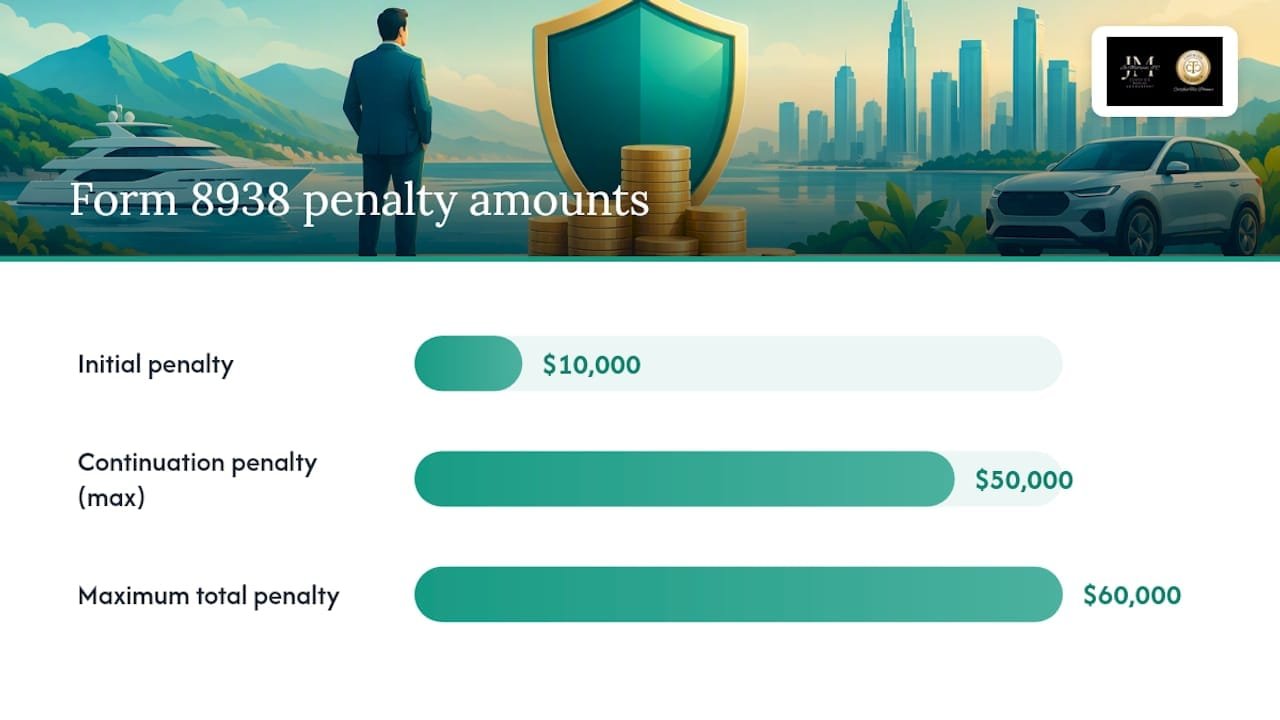
One missed Form 8938 can cost up to $60,000 once the initial penalty and the full continuation penalty stack together, according to the Instructions for Form 8938. That total assumes the taxpayer never files after receiving notice, which is exactly why prompt filing matters more than any other single step.
Form 8938 penalties are not the only exposure in play. When unreported foreign assets tie to an income understatement, other penalty regimes can layer on top:
- A 40% penalty may apply to understatements tied to undisclosed foreign financial assets.
- A 75% civil fraud penalty can apply in cases where the IRS establishes fraudulent intent.
- Criminal statutes exist for willful failures to report foreign assets, though they are reserved for the most serious cases.
Joint filers face a separate wrinkle: both spouses generally carry joint and several liability for a jointly filed return, which means either spouse can be pursued for the full penalty amount regardless of who controlled the foreign account. And when records are incomplete, the IRS is permitted to presume the value of an unreported asset was high enough to trigger the filing requirement, shifting the burden onto the taxpayer to prove otherwise.
How Form 8938 relates to FBAR and other international forms
Form 8938 and the FBAR (FinCEN Form 114) look similar on the surface. Both ask about foreign financial accounts. They are legally separate filings with separate thresholds, separate filing systems, and separate penalty structures, and filing one does not satisfy the other. The IRS comparison of Form 8938 and FBAR requirements is explicit on this point: a taxpayer who files FBAR but skips Form 8938, or the reverse, has still missed a required filing.
The thresholds diverge sharply. FBAR applies once the aggregate value of foreign financial accounts exceeds $10,000 at any point during the year, a threshold that has stayed flat for decades. Form 8938 uses a tiered system instead. According to the IRS guidance on who must file Form 8938, an unmarried taxpayer living in the United States files when specified foreign assets exceed $50,000 on the last day of the year or $75,000 at any point during the year, with higher thresholds for joint filers and still higher ones for taxpayers living abroad.
Other international forms complicate the picture further:
- Interests already reported on Form 5471 (foreign corporations), Form 8865 (foreign partnerships), or Form 3520 (foreign trusts and gifts) may not need to be duplicated on Form 8938, but they still must be identified on the form.
- The Form 5471 filing guidance shows a parallel $10,000 initial penalty structure with its own 30-day continuation penalties, so a missed Form 5471 does not get cheaper just because Form 8938 was filed correctly.
- A taxpayer who owns a foreign corporation and also holds a personal foreign brokerage account can trigger FBAR, Form 8938, and Form 5471 obligations in the same year, and a single oversight can produce three separate penalty exposures rather than one.
That stacking effect is the part most taxpayers underestimate. A missed filing rarely travels alone.
Immediate corrective steps after a missed Form 8938 or IRS notice
The sequence you follow in the first few weeks after discovering a miss often shapes whether relief is realistic later. Move in this order:
- File the missing Form 8938 and attach it to an amended return if the original return has already been submitted; file any missing FBAR or related international forms at the same time, since partial compliance rarely helps your position.
- Read the notice carefully and record the exact notice number, tax year, and proposed penalty amount before doing anything else. These details determine which response deadline applies and which office is handling your case.
- File corrected returns first when the IRS instructions call for it, rather than responding to the notice with an explanation alone. A completed filing shows good faith in a way that a promise to file never does.
- Build a dated timeline covering when you learned about the requirement, what you did to comply, and any obstacles you ran into along the way. Attach supporting documents: bank correspondence, medical records, prior accountant communications, anything that corroborates the story.
- Limit written statements to facts you can support. If your situation involves multiple missed forms, a large dollar exposure, or any possibility the IRS could view your conduct as willful, get a short factual summary in front of a tax professional before you send anything.
Pro Tip: Never respond to an IRS penalty notice with a phone call alone. Put your explanation in writing, keep a copy, and send it in a way that gives you proof of delivery.
The order matters because the IRS evaluates reasonable cause claims against what you actually did, not just what you say you intended to do. A taxpayer who files the missing form the same week they discover the problem has a materially stronger case than one who waits for the notice to arrive first. Filing before a notice ever shows up is stronger still, since it demonstrates the omission was not the product of ignoring a known problem.
If your situation touches more than one form, resist the urge to handle each one separately. An FBAR filed this month and a Form 5471 filed three months later tells a less coherent story than a coordinated catch-up filing that addresses everything at once. Consistency in your timeline is part of what makes a reasonable cause narrative credible.
Relief options: reasonable cause, First Time Abate, and other IRS programs
Several relief paths exist, and picking the wrong one can waste time you do not have.
Reasonable cause is the most commonly used path for Form 8938 penalties. The Instructions for Form 8938 describe reasonable cause as available when a taxpayer tried to comply but could not because of circumstances outside their control, such as hospitalization, lack of access to foreign bank records, or postal and delivery failures. The taxpayer bears the burden of affirmatively showing the facts that support the claim; a general statement of forgetfulness rarely succeeds.
- First Time Penalty Abatement can apply to certain penalties for taxpayers with a clean compliance history, but a prior penalty in the same category or a pattern of repeated late filings typically disqualifies a taxpayer from this route.
- Streamlined filing compliance procedures exist for taxpayers whose failure to report foreign assets was non-willful, though eligibility rules are specific and program terms can shift.
- Program availability changes over time. Reporting on IRS procedural changes, including the closing of the Delinquent FBAR Submission Procedures, shows that a pathway open one year may not be open the next, which is one more reason to move before your options narrow further.
- Voluntary disclosure variants and formal appeals become relevant when the exposure is large, multiple years are involved, or there is any risk the IRS could characterize the conduct as willful.
Pro Tip: Do not assume the relief program you read about online is still open. Confirm current program terms before you build a filing strategy around one, since foreign-reporting programs have changed before and can change again.
Filing corrected returns and missing forms before submitting an abatement request tends to improve outcomes, since both IRS practice and court decisions have favored taxpayers who fixed the omission promptly rather than waiting for enforcement to force the issue.
How to prepare an effective reasonable cause request
A reasonable cause request succeeds or fails on documentation, not persuasion. Build it in this order:
- Assemble your evidence first. Gather the dated timeline, any medical records or hospitalization documentation, proof of bank outages or foreign correspondence delays, prior communications with an accountant, and confirmation that the missing form has now been filed.
- Write a concise, signed statement that walks through what happened, when you learned about the requirement, and what you did once you knew. Avoid vague language like “I was busy” or “I didn’t understand,” since the IRS wants specific, verifiable facts.
- Determine whether Form 843 is required. Some penalty abatement requests are handled through correspondence with the notice itself, while others require a separate Form 843 claim for refund or abatement; the correct format depends on the notice you received.
- Attach every supporting document referenced in your statement, organized in the order your timeline presents them, so the reviewer can verify each claim without hunting for it.
The most common mistake is submitting a request that explains intent without proving it. A denial usually follows when the narrative sounds plausible but nothing in the file backs it up. If the IRS denies the request, you generally have appeal rights, and in some cases the matter can proceed to litigation, though most cases resolve at the administrative level when the record is solid. Reviewing what reasonable cause actually requires before you file can save a second, weaker attempt later.
Timelines, penalty math, and statute of limitations
The 90-day clock is the single most important date on a Form 8938 penalty notice. Once the IRS mails that notice, you have 90 days before continuation penalties begin. After that, an additional $10,000 penalty accrues for each 30-day period of continued failure to file, capped at $50,000, according to the Instructions for Form 8938. A taxpayer who files on day 89 avoids the entire continuation penalty. One who files on day 150 has already accrued at least $20,000 in additional penalties.
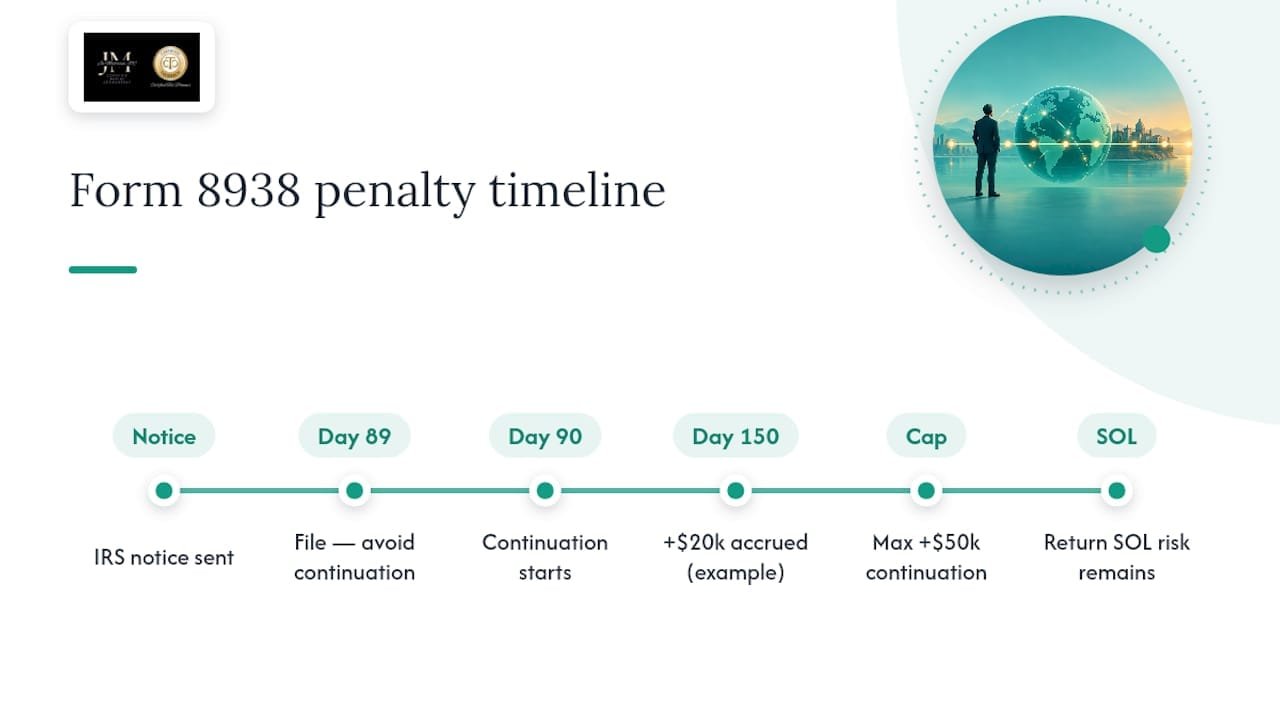
There is a second, quieter consequence. Filing Form 8938 late, or not at all, can keep the statute of limitations open for the related tax return, sometimes for the entire return rather than just the omitted item, according to the Form 8938 instructions. A single missed form in one year is expensive. The same omission repeated across multiple years, especially where an understatement penalty attaches, multiplies both the penalty exposure and the number of years the IRS can still examine.
When professional representation changes the outcome
Reasonable cause claims are judged on facts and documentation, and building that record correctly takes experience most taxpayers do not have. Joe Mastriano, CPA, has represented taxpayers before the IRS for more than 45 years, with particular depth in cases involving stacked international forms, suspected willfulness, and penalty amounts large enough that a denied request carries real consequences.
A paid engagement typically means someone packages your abatement request, represents you through appeals if the first request is denied, and negotiates a payment arrangement if penalties remain after relief efforts are exhausted. Before a consultation, have your notice, the last several years of returns, and your foreign account statements ready. Most engagements move quickly once the facts are organized, though multi-form cases take longer to document than a single missed filing.
Get a free evaluation of your Form 8938 situation

Filing the missing form is the right first move, but building a reasonable cause file that the IRS will actually accept is a different skill than filing a return. A free evaluation service can help review your notice, filing history, and foreign account details to identify which relief path fits: reasonable cause, First Time Abate, an Offer in Compromise if penalties and back taxes have piled up, or a payment plan if some liability remains after relief.
To make the first meeting productive, bring:
- A copy of any IRS notice, including the notice number and proposed penalty amount.
- The tax returns for the years involved, along with any foreign account or asset statements.
- A written timeline of what happened and when you learned about the filing requirement.
Reach out through the services page to schedule a review, or start directly with a consultation to go over your specific notice and options. If your case involves delinquent returns across multiple years, the IRS Delinquent Returns service page covers what a coordinated catch-up filing looks like.
This article is general information, not a substitute for advice from a qualified financial advisor. Consult a qualified financial professional about your own circumstances before acting on anything here.
FAQ
What is the penalty for filing Form 8938 late?
The initial penalty is $10,000 for a Form 8938 that is late, incomplete, or incorrect. If you still have not filed 90 days after an IRS notice, the agency adds $10,000 for each additional 30-day period, up to a $50,000 maximum on top of the initial penalty.
What happens if you forget to file Form 8938?
Nothing happens automatically the moment you miss the deadline, but the exposure exists from that point forward and grows once the IRS sends a notice. The safest move is to file the missing form voluntarily, before any notice arrives, since that timing tends to support a stronger reasonable cause claim.
Will the IRS forgive late filing penalties?
The IRS can abate Form 8938 penalties under reasonable cause when the taxpayer shows specific facts, such as hospitalization or inaccessible foreign records, that prevented timely filing, according to the Form 8938 instructions. Forgiveness is never automatic and depends on documentation, not just an explanation.
What happens if you forgot to file an FBAR?
An FBAR (FinCEN Form 114) is a separate filing from Form 8938, and missing it carries its own penalty exposure distinct from the Form 8938 penalty, per the IRS comparison of the two forms. Filing the missing FBAR as soon as possible, and coordinating that filing with any other missed international forms, is the standard first step before pursuing penalty relief.
— Joe