
Failure to file is the penalty for not submitting your return by the due date. Failure to pay is a separate penalty for not paying the tax you owe. The failure-to-file penalty accrues at 5% per month, ten times faster than the 0.5% monthly failure-to-pay penalty, and when both apply the combined monthly hit is effectively 5%. File your return now regardless of whether you can pay, then work out a payment plan or abatement request.
TL;DR:
- Filing past-due returns stops the failure-to-file penalty from growing, which accrues at 5% monthly and can reach 25% of the owed tax, with a minimum fee of $485 if late over 60 days.
- The failure-to-pay penalty runs at 0.5% per month, capped at 25%, but reduces to 0.25% if enrolled in an installment agreement, and doubles to 1% if a levy notice is ignored.
- When both penalties apply in the same month, the failure-to-file penalty is reduced by the failure-to-pay amount, resulting in a net rate of 5% per month until the failure-to-file penalty maxes out.
- Options like First-Time Penalty Abatement, automatic exemption starting in 2026, and reasonable cause requests can help reduce or eliminate penalties, especially with proper documentation.
- Early filing and prompt response to IRS notices significantly cut penalties and interest, and professional help is recommended for negotiating payment plans or handling levies.
Table of Contents
- Failure to File vs Failure to Pay: The Core Difference
- What Failure to File Means: Timing, Rates, and Traps
- What Failure to Pay Means: Rates, Plans, and the Levy Trap
- How the Two Penalties Combine: A Monthly Breakdown
- Relief Options: FTA, AEP, and Reasonable Cause
- What to Do Right Now: Your Emergency Checklist
- What Actually Moves the Needle in a Penalty Negotiation
- How Taxproblem Resolves Failure to File and Failure to Pay Cases
- Where to Verify These Rules Yourself
- A Closing Word on Staying Ahead of Both Penalties
- Sources
- FAQ
Failure to File vs Failure to Pay: The Core Difference
The two penalties punish different behavior, and mixing them up is the single most expensive mistake taxpayers make. Failure to file penalizes the act of not submitting a return, even a return showing zero balance due in some cases. Failure to pay penalizes the act of owing tax the IRS hasn’t received, whether or not you ever filed.
That distinction changes strategy. A taxpayer who files on time but can’t pay the full balance owes only the failure-to-pay penalty. A taxpayer who doesn’t file at all, even with a small balance, gets hit with both. Since failure to file accrues at 5% monthly versus 0.5% for failure to pay, the paperwork you skip costs roughly ten times more per month than the check you can’t write. This is why filing on time, or even filing late without paying, is almost always the better move than not filing at all.
What Failure to File Means: Timing, Rates, and Traps
The failure-to-file penalty starts the day after your original due date passes, not your extended deadline for paying. Filing Form 4868 buys you extra months to submit your return, but it never extends the time you have to pay. Taxes owed are still due on the original date, and interest and late-payment penalties begin accruing immediately if that balance sits unpaid.
Here’s how the IRS structures the penalty:
- Rate: 5% of unpaid tax for each month or partial month the return is late, capping at 25% of the tax owed.
- 60-day minimum: if your return is more than 60 days late, the penalty floor is the lesser of $485 for 2026 returns or 100% of the tax shown on the return.
- Substitute for Return risk: if you never file, the IRS can prepare a return on your behalf using W-2 and 1099 data it already has. These substitute returns typically ignore deductions and credits you’d otherwise claim, often inflating your assessed balance and triggering collection action faster than you’d expect.
What Failure to Pay Means: Rates, Plans, and the Levy Trap
Failure to pay moves at a fraction of the pace of failure to file, but it never stops on its own the way FTF does. The standard rate is 0.5% of unpaid taxes per month or partial month, capped at 25% of the balance.
Enroll in an approved individual installment agreement and the rate drops in half.
- Standard rate: 0.5% per month, capped at 25% of unpaid tax.
- Installment agreement rate: 0.25% per month for individuals with an approved payment plan.
- Levy-triggered rate: if tax remains unpaid 10 days after the IRS issues a notice of intent to levy, the rate jumps to 1% per month.
Pro Tip: Interest keeps compounding on top of both penalties for as long as the balance sits unpaid, so the earlier you pay anything toward the debt, the less the whole package costs by the time it’s resolved.
A taxpayer who ignores a levy notice for even a few weeks can watch their monthly penalty rate double, on top of interest that was already accruing. The same IRS guidance that sets the 0.5% baseline also confirms this escalation, and it’s one of the clearest signals that responding to IRS mail matters as much as paying the bill itself.
How the Two Penalties Combine: A Monthly Breakdown
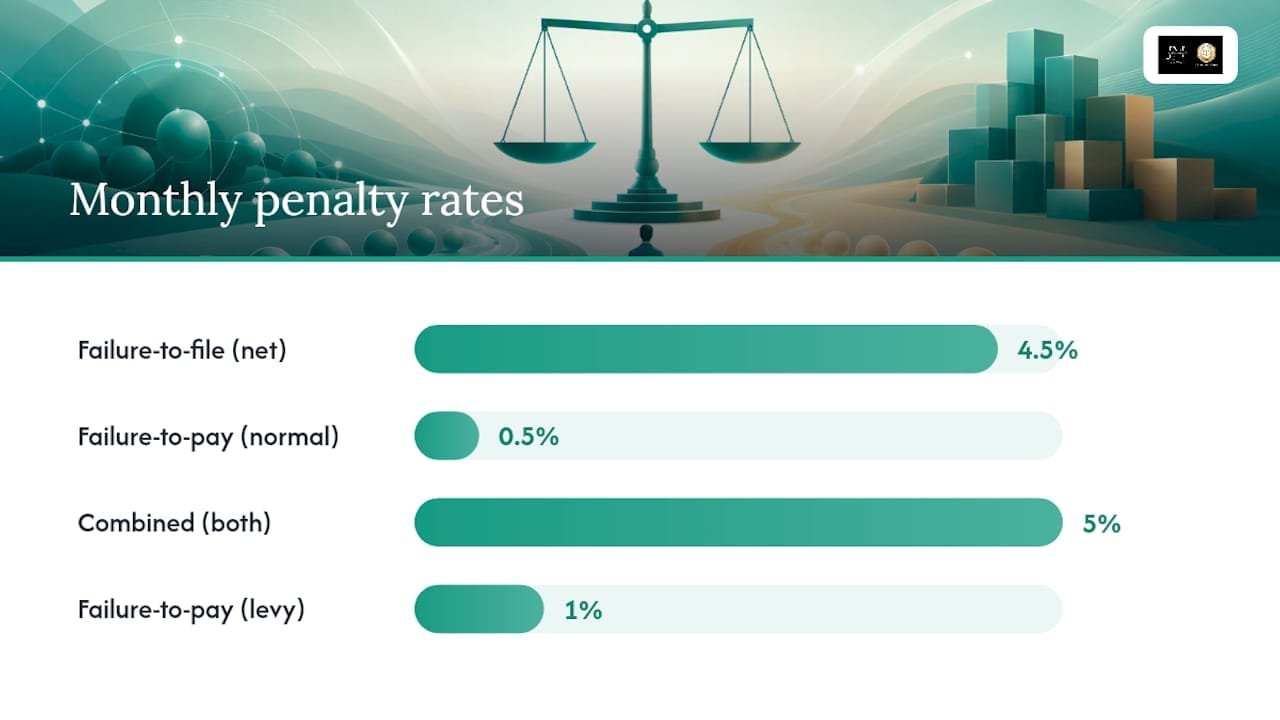
When failure to file and failure to pay both apply in the same month, the IRS doesn’t just add 5% and 0.5% together. It reduces the failure-to-file penalty by the amount of the failure-to-pay penalty assessed that month, so the net combined charge lands at 5%, not 5.5%.
The mechanics play out in stages:
- Months 1 through 5: both penalties run concurrently. Failure to file dominates the math at 4.5% (after the offset), plus 0.5% failure to pay, for a combined 5% per month.
- Month 5: failure to file hits its 25% ceiling and stops accruing entirely.
- Month 6 onward: only failure to pay continues, now running alone at 0.5% (or 1% if a levy notice has been ignored) until it reaches its own 25% cap.
Picture a $10,000 unpaid balance filed 90 days late. By month 3, the combined penalty already sits near $1,500, largely driven by failure to file. By month 6, failure to file has maxed out near $2,500, and failure to pay is still climbing on its own, plus interest on the whole balance. The 60-day minimum penalty matters most for small balances: a return filed 61 days late with only a few hundred dollars owed can still trigger the full $485 minimum charge for 2026 returns, because the floor ignores how small the underlying tax bill is.
Relief Options: FTA, AEP, and Reasonable Cause
You have more paths out of these penalties than most taxpayers realize, and the menu just got bigger. First-Time Penalty Abatement (FTA) is an administrative request available to taxpayers with a clean compliance history for the prior three years. You ask for it, either by phone or in writing, and the IRS grants it based on that track record alone.
Automatic Exemption from Penalty (AEP) is different, and new. Starting summer 2026, the IRS will apply this relief automatically for eligible taxpayers with a three-year history of timely filing and paying, meaning certain failure-to-file, failure-to-pay, and failure-to-deposit penalties never get assessed in the first place. Watch for a CP95 or CP895 notice confirming the exemption applied to your account.
When neither FTA nor AEP fits your situation, reasonable cause is your fallback. The standard is “ordinary business care and prudence,” which the IRS interprets through documentation:
- Medical records showing hospitalization or serious illness during the filing period.
- FEMA disaster declarations covering your address.
- Bank or payment processor records proving a payment attempt failed through no fault of your own.
You request reasonable cause relief by filing Form 843, generally a separate claim for each tax period and penalty type. Unlike AEP, which prevents the penalty from ever posting, reasonable cause and FTA both require you to prove your case after the fact. For a deeper look at what qualifies, see our breakdown of reasonable cause standards.
What to Do Right Now: Your Emergency Checklist
If you’re behind on filing, paying, or both, work through these steps in order:
- File every past-due return immediately, even if you can’t pay a dime. Filing stops the failure-to-file penalty from accruing further and preserves your right to any refund within the three-year lookback window.
- Pay whatever you can afford right now, then apply for an Online Payment Agreement or a short-term extension for the rest. Even a partial payment shrinks the balance the failure-to-pay penalty is calculated against.
- Evaluate an Offer in Compromise only after you’ve honestly assessed your ability to pay in full. It’s a settlement tool for genuine financial hardship, not a shortcut for delaying payment.
- Respond to every IRS notice promptly, and keep records of every payment and communication. A missed levy notice is what turns a 0.5% penalty into 1%.
For step-by-step guidance on getting delinquent returns filed, see why filing past returns stops penalties.
What Actually Moves the Needle in a Penalty Negotiation
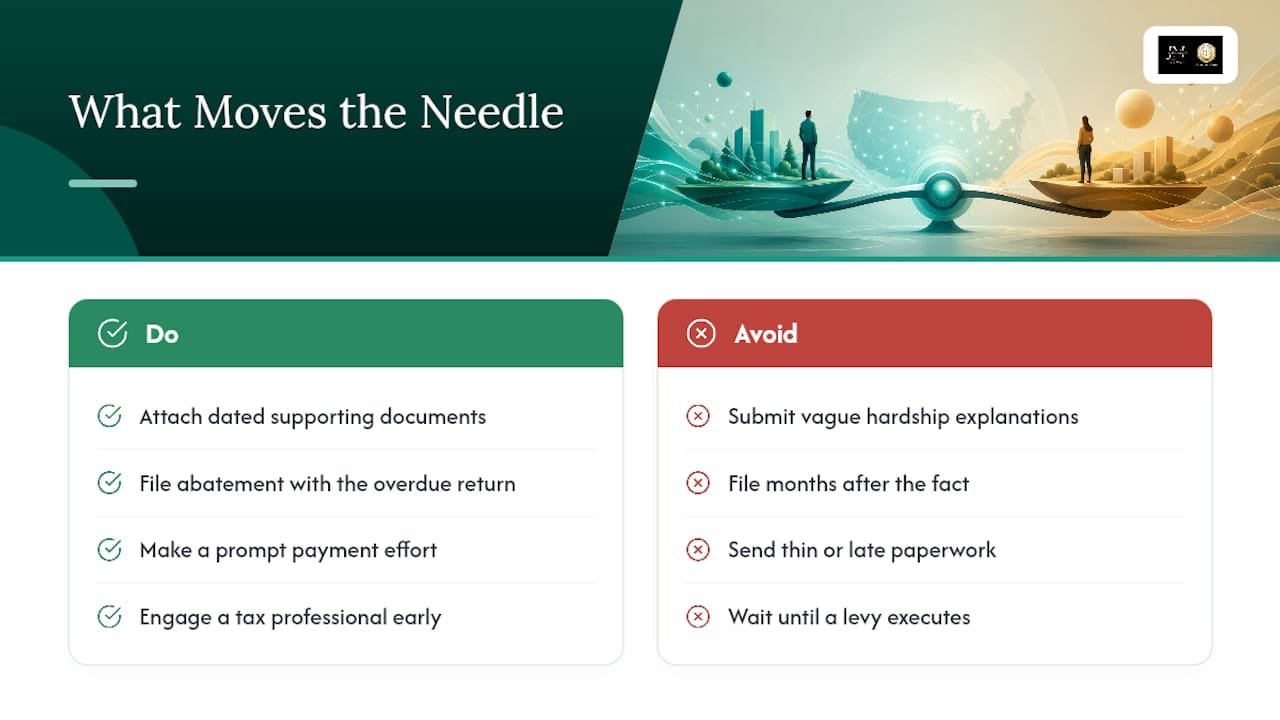
Documentation quality decides more outcomes than most taxpayers assume. Dated medical records, FEMA disaster letters, and bank statements showing a failed electronic payment attempt carry far more weight than a general explanation of hardship. Practitioner experience with these cases suggests that well-documented reasonable cause requests tied to a prompt filing and payment effort see meaningfully better results than requests filed months later with thin paperwork.
Professional representation tends to matter most in three moments: structuring an installment agreement so it survives IRS review, preparing an Offer in Compromise package that reflects true ability to pay, and intervening before a levy notice converts into an actual bank or wage levy.
A penalty abatement request built on dated documentation and filed alongside your overdue return moves faster and further than one submitted alone, months after the fact.
Resolution timelines vary, but simple FTA requests can resolve in weeks while installment agreements and abatement claims tied to reasonable cause often take longer. Professional tax resolution firms often provide evaluations of your IRS situation as a starting point.
How Taxproblem Resolves Failure to File and Failure to Pay Cases
Certain tax resolution services specialize in helping taxpayers facing both penalties, offering guidance on whether to file first, pay first, or seek assistance. Experienced tax resolution professionals have negotiated installment agreements, prepared Offers in Compromise, and stopped levies before they hit a bank account, often working directly with each client rather than routing cases through call centers like many national resolution firms.

An initial consultation reviews your specific filing gaps, your balance, and any notices you’ve already received, then maps out whether FTA, AEP eligibility, reasonable cause, or a negotiated payment plan fits your case. If your returns are overdue, start with delinquent return filing to stop the failure-to-file penalty from growing. If you already owe more than you can pay, review the Offer in Compromise process to see whether a settlement makes sense. For a full picture of available services, visit the services overview, or schedule a consultation with Joe to get a direct answer on your situation.
Where to Verify These Rules Yourself
- Failure to File Penalty — IRS rate tables and the 60-day minimum rule.
- Failure to Pay Penalty — standard, reduced, and levy-triggered rates.
- Automatic Exemption from Penalty — 2026 AEP eligibility.
- Instructions for Form 843 — abatement claim filing procedure.
- Consequences of Not Filing — Taxpayer Advocate Service summary.
A Closing Word on Staying Ahead of Both Penalties
The pattern I see repeat itself in delinquent case after delinquent case is avoidable. File on time, even when payment isn’t ready. Estimate quarterly taxes if you’re self-employed, so April doesn’t ambush you. Open every IRS notice the day it arrives, because the gap between a 0.5% penalty and a 1% penalty is often just ten ignored days.
When a notice mentions a levy, or a balance has ballooned past what you can reasonably pay off in a year, that’s the point to call a professional rather than continue handling it alone. Representation won’t erase a debt, but it changes how the negotiation goes and how fast a resolution takes shape.
— Joe
This article is general information, not a substitute for advice from a qualified financial advisor. Consult a qualified financial professional about your own circumstances before acting on anything here.
Sources
- Failure to file penalty | Internal Revenue Service
- Failure to Pay Penalty | Internal Revenue Service
- Automatic Exemption from Penalty (AEP) | Internal Revenue Service
- Consequences Of Not Filing – Taxpayer Advocate Service
FAQ
Is it better to file and not pay, or not file at all?
Filing without paying is always better. Failure to file accrues at 5% per month, ten times faster than the 0.5% monthly failure-to-pay penalty, and not filing also risks a substitute return that ignores your deductions and credits.
What happens if both failure to file and failure to pay penalties apply?
The IRS reduces the failure-to-file penalty by the failure-to-pay amount assessed in the same month, producing a combined monthly charge of 5%.
How do you calculate failure-to-file and failure-to-pay penalties?
Multiply your unpaid tax by 5% for each month or partial month late for failure to file, and by 0.5% for failure to pay, both capped at 25%.
What is the IRS penalty for failure to pay?
The standard failure-to-pay penalty is 0.5% of unpaid tax per month, capped at 25%.
Can Taxproblem help if I owe both penalties?
Yes. Some tax resolution firms handle delinquent return filing, penalty abatement requests, installment agreement negotiation, and Offers in Compromise for taxpayers facing combined failure-to-file and failure-to-pay balances. Pricing for representation is available through a consultation.