
The most common schedule C audit triggers are unreported or mismatched income, deductions that look large compared to gross receipts, repeated losses that suggest a hobby rather than a business, and home office or vehicle claims without contemporaneous logs. Cash-heavy businesses and round-number expense reporting add to the risk, and EITC claims paired with Schedule C activity draw extra preparer scrutiny. The single most effective move you can make right now is to reconcile your reported income against every 1099-NEC and 1099-K you received, and pull your documentation together before any notice ever arrives.
TL;DR:
- Comparing all received 1099-NEC and 1099-K forms against your Schedule C and bank deposits is crucial to identify income mismatches before an audit notice arrives.
- Business deductions that are disproportionately large compared to gross receipts, especially if expenses land on round numbers or appear estimated, increase audit risk.
- Repeated losses over multiple years and lack of documentation for home office or vehicle expenses, like logs and photos, can trigger deeper IRS scrutiny.
- Cash-heavy businesses and those claiming EITC with Schedule C income are subject to higher review; detailed records and proper due diligence are essential.
- Maintaining organized, verifiable records within statute limitations and promptly responding with targeted documentation can significantly reduce audit exposure.
Table of Contents
- Top 10 Schedule C Audit Triggers: Quick Checklist
- Why Each Trigger Flags You, and What Documents Satisfy the IRS
- Building an Audit-Ready Recordkeeping System
- What to Do the Moment the IRS Contacts You
- Practitioner Tips from Joe Mastriano, CPA
- Where This Guide Fits Against the Usual Advice
- How Taxproblem Helps You Close an Audit With Less Exposure
- Sources
- FAQ
Top 10 Schedule C Audit Triggers: Quick Checklist
Before you file, or before you answer a notice that already landed in your mailbox, run through this list. Each item reflects a pattern the IRS’s automated systems are built to catch, and each one has a fix you can apply today.
- 1099-NEC or 1099-K mismatch. Payers report your income to the IRS independently of you. Compare every 1099 you received against your Schedule C gross receipts line, and against your bank deposits, before you file.
- Deductions disproportionate to income. A business reporting $40,000 in receipts and $38,000 in expenses reads as an outlier against industry norms. Check your expense ratio against typical margins for your NAICS code.
- Consecutive-year losses. Three or more years of losses invites a hobby-loss review under IRC §183. Document your profit motive with a business plan, marketing records, and hours logged.
- Home office deductions without exclusivity proof. The space must be used regularly and exclusively for business. Photos, floor plans, and a copy of Form 8829 workpapers back this up.
- Vehicle expenses without a mileage log. A single annual mileage figure with no daily entries is a red flag. Contemporaneous logs, whether paper or an app, are what auditors expect to see.
- Round-number expenses. Reporting “$5,000” for office supplies or “$10,000” for advertising, year after year, signals estimation rather than bookkeeping. Real expenses rarely land on clean multiples of $500 or $1,000.
- Cash-intensive operations. Businesses that deal heavily in cash (salons, contractors, food service) get compared against bank-deposit analysis. Deposits that consistently exceed reported gross receipts invite questions.
- EITC claims tied to Schedule C income. Paid preparers must follow due-diligence rules under EITC guidance for self-employed taxpayers, and returns claiming the credit alongside self-employment income face closer review.
- Math errors or omitted forms. A transposed number or a forgotten 1099 often triggers a correspondence audit long before anyone suspects fraud.
- Statistical outlier scoring. The IRS’s Discriminant Inventory Function, or DIF, assigns every return a score based on deviation from norms for similar filers. A high DIF score alone can trigger a full audit even with no single glaring error.
Each of these ties back to how the IRS’s matching programs actually work, not just anecdote. Understanding the mechanism is what lets you fix the pattern instead of just hoping it doesn’t apply to you.
Why Each Trigger Flags You, and What Documents Satisfy the IRS
The IRS doesn’t read every Schedule C by hand. It runs your return through DIF, a scoring model that compares your numbers against statistical norms for similar businesses, and layers automated information matching on top of that using third-party forms like 1099-NEC and 1099-K. Returns that deviate significantly from the norm, or that don’t match what third parties reported, get pulled for a closer look. The IRS’s own return-selection guidance confirms this is the primary mechanism behind both correspondence audits and full examinations.
Unreported or mismatched income
When a client or platform pays you and reports it on a 1099, the IRS already has that number before you file. If your Schedule C gross receipts come in lower, the system flags the gap automatically, often generating a CP2000 notice rather than a full audit. A CP2000 isn’t an audit in the traditional sense. It’s an automated notice pointing out a discrepancy between what you reported and what the IRS’s records show, and it gives you a chance to respond in writing. Many of these resolve with a simple explanation and supporting documents. Others escalate when the taxpayer ignores the deadline.

Pro Tip: Reconcile your 1099s against your bank deposits before you file, not after. If a platform issued a 1099-K that includes refunds, sales tax, or personal transfers mixed in with business income, document that difference in your own records now so you’re not scrambling to explain it later.
Excessive deductions relative to receipts
A landscaping business reporting $60,000 in gross receipts and claiming $55,000 in expenses looks suspicious next to industry averages for that NAICS code. The IRS’s DIF model bakes in these comparisons. It doesn’t mean your numbers are wrong. It means you need documentation ready that explains the ratio: equipment purchases, a slow start-up year, or a one-time capital expense. Vague or unsupported deductions are what turn a routine comparison into a real problem.
Repeated Schedule C losses and the hobby-loss presumption
Under IRC §183, a business that loses money year after year risks being reclassified as a hobby, which disallows the losses against other income entirely. The IRS looks for evidence of genuine profit motive: a written business plan, time records showing meaningful hours worked, advertising and marketing efforts, and any changes made in response to prior losses. A practitioner guide from Blue Cloud CPA lists multiple consecutive losses among the most frequently cited Schedule C red flags, right alongside high deduction ratios and vehicle claims.
Home office and vehicle claims
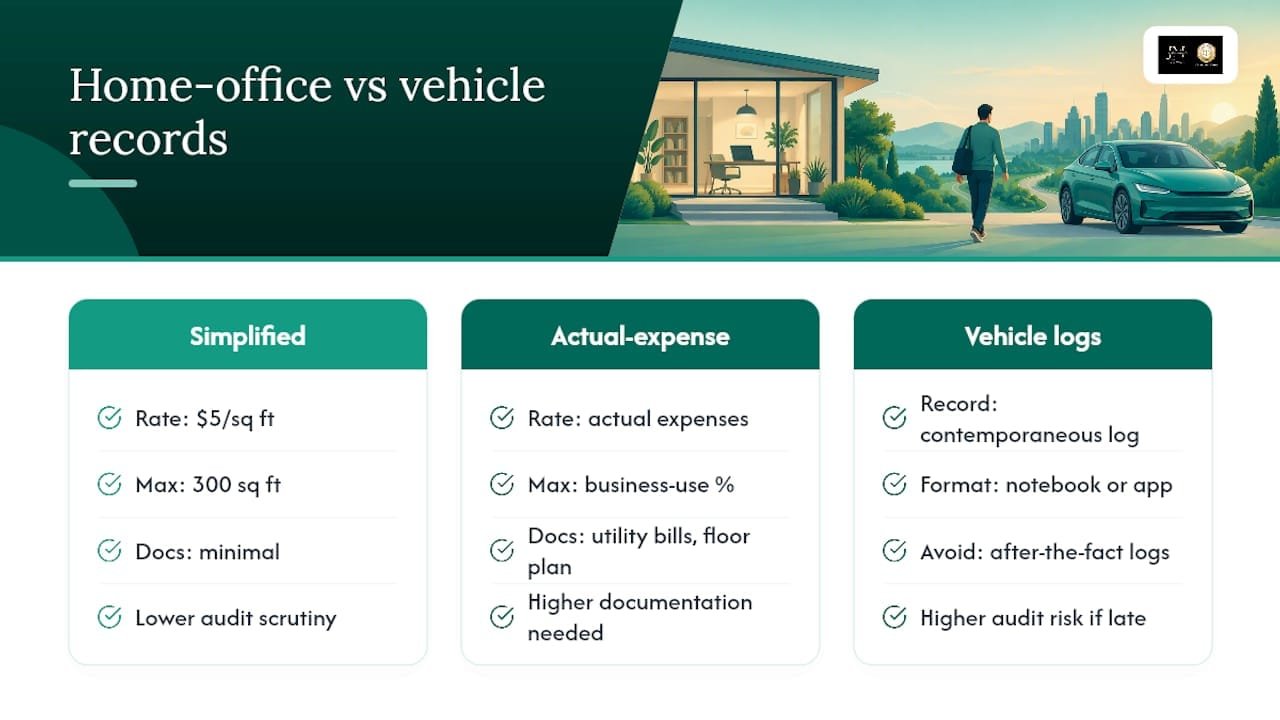
Form 8829 governs the home office deduction, and the exclusivity test is where most claims fall apart. If your “office” doubles as a guest room or your kids do homework at that desk on weekends, the space fails the exclusive-use requirement even if you genuinely work there most days. The simplified method ($5 per square foot, up to 300 square feet) avoids some of this scrutiny but caps your deduction; the actual-expense method requires the full documentation trail, including utility bills and a floor plan showing the business-use percentage.
Vehicle deductions carry a similar burden. A mileage log created after the fact, or one that shows suspiciously round trip totals, doesn’t hold up well. Contemporaneous logs, whether a notebook or a mileage-tracking app, are what separates a defensible deduction from a guess.
Round numbers, estimates, and weak bookkeeping
Nothing undermines credibility with an examiner faster than a return full of numbers ending in zero. According to Investopedia’s audit-trigger analysis, less than 1% of individual returns get audited in a given year, but Schedule C filers face materially higher scrutiny than W-2-only filers, largely because self-employment income and expenses aren’t independently verified the way wages are.
Many audits don’t start with suspicion of fraud at all. They start with a math error or an omitted form, the kind of mistake that a second read-through before filing would have caught.
EITC and preparer due-diligence issues
If you claim the Earned Income Tax Credit while reporting Schedule C income, your return gets extra attention from both sides. Paid preparers are required to complete Form 8867 and document their due-diligence inquiries under IRC §6695(g) whenever a return claims EITC. That requirement exists because self-employment income tied to EITC claims has historically shown higher error rates, and it means your preparer should be asking pointed questions about your records, not just taking your numbers at face value.
Building an Audit-Ready Recordkeeping System
Form 11652, the IRS’s Questionnaire and Supporting Documentation for Schedule C, is essentially a preview of what an examiner will ask for. It lists bank statements, invoices, electronic payment records, and mileage logs as the core evidence categories, and treating it as a packing list before you’re ever audited puts you ahead of most filers.
Build your system around these habits:
- Keep a dedicated business bank account and credit card so personal and business transactions never mix.
- Log mileage contemporaneously, either on paper or through an app, noting date, destination, and business purpose for every trip.
- Photograph or scan receipts immediately and back them up digitally, using a consistent file-naming pattern by month and category.
- Preserve original accounting software files and exportable backups rather than just summary spreadsheets. The IRS’s own guidance on electronic accounting records notes that original files are typically more persuasive to an examiner than a hand-built summary.
- If home office expenses involve a HELOC or business-use interest allocation, keep records tying the loan proceeds to business use; a primer on HELOC interest deductibility covers the documentation the IRS looks for in that specific scenario.
On retention timelines, the IRS recordkeeping guidance and 26 U.S. Code §6501 set the framework:
- Three years from the filing date is the standard statute of limitations for most returns.
- Six years applies if you omitted more than 25% of your gross income.
- No statute of limitations exists for fraud or for a return that was never filed at all.
If records are lost, the accepted path is disciplined reconstruction using bank statements, customer invoices, signed contracts, and contemporaneous third-party logs. A credible, well-documented estimate built from these sources carries real weight with an examiner, even when the original receipt is gone.
What to Do the Moment the IRS Contacts You
Not every IRS letter means the same thing. A CP2000 notice flags an income discrepancy and asks for a written response, usually without requiring a meeting. A correspondence audit requests specific documents by mail. An office audit requires an in-person meeting at an IRS office, and a field audit means an examiner comes to your business, typically reserved for more complex returns. Each carries its own deadline, almost always 30 days from the notice date, and missing it can result in the IRS assessing the proposed changes automatically.
Here’s the order of operations that keeps you in control:
- Read the notice completely before doing anything else, and identify exactly which tax year and which line items are in question.
- Pull only the documents requested, cross-referenced against your Form 11652-style packet: bank statements highlighting relevant deposits, copies of the 1099s in question, receipts for disputed deductions, and mileage logs or Form 8829 workpapers if home office or vehicle expenses are at issue.
- Write a focused response that addresses each discrepancy directly, without volunteering unrelated information the examiner didn’t ask for.
- Send it by the deadline, using certified mail or the method the notice specifies, and keep a copy of everything you submit.
- Bring in representation if the exposure is significant, the records are incomplete, or the notice involves multiple tax years. Our detailed audit response guide walks through this decision in more depth.
Pro Tip: Never admit wrongdoing in writing, even informally, while a notice is pending. Explain the facts and let the documentation speak. A casual phrase like “I probably should have tracked this better” in a letter can be read as an admission and used against you later.
If your records genuinely can’t answer what’s being asked, or if the notice touches more than one year, that’s the point to stop handling it alone. Our step-by-step audit response walkthrough covers what a professional response packet looks like in practice.
Practitioner Tips from Joe Mastriano, CPA
I’ve spent more than 45 years representing taxpayers in front of the IRS, and the pattern I see most often isn’t fraud. It’s disorganization. People who ran a genuinely legitimate business simply didn’t keep the paper trail that proves it, and by the time a notice arrives, they’re trying to reconstruct two years of records under deadline pressure.
The taxpayers who come out of an audit with the least damage aren’t the ones with the cleanest businesses. They’re the ones who can hand an examiner exactly what was asked for, in the format requested, without a six-week scramble first.
A realistic expectation matters here too. Most correspondence audits resolve within a few months once you respond with organized documentation. Office and field audits take longer, sometimes six months to a year, and the outcome depends heavily on how complete your records are when the process starts, not on how good your explanation sounds. If you’re rebuilding records from scratch, prioritize bank statements and invoices first. They corroborate almost everything else. Our audit-proofing checklist walks through the same reconstruction priorities we use with clients.
— Joe
Where This Guide Fits Against the Usual Advice
Most articles on this topic hand you a list of red flags and stop there, as if knowing the trigger is the same as being protected from it. It isn’t. The deduction ratio, the home office claim, the round numbers, none of that is the actual risk. The risk is not having documentation that matches the claim when someone finally asks.
The conventional advice also overstates how scary an audit notice has to be. A CP2000 is not a summons. It’s a data mismatch the IRS wants explained, and most of the time a clear, documented response closes it without escalation. What the reader should prioritize first isn’t avoiding every possible trigger; some, like a legitimate loss year or a real home office, are unavoidable and defensible. The priority is making sure every claim on the return has a paper trail sitting behind it before the IRS ever asks.
How Taxproblem Helps You Close an Audit With Less Exposure
A professional tax resolution service gives Schedule C filers something the checklist articles can’t: licensed CPA representation with extensive IRS negotiation experience, correcting issues left by other preparers. Where a generic guide tells you what documents to gather, Taxproblem’s audit representation service handles the gathering, the response drafting, and the direct negotiation with your examiner.

If you’ve already received a notice, or you simply want your Schedule C reviewed before the IRS ever looks at it, a free evaluation is the place to start. Joe and his team review your specific situation, including record reconstruction if your files are incomplete, and outline your options, whether that means responding to a pending audit, negotiating an IRS Offer in Compromise on back taxes, or setting up an installment agreement if the audit results in a balance you can’t pay in full. Cases are handled confidentially, with direct access to the responsible tax professional rather than a rotating case team. Visit Taxproblem’s services page to schedule your evaluation and see exactly where your return stands before the IRS decides for you.
Sources
These are the official references behind the guidance above, worth keeping on hand if you’re preparing your own audit-ready file:
- IRMs: Overview of return selection (DIF) – IRS
- Red flags that trigger an audit – Investopedia
- EITC due diligence guidance for self-employed taxpayers and paid preparers – IRS
This article is general information, not a substitute for advice from a qualified financial advisor. Consult a qualified financial professional about your own circumstances before acting on anything here.
FAQ
What triggers an IRS audit on Schedule C?
The most common triggers are income that doesn’t match 1099-NEC or 1099-K reporting, deductions that are large relative to gross receipts, repeated losses, and home office or vehicle claims without supporting logs. The IRS’s DIF scoring system flags returns that deviate from statistical norms for similar businesses, as described in the IRS’s return-selection guidance.
What percentage of Schedule C filers get audited?
Less than 1% of individual returns get audited in a given year, but Schedule C filers face notably higher scrutiny than W-2-only taxpayers because self-employment income isn’t independently verified the way wages are. Cash-heavy businesses and those with high deduction ratios see even closer review.
What are the top triggers for an IRS audit?
Beyond income mismatches, the top triggers include disproportionate deductions, multiple consecutive-year losses raising hobby-loss concerns under IRC §183, round-number expense reporting, missing mileage logs, and EITC claims paired with self-employment income. Math errors and omitted 1099 forms also generate a large share of correspondence audits.
What should I do if I get a CP2000 notice?
Read the notice carefully to identify the specific discrepancy, gather documentation that directly addresses it (1099 copies, bank statements, receipts), and respond in writing by the deadline listed, usually 30 days. If the notice involves multiple years or you can’t fully document the disputed items, professional representation through a service like Taxproblem’s audit response guide is worth considering before that deadline passes.
How far back can the IRS audit my Schedule C return?
The standard window is three years from your filing date, extending to six years if you understated gross income by more than 25%. There’s no time limit at all if the IRS finds fraud or if a return was never filed, per 26 U.S. Code §6501.