
If you cannot pay your IRS bill in full today, the IRS short-term payment plan is the simplest way to buy time. It gives you up to 180 days to pay the balance in full, with no setup fee. Interest and penalties keep running until you pay, so it works best when you know where the money will come from within about six months. It is not the same as an extension to file your return, and the two are often confused.
Below, we walk through who qualifies, how to request the plan, what it costs, how it protects you from collection, and what to do if six months is not enough.
TL;DR
- A short-term payment plan gives you 180 days or less to pay your balance in full. Longer monthly plans are installment agreements.
- Individuals who owe less than $100,000 in combined tax, penalties and interest may apply online. Businesses must call.
- There is no setup fee, but interest and penalties continue until the balance is zero.
- A filing extension (Form 4868) gives you more time to file, not more time to pay.
- If you cannot pay within 180 days, move to an installment agreement, an offer in compromise, or hardship status before the plan runs out.
Table of Contents
- What the IRS short-term payment plan actually is
- Who qualifies
- Short-term plan vs. an extension to file
- How to request a short-term plan
- What it costs: fees, interest and penalties
- Does the plan protect you from levies and garnishment?
- What if 180 days is not enough?
- Common mistakes to avoid
- Perspective: why we steer people toward the plan that fits
- Get a second set of eyes before you commit
- FAQ
- Sources
What the IRS short-term payment plan actually is
People search for a “short-term payment extension,” but the IRS calls it a short-term payment plan. The IRS describes it as a plan that lets you pay what you owe in 180 days or less, while long-term installment agreements are paid monthly.
The Taxpayer Advocate Service frames it as additional time to pay in full, with no application and no fee, while interest and penalties continue to add up. Think of it as pressing pause on the due date, not deleting the debt. The bill is still there, and the clock on interest is still ticking.
This plan suits you if:
- You are expecting a lump sum, such as a property sale, a bonus, a retirement distribution or a customer payment that will clear within six months.
- You can pay in a few larger chunks and do not need a small monthly payment spread over years.
- You want to stay in good standing with the IRS while you gather the funds.
It is a poor fit if your honest forecast is that you will still owe most of the balance in month six. In that case, start with a longer arrangement now rather than later.
Who qualifies
The rules differ for individuals and businesses.
Individuals. According to the IRS, you may qualify to apply online if you owe less than $100,000 in combined tax, penalties and interest. Sole proprietors and independent contractors apply as individuals.
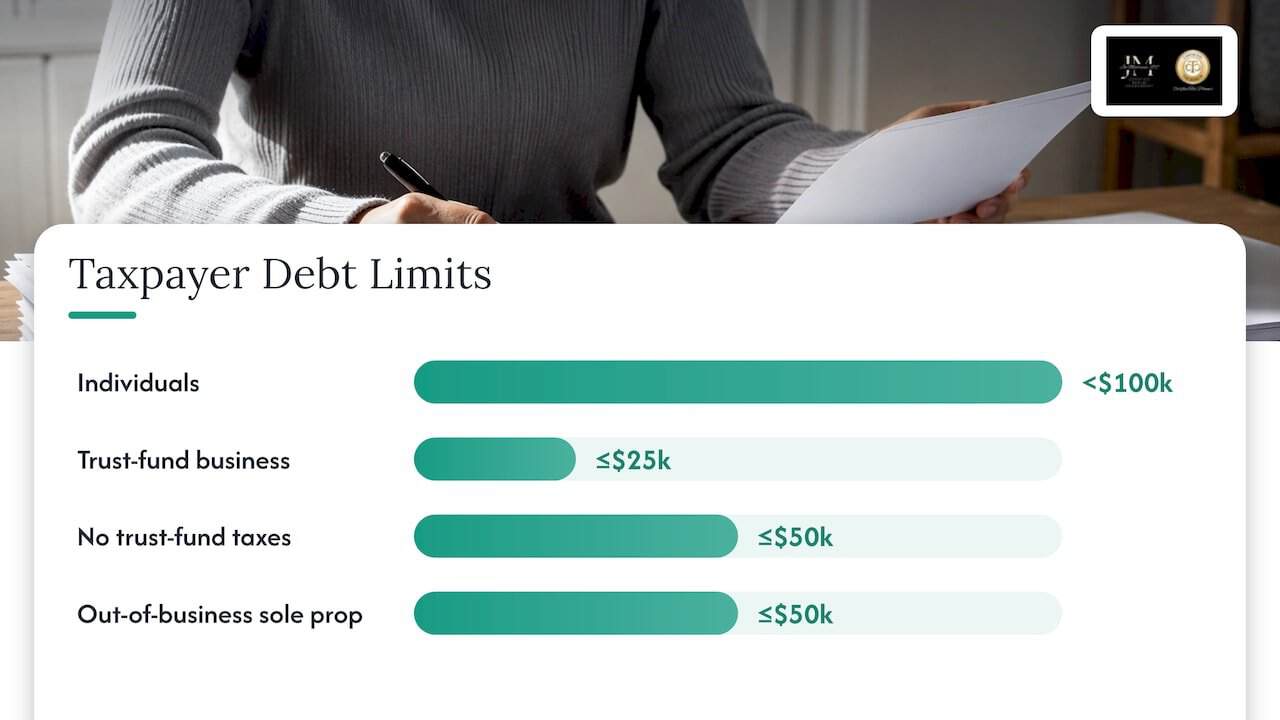
Businesses. The online short-term application is limited to individuals. IRS Topic 201 says business taxpayers must call to arrange a short-term plan. Business applicants for a Simple Payment Plan must also be current with all filing and payment requirements.
For businesses with payroll (trust-fund) taxes, IRS Topic 202 lists generally $25,000 or less in assessed tax, penalties and interest, or $50,000 or less for an out-of-business sole proprietorship. Without trust-fund taxes, the listed threshold is generally $50,000 or less.
| Taxpayer | Typical limit | How to apply |
|---|---|---|
| Individual, sole proprietor, contractor | Under $100,000 owed | Online account or phone |
| Business with trust-fund taxes | Generally $25,000 or less | Phone |
| Business without trust-fund taxes | Generally $50,000 or less | Phone |
One practical point: unfiled returns can block you. If you are behind on filing, the IRS generally expects returns to be filed before it agrees to a payment arrangement. Our delinquent returns service exists for exactly that situation.
Short-term plan vs. an extension to file
This is the mix-up that costs people the most money. A filing extension and a payment plan solve different problems.
- Extension to file (Form 4868): gives you extra time to submit your return. The IRS has long reminded taxpayers that an extension to file is not an extension to pay. Taxes are still due on the original deadline, and interest and penalties run on anything unpaid after that date.
- Short-term payment plan: gives you time to pay a balance you already owe, usually after you have filed or received a notice.
If you filed an extension and cannot pay the estimate, file the return anyway once it is ready, then request a payment plan. Filing on time, even without full payment, avoids the much heavier failure-to-file penalty.
How to request a short-term plan
- Gather your numbers. Know your total balance. If you filed recently, the IRS may ask for the balance due shown on your return.
- Choose your route. Individuals can use the IRS Online Payment Agreement application or call. Businesses should call the number on their notice or the IRS business line, 800-829-4933.
- Prepare identification and banking details. Online applicants need photo identification to create an IRS online account. If you choose direct debit, have your bank routing and account numbers ready.
- Submit and save confirmation. The online application gives immediate notice of whether the plan is approved.
You can also mail Form 9465 with your bill, but Topic 201 shows that form is principally for monthly installment agreements. If you go by mail, the Form 9465 instructions say the IRS will usually respond within 30 days, though requests involving a return filed after March 31 may take longer. Our guide to Form 9465 and IRS payment plans covers how to fill it out.
If you would rather talk to someone before you commit, see our notes on the IRS payment plan phone number and what to have in front of you when you call.
What it costs: fees, interest and penalties
The good news first: the IRS charges no setup fee for a short-term plan, whether you arrange it online, by phone, by mail or in person. Card-payment processing fees may apply if you pay by card.
Now the part people overlook. Interest and applicable penalties continue to accrue until the balance is paid in full. Topic 201 notes that unpaid balances accrue interest compounded daily plus a monthly late-payment penalty.
The failure-to-pay penalty is 0.5% per month or part of a month, up to 25%, and it drops to 0.25% while a payment plan is in effect.

Here is a simple way to think about it. The penalty rate is cut in half once your plan is active, but interest does not stop. Every dollar you pay early shrinks the balance that interest and penalties are calculated on. If you can send part of the balance now and the rest later, do it.
Pro tip: Use the 180 days as a ceiling, not a target. Pay as soon as the funds arrive, and keep your confirmation receipts.
Does the plan protect you from levies and garnishment?
Mostly, with exceptions. The IRS says it generally does not levy while an installment-agreement request is pending or while an approved plan is in effect, subject to exceptions. It also generally allows 30 days after a rejection or proposed termination before levying. Publication 6103 adds that approved payment plans protect your accounts from enforcement action and further collection notices while you remain in good standing.
Two cautions:
- Liens are different. The IRS may still file a Notice of Federal Tax Lien. Topic 201 explains that the lien generally arises after the first demand for payment when the assessed debt is not paid in full.
- Refunds can be taken. Even with an active plan, the Form 9465 instructions warn that refunds may be applied to your balance, and you must stay current on future filing and payments.
If a levy notice has already arrived, do not wait for the plan to be approved. Call us or the IRS right away, because response deadlines in collection notices are short.
What if 180 days is not enough?
Be honest with yourself at the start. If you will not full-pay in six months, you have better tools. IRS Topic 201 lays out the ladder:
| Your situation | Option to consider |
|---|---|
| Can pay in full within 180 days | Short-term payment plan |
| Can pay in full, but need longer | Monthly installment agreement |
| Cannot full-pay even over time | Offer in compromise |
| Genuine financial hardship | Delayed collection (currently not collectible) |
Installment agreements. The IRS says Simple Payment Plans are long-term plans that generally require current filing and payment compliance and may give most taxpayers up to 10 years to pay, though longer repayment increases interest and penalties. Our IRS payment plan options guide helps you choose, and the qualify, apply and save fees article covers costs.
Partial payment installment agreements. The Taxpayer Advocate Service explains that this option may fit a taxpayer who cannot full-pay by the collection-statute expiration date. Affordable monthly payments continue until that date, and the remaining collectible balance may cease to be collected.
Offer in compromise. If you cannot full-pay under an installment agreement, you may apply to settle for less. Read our overview of the IRS offer in compromise and our wider look at tax relief options for IRS debt and penalties.
Currently not collectible. Hardship can lead to delayed collection, but interest and penalties continue during a temporary delay.
The Taxpayer Advocate Service stresses matching the plan to your realistic ability to pay, because default can lead to termination and renewed enforcement. If you have already missed a payment, see our page on installment agreement default help.
Common mistakes to avoid
- Assuming a filing extension covers payment. It does not.
- Ignoring future obligations. A plan changes timing, not the underlying obligation. Estimated payments and next year’s return still count.
- Choosing a plan you cannot finish. A missed deadline can bring back collection notices.
- Applying while returns are unfiled. File first, then arrange payment.
- Overstating your income or understating expenses if you later need hardship status. Accuracy matters on the financial statements.
Perspective: why we steer people toward the plan that fits
We have handled IRS cases for more than 45 years, and the most expensive mistake we see is a good plan chosen for the wrong reason. People grab the 180-day option because it is easy and free to set up, then discover in month five that the money is not coming.
Our approach is to look at your whole picture first: what you owe, which returns are missing, what you can truly pay, and what the IRS can collect from you. Then we choose between a short-term plan, a durable installment agreement, an offer in compromise or hardship status. When a client needs a longer arrangement, we set it up so it is built to hold, not to collapse after one bad month.
You deal directly with a licensed CPA, not a call center. That matters when the right answer is not the easiest form to fill out.
Joe
Get a second set of eyes before you commit
If your balance is small and the money is coming soon, you can handle a short-term plan yourself. If you owe more, have unfiled years, a business with payroll taxes, or a levy notice in hand, a mistake is costly. We review your IRS situation, tell you which route fits and represent you with the IRS if needed. You can book a consultation with Joe or see our full list of tax resolution services.

For a deeper look at what happens after the short-term window, our complete installment agreement guide walks through each step.
FAQ
Is there a fee for a short-term payment plan?
No. The IRS charges no setup fee for a short-term plan, however you arrange it. Interest and penalties still accrue until you pay in full, and card processing fees may apply if you pay by card.
Can I get a short-term plan for a business tax debt?
Businesses cannot apply online and must call. Topic 201 says business taxpayers must call the number on their notice or the IRS business line. You generally need to be current on filing and payments, and balance limits apply.
Does a tax filing extension give me more time to pay?
No. An extension to file only moves your filing deadline. Interest and penalties run on any tax unpaid after the original due date, as the IRS has reminded taxpayers.
Will the IRS garnish my wages during the plan?
Generally not while a request is pending or an approved plan is in effect, subject to exceptions. The IRS also notes that it may still file liens or apply overpayments. Do not assume protection is unconditional.
What if I cannot pay within 180 days?
Ask for a monthly installment agreement, or explore an offer in compromise or hardship status. Act before the 180 days end, so you are not left without an arrangement. A CPA can help you choose.
Sources
- Payment plans; installment agreements | Internal Revenue Service
- Installment Agreements | Taxpayer Advocate Service
- Online payment agreement application | Internal Revenue Service
- Topic no. 201, The collection process | Internal Revenue Service
- Topic no. 202, Tax payment options | Internal Revenue Service
- Simple Payment Plans for individuals and businesses | Internal Revenue Service
- Instructions for Form 9465 | Internal Revenue Service
- If you’ve filed but haven’t paid | Internal Revenue Service
- Publication 6103 | Internal Revenue Service
- Partial Payment Installment Agreement | Taxpayer Advocate Service
- An extension to file is not an extension to pay taxes | Internal Revenue Service