
The difference is timing. Under the cash method, you report income in the year you receive it and deduct expenses in the year you pay them. Under the accrual method, you report income in the year you earn it and deduct expenses in the year you incur them, whether or not money has changed hands. Most individuals and many small businesses use cash. Larger businesses, and some businesses that carry inventory, must use accrual. The method you pick, or are required to use, decides which year a dollar of income lands in, and that decides your tax bill and how closely the IRS looks at your return.
If you are facing an audit, a notice or back returns, the accounting method is often where the problem started. A method that does not match the rules can shift income between years and create a balance due you did not expect. That is what we untangle at Taxproblem.
TL;DR
- Cash method: income counts when you actually or constructively receive it, and expenses count when you pay them (IRS Publication 538).
- Accrual method: income counts when all events fixing your right to it have happened and the amount can be reasonably determined, even if the customer has not paid yet.
- Who must use accrual: C corporations and certain partnerships above the gross receipts limit, tax shelters, and some businesses with inventory. For 2026 the limit is $32 million in average annual gross receipts.
- Changing methods generally requires IRS consent on Form 3115, and the switch usually creates an adjustment that you must report.
- Wrong method, wrong year: if you used a method you were not eligible for, fix it before the IRS does.
Table of Contents
- How each method works
- Who may use the cash method
- Inventory: the rule that surprises owners
- What the method does to your tax bill
- Choosing a method, and what locks it in
- Changing methods: Form 3115 and the 481(a) adjustment
- When the wrong method becomes an IRS problem
- Promo: bring the method question to a CPA
- Perspective
- FAQ
- Sources
How each method works
Both methods are legal ways to measure the same business. They differ only in the moment a transaction “counts.”
The IRS describes the cash method as focusing on the tax year in which you actually or constructively receive income and pay expenses. Constructive receipt means the money is available to you even if you have not picked it up, such as a check waiting in your mailbox. The accrual method focuses on the year income is earned and expenses are incurred (IRS Publication 538, January 2022).
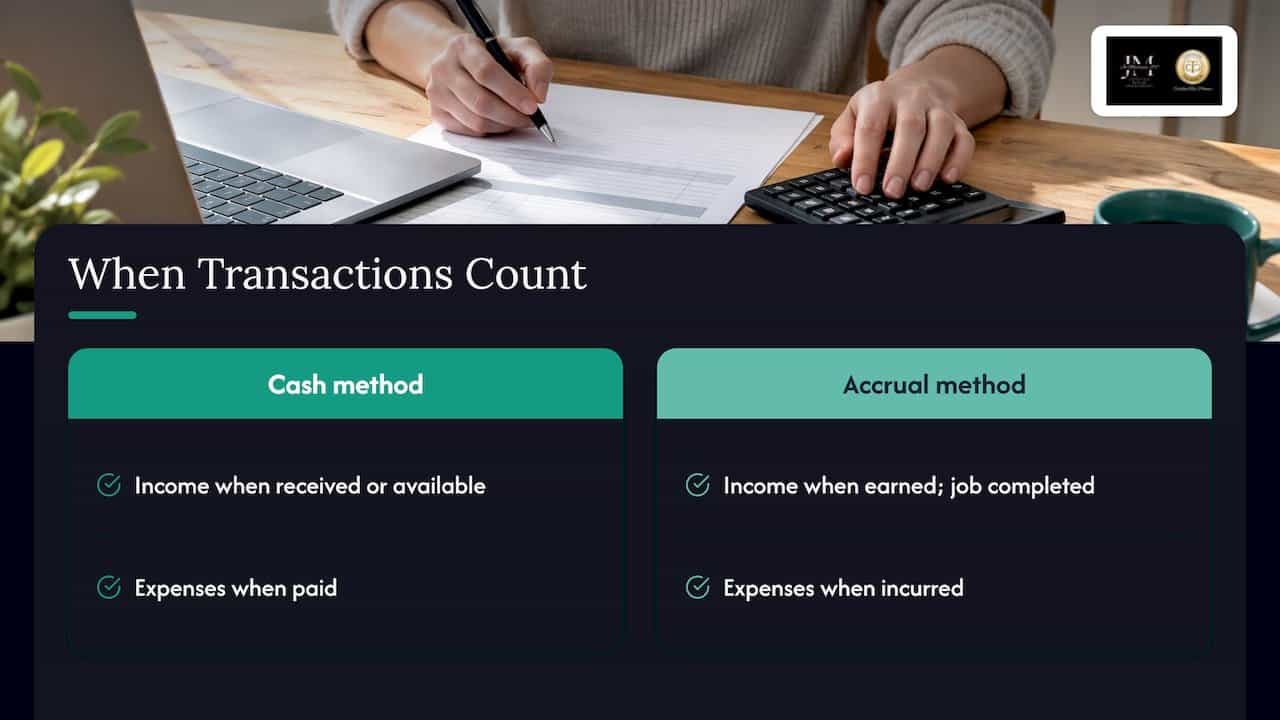
For income, accrual relies on the all-events test. Income belongs in the tax year when all events have occurred that fix your right to receive it and you can determine the amount with reasonable accuracy (IRS Publication 538). In plain terms: you finished the job and know what you are owed.
The same sale, booked both ways
Here is an illustration. A consultant finishes a project on December 20 and sends a $6,000 invoice. The client pays on January 15. The consultant receives a $1,000 vendor bill on December 28 and pays it on January 5.
| Cash method | Accrual method | |
|---|---|---|
| Income in year 1 | $0 | $6,000 |
| Expense in year 1 | $0 | $1,000 |
| Taxable profit, year 1 | $0 | $5,000 |
| Income in year 2 | $6,000 | $0 |
| Expense in year 2 | $1,000 | $0 |
| Taxable profit, year 2 | $5,000 | $0 |
Over two years the totals match. Year by year, they do not. A growing business on accrual pays tax on revenue it has not collected. A business on cash can defer income by timing when it bills and collects. That flexibility is why the IRS limits who may use cash, and why it examines year-end timing closely.
Who may use the cash method
Publication 538 says most individuals and many small businesses use the cash method. The IRS generally does not allow it for corporations other than S corporations, partnerships that have a C corporation as a partner, and tax shelters. Qualifying corporations and partnerships, and qualified personal service corporations, are exceptions (IRS Publication 538).
The key exception is the gross receipts test. A corporation or partnership meets it when its average annual gross receipts for the three prior tax years do not exceed an inflation-adjusted limit. For 2026 that limit is $32,000,000. The IRS adjusts the figure each year in its inflation-adjustment guidance, so check the current year’s number before you rely on it.
A few practical points:
- Sole proprietors, freelancers and single-owner LLCs generally use cash. If that describes you, our guide to income tax filing types for individuals and small businesses shows where your income reports.
- S corporations are not barred from cash the way C corporations are. How your entity is taxed matters, and our comparison of S corp vs. LLC taxes walks through it.
- Related businesses can be combined for the receipts test, so splitting a company into several entities does not automatically keep you under the limit.
Inventory: the rule that surprises owners
If you buy or make goods for sale, inventory can force accrual treatment for purchases and sales. Publication 538 says businesses that do not qualify as small business taxpayers, and for which inventory is an income-producing factor, must generally use accrual for purchases and sales.
The small business exception comes from the Tax Cuts and Jobs Act. Treasury and the IRS issued final regulations that give businesses meeting the inflation-adjusted gross receipts test relief from the inventory and UNICAP requirements (TD 9942). UNICAP is a set of rules requiring certain indirect costs to be added to the cost of inventory instead of deducted right away.
So a retailer or a contractor with materials on hand, under the limit, may use cash and keep inventory rules simple. Over the limit, accrual for purchases and sales is the default.
What the method does to your tax bill
For an owner under pressure, the method matters in three ways.
1. Which year you owe. Under cash, unpaid invoices at year end are not income yet. Under accrual they usually are. A business that switched methods, or one that was always on the wrong method, can carry a tax liability in a year it never saw the cash.
2. Cash flow. Accrual can produce a tax bill before customers pay you. If that gap becomes a balance you cannot cover, an installment agreement is one route. Our guide to IRS business installment requirements explains what the IRS expects from a business.
3. Audit exposure. Inconsistent methods, income recorded in the wrong year and unexplained timing shifts are things examiners look for. See the common mistakes that trigger IRS audits for owners for the patterns that draw attention.
Choosing a method, and what locks it in
You choose your accounting method when you file your first tax return that includes the business. After that, the method generally cannot be changed on a whim. Publication 538 says you must generally get the Commissioner’s consent to change, and you ask for it by filing Form 3115 (IRS Publication 538).
Three questions help you decide where you stand:
- Are you eligible for cash? Check your entity type and your three-year average gross receipts.
- Do you carry inventory? If so, confirm that you meet the small business exception.
- Does your method clearly reflect income? Whatever you use should be applied consistently from year to year and match the books behind your return.
Cash is simpler, and its deferral opportunities are real, but eligibility comes first. If you have been on cash and your receipts crossed the limit, the rule applies to you whether or not anyone has told you.
Changing methods: Form 3115 and the 481(a) adjustment
A change in method creates a timing problem. Income or deductions could be counted twice or skipped entirely when you move from one method to the other. The IRS prevents that with an IRC section 481(a) adjustment, a catch-up amount that keeps anything from being duplicated or omitted (IRS Accounting Method Basics).
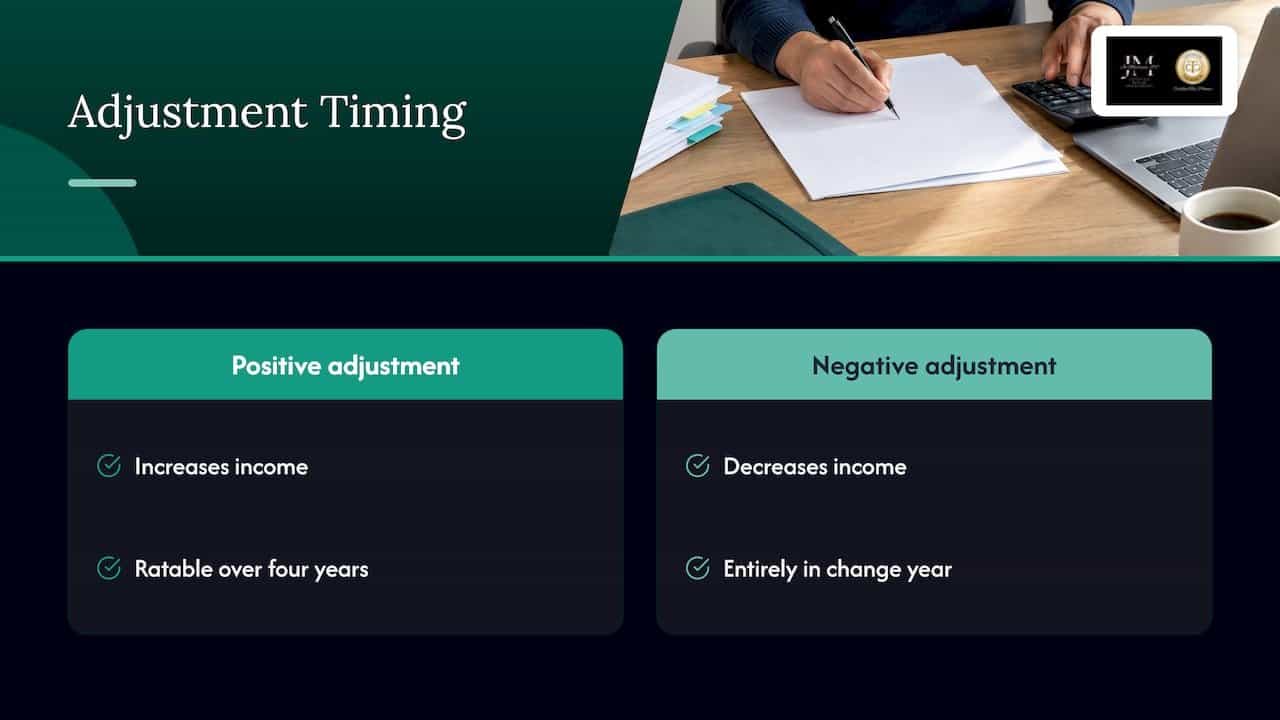
For voluntary changes the taxpayer starts, the same IRS document says a positive adjustment (which increases income) is generally taken into income ratably over four years. A negative adjustment (which decreases income) is taken entirely in the year of the change (IRS Accounting Method Basics).
Many changes qualify for automatic consent, meaning you file Form 3115 under a published procedure instead of waiting for individual approval. The procedures are updated periodically. Revenue Procedure 2025-23 updated the list of automatic procedures, and Revenue Procedure 2026-32 provides updated administrative procedures for automatic consent. Which procedure fits your change, and what deadline and attachments apply, depends on the specifics. Confirm them against the current IRS guidance before you file.
Where changes go wrong
- Switching by just filing differently. Using a new method on your return without Form 3115 is not a method change in the IRS’s eyes.
- Ignoring the adjustment. The catch-up amount belongs on the return, and an omitted positive adjustment becomes an unreported-income issue.
- Mixing methods. Cash for some items and accrual for others, without a basis in the rules, invites an examiner’s questions.
- Missing the receipts limit. Growth pushes the three-year average over the line, and the return still says cash.
When the wrong method becomes an IRS problem
Method errors rarely announce themselves. They show up as a notice proposing additional tax, an audit adjustment that moves income into an earlier year, or a stack of unfiled returns in which nobody settled on a method. Each of these is solvable, but the path differs:
- Under audit, the examiner may propose a change of method and its adjustment. How you document your books and the eligibility facts shapes the outcome. Our pages on audit representation and audit defense explain what representation involves.
- Behind on returns, you need a method decided before the returns are prepared, so every year is consistent. See IRS delinquent returns.
- With a balance owed, the method may explain why the number is higher than your cash position suggested, and your options include payment plans and, where the facts support it, an Offer in Compromise.
Promo: bring the method question to a CPA
Joe Mastriano, CPA, has handled IRS cases for over 45 years, and our services include tax preparation for all IRS filing entities, domestic and foreign, entity choice decisions, tax planning, audit representation and representation before the IRS. If you are unsure which method you are on, whether you qualify for cash, or how to correct a past year, start with a free evaluation of your situation or a consultation with Joe.

See how we work on our services page, or review consultation with Joe.
Perspective
When a client calls about an IRS problem, I ask early which accounting method the returns were prepared on. The answer is often “I don’t know,” and that tells me the preparer chose it for convenience rather than by the rules.
The method is not a minor setting. It decides which year income is taxed, whether an examiner sees a clean return or an adjustment waiting to happen, and whether a change later creates a four-year catch-up amount. A choice made carefully at the start costs little. A choice made carelessly costs a great deal to unwind.
Our approach is personal. You work with a licensed CPA who has spent decades on IRS cases, not a call center. We prepare returns for every filing entity, help with entity choice decisions and tax planning, and represent you before the IRS when a method issue turns into an audit or a balance due. We also correct mistakes made earlier by less qualified preparers.
If you suspect your method is wrong, the time to look is before the notice arrives.
Joe
FAQ
Are taxes on a cash basis?
That depends on who you are. Most individuals report income on the cash method, and many small businesses do as well. A business can use cash if it is eligible, and some, such as C corporations over the gross receipts limit, must use accrual (IRS Publication 538).
Do most businesses use cash or accrual?
Publication 538 says most individuals and many small businesses use the cash method. Larger companies and those that cannot qualify under the gross receipts test use accrual. Your own entity type, receipts and inventory determine the answer for you.
Can I switch from cash to accrual, or the other way?
Generally yes, but you need the IRS’s consent, requested on Form 3115. Many changes fall under automatic consent procedures. The change usually produces a section 481(a) adjustment, spread over four years if it increases income (IRS Accounting Method Basics).
Does inventory force me onto accrual?
Not always. Businesses that meet the small business gross receipts test are generally relieved from the inventory and UNICAP requirements and may use cash (TD 9942). Above the limit, accrual for purchases and sales is generally required when inventory is an income-producing factor.
Sources
- IRS Publication 538, Accounting Periods and Methods
- IRS Rev. Proc. 2025-32, inflation-adjusted items for 2026
- IRS TD 9942, final regulations on inventory and UNICAP relief
- IRS Accounting Method Basics
- Internal Revenue Bulletin 2025-24, Rev. Proc. 2025-23
- IRS Rev. Proc. 2026-32, automatic consent procedures