
An IRS transcript is the IRS’s own record of your account, and you read it in three passes. First, pick the right type: the Account Transcript for balances and penalties, the Return Transcript for what you filed, the Wage and Income Transcript for what third parties reported. Second, read the summary at the top. Third, read the transaction codes line by line, with the date and the amount beside each. If a code points to an audit, a lien, a levy or a missing return, bring in a CPA before you answer the IRS.
I have read thousands of these in over 45 years of handling IRS cases. Most people who call me have already looked at a transcript and could not tell whether it was good news or bad. This guide gives you the method I use.
TL;DR
- Use the Account Transcript to see balances, penalties, interest and payments. Use the Return Transcript to see what you filed. Use the Wage and Income Transcript to see what the IRS received from employers and banks.
- Read the top summary first, then the transactions in date order. Each line has a three-digit transaction code (TC), a description, a date and an amount.
- A negative amount is normally a credit in your favor, and some codes carry no dollar amount at all.
- Codes such as TC 420 (examination indicator), TC 480 (Offer in Compromise pending), TC 530 (currently not collectible) and TC 582 (lien indicator) tell you where your case stands.
- If a transcript shows a collection step, an exam or a gap in filings, get representation before you reply to the IRS.
Table of Contents
- Which transcript should you read?
- Getting the transcript in front of you
- How to read the layout, step by step
- Common transaction codes and what they mean
- What a transcript can tell you about audits, back returns and collections
- A worked example
- Mistakes I see readers make
- Perspective
- When your transcript says it is time to act
- FAQ
- Sources
Which transcript should you read?
The IRS issues six kinds of transcripts through its Transcript Delivery System: Tax Return, Tax Account, Record of Account, Wage and Income, Verification of Non-Filing Letter, and the business entity transcripts. Wage and Income and Non-Filing are for individuals only. The business entity versions are for business accounts only.
Match the question you have to the transcript that answers it:
| Your question | Transcript | What it shows | Years available (per the IRS) |
|---|---|---|---|
| What did I report on my return? | Tax Return | Most line items from the original Form 1040-series return | Current year and three prior years |
| What do I owe, and what happened since filing? | Tax Account | Filing status, taxable income, payments, penalties, interest, balance with accruals | Current year and nine prior years |
| I need both the return and the activity | Record of Account | Return and account transcripts combined | Current year and three prior years |
| What did employers and banks report about me? | Wage and Income | Data from Forms W-2, 1098, 1099 and 5498 | Current year and nine prior years |
| Did the IRS process a return for that year? | Verification of Non-Filing Letter | A statement that no processed return exists as of the request date | Current year after June 15, or any of the prior three years |
The year ranges come from the IRS newsroom page on transcript types. They can change, so confirm on IRS.gov when you request.
Two details trip people up:
- The Return Transcript is a snapshot. It shows the return as originally filed. A standard business return transcript will not show amendments made after the original posted, and the IRS offers the record of account instead when adjustments exist, according to IRS guidance on BMF 94X transcripts. For individuals, the Account Transcript is where changes show up.
- The Non-Filing Letter is narrow. It says the IRS has no processed Form 1040-series return on record as of the request date. It does not say whether you were required to file, per the IRS newsroom page.
The Taxpayer Advocate Service, an independent office inside the IRS, calls the Record of Account the most comprehensive transcript. It adds that if you amend a return on Form 1040X, you should start from the correct figures on that transcript, or you risk processing problems. If you are weighing an amendment, our guides on why amending a return matters and how to amend for the best refund explain the next step. For a side-by-side of the two most used types, see our account versus return transcript checklist.
Getting the transcript in front of you
The fastest route is your IRS online account. Individuals now need an ID.me account to get in, and if you do not have one you create it through Your Online Account at IRS.gov, according to the Taxpayer Advocate Service, February 2026. ID.me is run by a private technology company. Expect to upload identity documents.
Once inside, the account also shows your balance by year, payment history, payment plan details and authorization requests from tax professionals. Keep one timing fact in mind: the balance refreshes once every 24 hours, usually overnight, and check or money order payments can take up to three weeks to appear. A payment missing from your balance may simply not have posted yet.
Transcripts can also be requested by mail or phone, and with Form 4506-T. The step-by-step is in our guide to requesting an IRS transcript. Our overview of transcript types, uses and access covers what each route returns.
Business owners have their own path. A business can view, print or download transcripts in its business tax account, request them by mail with Form 4506-T, or call the IRS business and specialty tax line, per the IRS page on business tax transcripts.
A privacy note: the IRS masks personal identifiers on most transcripts. Business Entity transcripts are the exception and are provided unmasked, with only a sole proprietor’s TIN and a parent entity’s EIN hidden, per IRM 21.2.3.
How to read the layout, step by step
Step 1: Check the header and the tax period
Confirm the tax year, the form number (1040, 941, 1120 and so on) and the last four digits of the identifier. Every year is its own record. A clean 2023 says nothing about 2021, so pull each year in question.
Step 2: Read the summary at the top
On a Record of Account, the top shows any balance due or overpayment and the date through which penalty and interest have been calculated, per the Taxpayer Advocate Service. That date matters. Interest keeps running after it, so the figure is accurate only through that date. If you plan to pay or negotiate, ask for an up-to-date payoff.
On the Account Transcript, the IRS shows adjusted gross income, taxable income, refundable credits allowed, return received date and balance due with accruals.
Step 3: Read the transactions in date order
Each line carries a transaction code, a short description, a date and an amount. Transcripts are built from the IRS’s Integrated Data Retrieval System, an older and complex system that records account activity as codes. The Taxpayer Advocate Service notes that not every internal code appears on public transcripts, and some descriptions explain little. Read each code in context with the lines around it.
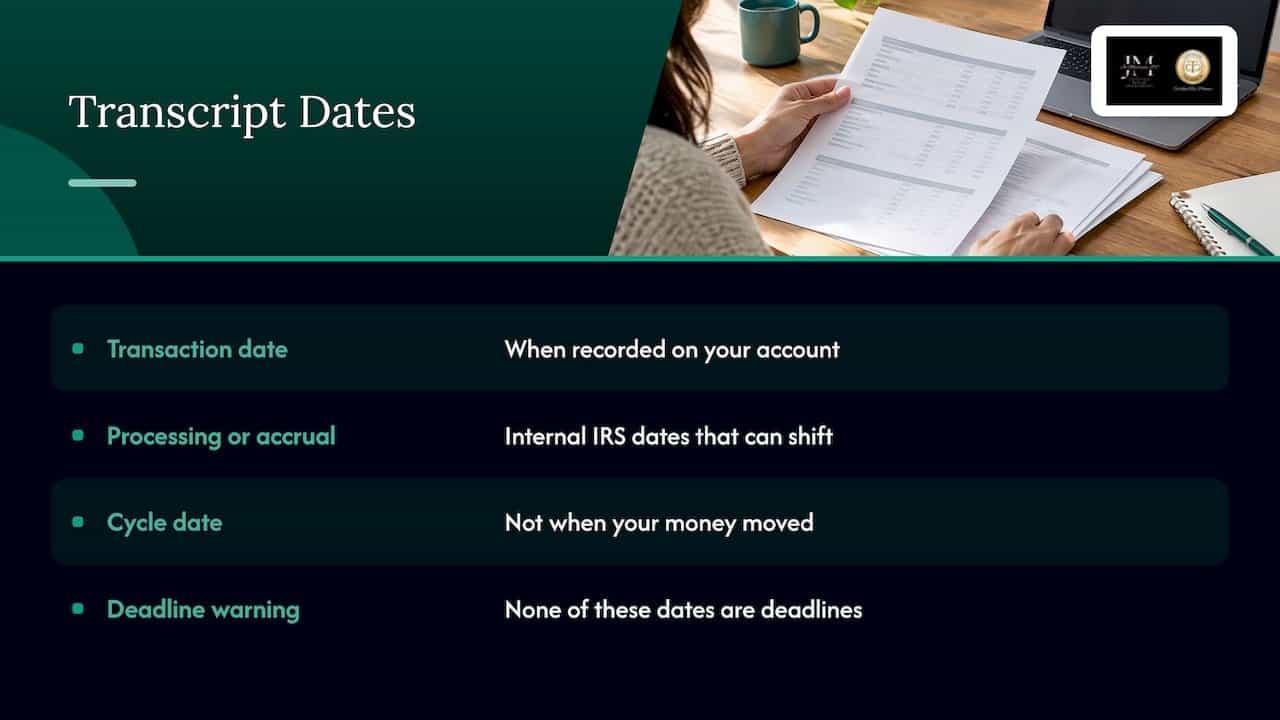
Step 4: Understand the three dates
Many lines show more than one date. The “date” next to a transaction is when it was recorded on your account. Processing and accrual dates are internal IRS dates that can shift. A cycle date is not the date your money moved. Never treat them as deadlines.
Step 5: Watch the signs
A negative amount on an Account Transcript can be an amount in your favor, such as a credit or refund, and some codes are informational only, with no dollar amount, according to the Taxpayer Advocate Service. A line of 0.00 is not an error.
Common transaction codes and what they mean
These are the codes I see most. The meanings come from the Taxpayer Advocate Service’s transcript guide unless noted.
| Code | Name on the transcript | What it tells you |
|---|---|---|
| TC 150 | Tax return filed | The date the return was filed and the tax shown on it |
| TC 196 | Interest assessed | Interest has been added to the account |
| TC 276 | Failure to pay tax penalty | A penalty for paying late |
| TC 291 | Abatement of prior tax assessment | A previously assessed tax was reduced |
| TC 300 | Additional tax or deficiency assessment | Added tax after an exam or collection review |
| TC 420 | Examination indicator | The return is under examination consideration |
| TC 428 | Examination or Appeals case transfer | The case moved between exam and Appeals |
| TC 460 | Extension of time to file | An extension is on record |
| TC 480 | Offer in Compromise pending | An offer is under review |
| TC 494 | Notice of deficiency | The IRS issued a statutory notice of deficiency |
| TC 520 | IRS litigation instituted | A litigation hold or legal proceeding is recorded |
| TC 530 | Account currently not collectible | Collection is on hold for now |
| TC 582 | Lien indicator | A federal tax lien filing is indicated |
| TC 768 | Earned income credit | The credit was allowed |
| TC 806 | Credit for tax withheld | Withholding applied to the year |
| TC 846 | Refund issued | A refund went out, with its date and amount |
The IRS also adds plain-language definitions on the Account Transcript. For instance, TC 610 reads as a payment with return.
Two more are worth knowing when penalties are in play. A late filing penalty appears as TC 166 with its dollar amount. To confirm it was removed, look for TC 167 on the left side of the account transcript, per the Taxpayer Advocate Service, 2022. A refund shows as TC 846.
What a transcript can tell you about audits, back returns and collections
Audit signals
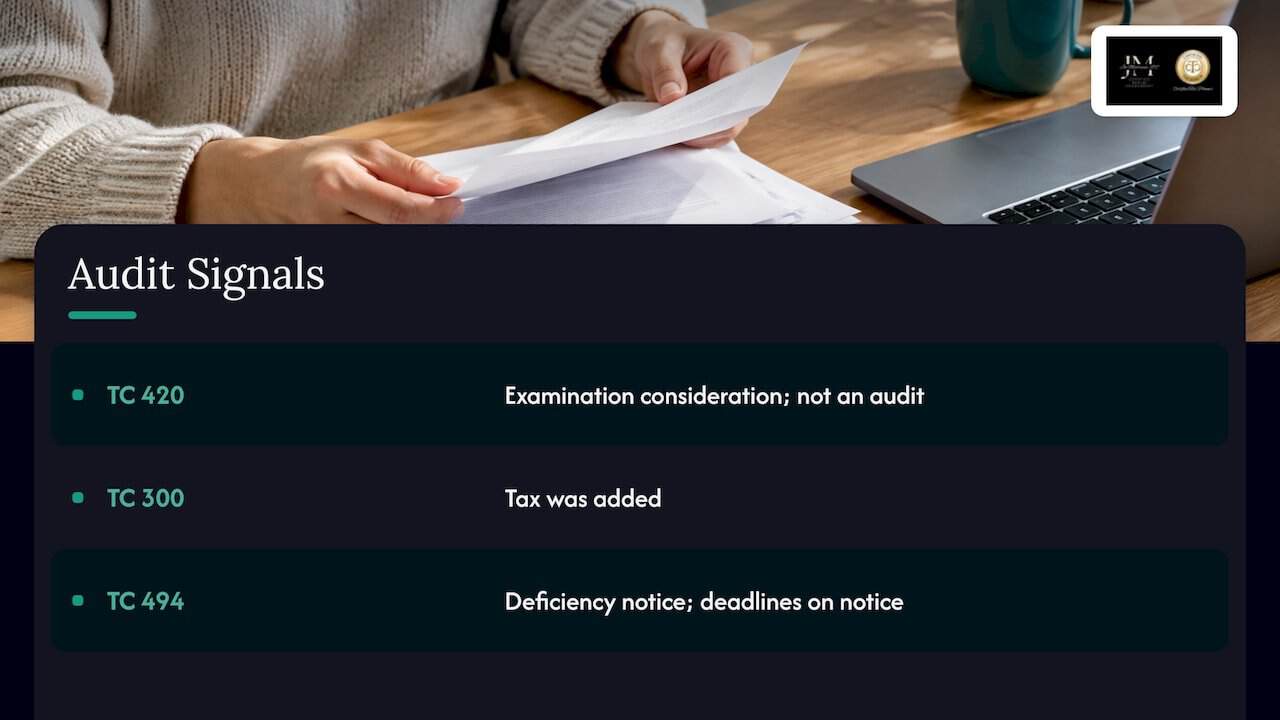
TC 420 means the return is under examination consideration. That is not the same as being audited. The return may or may not end up examined, according to the Taxpayer Advocate Service. Treat it as a reason to prepare. If TC 300 follows, tax was added, and if TC 494 appears, a notice of deficiency has been issued, which has response deadlines printed on the notice itself. Do not let a notice sit. Our guide to reading and answering IRS notices shows what the letters mean, and our pages on what audit representation is and defending your rights in an audit show how a representative takes the exam off your desk.
Missing or late returns
The Wage and Income Transcript lists what third parties reported under your Social Security number, such as W-2s and 1099s. It helps if you lost a document, but it does not reflect state tax withholding, so it will not finish a state return, per the Taxpayer Advocate Service. If a year shows income reported but no TC 150, the IRS has your income and no return. That is how substitute returns and bills get started. Our delinquent return service handles filing the missing years.
Collection steps
A TC 582 means a lien is indicated. TC 530 means collection is paused, and it is not forgiveness. TC 480 shows an Offer in Compromise is pending. TC 276 and TC 196 show penalties and interest growing on an unpaid balance. If you see these, review our IRS tax collection overview and our IRS tax problems guide.
What a transcript cannot do
It cannot tell you why the IRS acted, what it plans to do next, or whether you qualify for relief. The descriptions are literal and, as the Taxpayer Advocate Service says, sometimes do not fully explain the transaction. It is a record, not advice.
A worked example
Suppose your 2022 Account Transcript shows this, in date order:
- TC 150 with a tax amount: the return was filed and the tax assessed.
- TC 806 for withholding: your employer’s withholding was credited.
- TC 276 with a penalty amount: you paid late.
- TC 196 with an interest amount: interest was charged on the unpaid tax.
- TC 582: a lien filing is indicated.
Read it as a story. You filed, you underpaid, penalties and interest piled on, and the IRS filed or intends to file a lien. The balance at the top, with accruals through the stated date, is your starting number. Now the choices are practical: ask whether the penalty qualifies for abatement, set up a payment plan, or look at an offer. The transcript did not give you the answer, but it showed you which questions to ask.
Mistakes I see readers make
- Reading one year. Balances and collection actions span years. Pull all of them.
- Treating TC 420 as a verdict. It is an indicator, not an audit finding.
- Reading a negative as a debt. In most cases a minus sign is a credit.
- Trusting the balance without its date. Interest and penalties continue after the accrual date.
- Assuming a Return Transcript is current. It shows the return as originally filed. Use the Account Transcript or Record of Account for changes.
- Answering the IRS before you understand a code. A wrong reply can make a rule deadline run out or lock in a bad number.
Perspective
A transcript is the one document in your case where the IRS cannot argue with itself. Before I make a call, send a protest or propose a payment, I want the transcript years in front of me, because every negotiation starts from what the IRS says it has on record.
What I tell clients is that the codes are not the problem. The problem is reading them alone, at night, with a notice on the table. A TC 582 or a TC 420 sounds frightening, but each one has a next step, and the right next step depends on the year, the amount and your facts.
That is why I handle each case myself as a CPA. I have represented taxpayers before the IRS for over 45 years, and I deal with you directly. If your transcript shows an exam, back years or a collection action, we can set up the response, whether that is audit representation, filing the missing returns, an installment agreement or an Offer in Compromise.
Joe
When your transcript says it is time to act
If your transcript shows an open exam, unfiled years, a lien indicator or a growing balance, start with a conversation. Our consultation with Joe is where we review your IRS situation and the transcripts behind it. Our services page lists what we handle, including representation before the IRS, audit representation, delinquent returns, installment agreements and Offers in Compromise.

If your transcript shows a pending or planned offer, our pages on the IRS Offer in Compromise and installment agreements explain how each option works.
FAQ
Is an IRS Account Transcript the same as a Return Transcript?
No. The Return Transcript shows most line items from your original return. The Account Transcript shows your filing status, income figures, payments, penalties, interest and balance with accruals. Use the Record of Account if you want both in one document.
What does a negative amount on my transcript mean?
Usually it is a credit in your taxpayer’s favor, such as a payment or refund. Some codes are informational and have no dollar amount at all. Read the code description and the date before drawing a conclusion.
Does TC 420 mean I am being audited?
Not necessarily. TC 420 shows your return is under examination consideration, and it may or may not end up audited. Treat it as a signal to gather your records and review your return.
How far back can I see transcripts?
Per the IRS, Return Transcripts and Records of Account are available for the current and three prior years. Account and Wage and Income Transcripts reach the current and nine prior years. Confirm the ranges on IRS.gov, since they can change.
What do I need to get my transcript online?
An IRS online account, which requires an ID.me account for individuals. If you do not have one, you create it through Your Online Account at IRS.gov. Have identity documents ready.
Sources
- IRM 21.2.3 Transcripts, Internal Revenue Service
- Tax transcripts: know the different types and how to get them, IRS
- Decoding IRS Transcripts, part 2, Taxpayer Advocate Service
- Decoding IRS Transcripts, part 1, Taxpayer Advocate Service
- Understanding tax account transcripts, Taxpayer Advocate Service, 2022
- Create an online account, Taxpayer Advocate Service, 2026
- Get a business tax transcript, IRS
- BMF 94X tax return transcripts, IRS