
If you left 1099 income off your return, or never received the form, the fix is simple in principle: report the income and pay the tax. If you have already filed, that usually means amending with Form 1040-X. The sooner you do it, the less interest and penalty builds up, and the less likely it is that an IRS notice gets there first.
I’m Joe, a CPA who has handled IRS cases for more than 45 years. Missed 1099 income is one of the most common problems I see, and it is almost always fixable when you act early. This guide walks you through what the IRS expects, how to amend, what the penalties really are and what to do if a notice has already arrived.
TL;DR
- Income is taxable whether or not you got a 1099. The IRS says you must report it either way, and the missing form does not change your duty.
- If you already filed, file Form 1040-X, one form per tax year, with the missed forms attached.
- If the IRS writes first, the CP2000 notice is a proposal, not a bill. Answer it by the deadline on the notice.
- Penalties and interest grow every month the tax stays unpaid, so amending early costs less than waiting.
- If you owe more than you can pay, payment plans and other relief exist. Ask for help before a balance turns into a collection action.
Table of Contents
- Why the IRS Knows About 1099 Income You Forgot
- Do You Have to Report Income Without a 1099?
- How to Reconstruct Income When the Form Never Arrived
- If You Already Filed: How to Amend With Form 1040-X
- What Happens If the IRS Finds It First: The CP2000 Notice
- What Missed 1099 Income Can Cost You
- When You Cannot Pay the Added Balance
- Common Mistakes to Avoid
- Our Perspective on Missed 1099 Income
- Get Your Missed Income Corrected Properly
- FAQ
- Sources
Why the IRS Knows About 1099 Income You Forgot
Payers send a copy of every 1099 to the IRS. When your return comes in, the IRS compares it with those third-party forms. If a payment appears in their records but not on your return, the system flags the gap, usually months after you file and sometimes more than a year later.
This is the part that surprises people. You can forget a $400 interest statement and the IRS will not. The matching program does not care that the omission was an honest mistake. It only sees a number that is on their side and not on yours.
The flip side is also true. If you never received a 1099, that does not mean the IRS has no record. The payer may have filed it late, filed it with an old address, or filed under a slightly different name. Your duty to report is the same either way.
Do You Have to Report Income Without a 1099?
Yes. The IRS treats the form as a record of a payment, not as the thing that makes it taxable. Its guidance for a contractor who gets no Form 1099-NEC says to report the payments on Schedule C and to rebuild income and allowable expenses from your own records.
The same logic covers the question about amounts under $600. That figure is a payer filing threshold, not a tax exemption. For payments made before 2026, the Form 1099-NEC threshold is $600, and for payments made in 2026 it is $2,000. Those numbers decide whether a business must send you a form. They do not decide whether you owe tax on what you earned.
For freelance and gig work, the IRS tells taxpayers to use receipts and other records to include payments that no 1099 reported. It also notes that net self-employment earnings of $400 or more generally trigger a filing requirement.
Where each type of missed income goes
| Type of income | Typical form | Where it is reported |
|---|---|---|
| Freelance or contract work | 1099-NEC | Schedule C and Schedule SE |
| Online sales or payment apps | 1099-K | Schedule C, or the schedule that fits the activity |
| Bank interest | 1099-INT | Schedule B, if required, and Form 1040 |
| Dividends | 1099-DIV | Schedule B, if required, and Form 1040 |
| Retirement distributions | 1099-R | Form 1040 |
If you are unsure which payment form applies to your side income, our guide to 1099-K vs 1099-NEC explains who sends which and why.
How to Reconstruct Income When the Form Never Arrived
Before you can report the income, you need the number. Work through these sources in order:
- Bank and card deposits. Match deposits to the client or platform that paid you.
- Invoices and contracts. Your own billing records show what you were owed and paid.
- Payment app history. For 1099-K payments, the IRS says you must report the income even if you did not receive the form, and you should reconcile the gross amount with platform records, including refunds, fees, shipping and discounts.
- Payer contact. Ask the payer for a copy or a corrected form. If you are wrong about the amount, a corrected form can later settle a dispute.
- IRS transcripts. Your online IRS account can show information returns filed under your Social Security number, which helps you see what the IRS already has.
Keep expenses in the same exercise. Reporting gross income without the deductions you are entitled to overstates your tax. Self-employed contractors report both sides on Schedule C, so gather receipts for the same period.
Rental income works the same way. If a property manager collects rent for you, the monthly statement is your starting record. How to read an owner statement shows how to separate rent collected from fees and repairs so the net figure you report is right.
If You Already Filed: How to Amend With Form 1040-X
If the omitted income changes what you reported, the IRS generally directs you to file Form 1040-X after the original return. The exception is when an IRS notice proposes a change you agree with. In that case, you can respond to the notice instead of amending.
Here is the process I follow with clients.
- Gather the missed forms. Get every 1099 or the reconstructed figures.
- Pull your original return. The 1040-X works by comparing three columns: what you filed, the change and the corrected amount.
- Use one form per year. The Form 1040-X instructions call for a separate form for each tax year, and you attach any supporting forms and schedules.
- Recalculate everything the income touches. Added income raises adjusted gross income. That can affect credits, deductions, taxable Social Security and other items tied to AGI, so the change is rarely a single line.
- Explain the change. Use the explanation section to state plainly that you omitted income and list the source.
- Pay what you owe. If the amendment creates a balance, pay as much as you can with it. Interest does not wait for processing.
For a deeper walk-through, see our guide on how to amend tax returns.
How long you have and what to expect
If the amendment would produce a refund, the IRS generally requires the form within three years of filing the original return or two years of paying the tax, whichever is later. Adding income usually creates tax due rather than a refund, but a missed expense or credit discovered along the way can offset some of it.
The IRS says amended returns generally take 8 to 12 weeks to process, and up to 16 weeks in some cases. You can check status after about three weeks. A processing delay is not a reason to hold off paying.
Do not wait for the IRS to tell you
Some people hear that amending invites an audit. Our experience is that the opposite risk is far bigger: the information-matching system will find the gap whether you amend or not. A voluntary correction with the income, the tax and an honest explanation puts you in a much stronger position than a notice answered late.
What Happens If the IRS Finds It First: The CP2000 Notice
When the IRS compares your return with third-party forms and finds a discrepancy, it typically issues a CP2000. The notice is a proposed adjustment, not a bill. It shows the income the IRS has on file, the change it proposes and the tax, penalty and interest that would result.
Your options, according to the IRS:
- You agree. Sign and return the response by the deadline on the notice.
- You disagree. Send a signed explanation and supporting documents.
- The notice is right, but you have other changes. File Form 1040-X and write CP2000 on it.
- You do not respond. The IRS can issue a Statutory Notice of Deficiency.
If the notice is wrong because the payer reported an incorrect amount, the Taxpayer Advocate Service advises you to contact the payer and request a corrected information return. If the payer will not correct it, respond with an explanation and supporting information.
The same page makes a point worth remembering: the discrepancy can raise, lower or leave unchanged your final liability, and interest and possible penalties continue on any increased balance that goes unpaid. Read the notice closely before you sign. Our guides on responding to IRS notices and how to read an IRS notice go through the common types line by line.
Pro tip: Never ignore the response deadline because you are still gathering paperwork. A response that says you disagree and are collecting documents is better than silence. If you need more time, ask for it in writing before the date passes.
What Missed 1099 Income Can Cost You
The tax itself is the base cost. On top of it, three charges can appear.
Failure-to-file and failure-to-pay penalties. The IRS describes 5% of unpaid tax per month for failure to file, capped at 25%, and 0.5% per month for failure to pay, also capped at 25%. When both apply in the same month, the failure-to-file amount is reduced by the failure-to-pay amount, so the combined rate is generally 5% per month, subject to the limits. If you filed on time and only the added income is unpaid, the failure-to-pay penalty is usually the one in play.
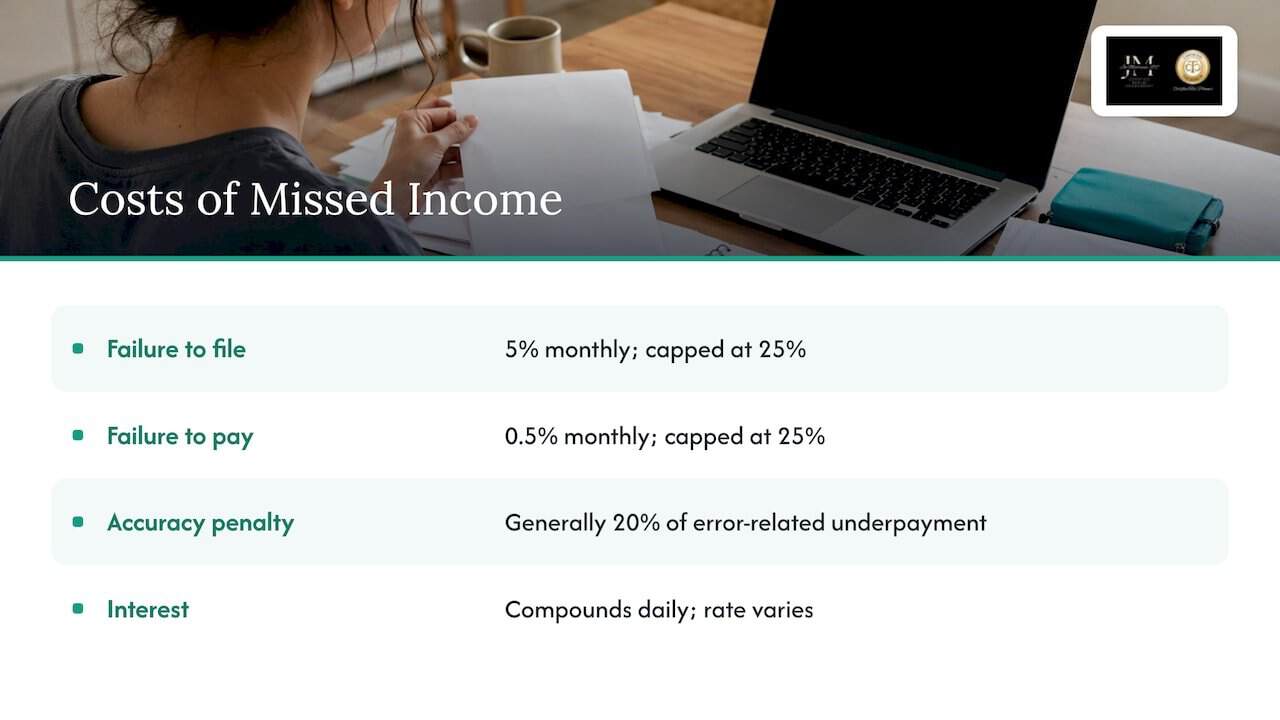
Accuracy-related penalty. The IRS says this penalty can apply to omitted income shown on an information return when it reflects negligence or disregard. For negligence or substantial understatement, it is generally 20% of the underpayment attributable to the error. For individuals, a substantial understatement means at least 10% of the tax required to be shown or $5,000, whichever is greater.
Interest. IRS interest on an unpaid individual balance compounds daily from the return due date, without regard to an extension, until the balance is paid. The standard rate is the federal short-term rate plus 3 percentage points, so it moves over time.
A simple illustration
Suppose a missed freelance payment adds $1,000 of tax to your return. If the IRS asserts the accuracy-related penalty, that alone is up to 20%, or $200. The failure-to-pay penalty adds 0.5% of the unpaid tax each month, which is $5 for each month the $1,000 stays unpaid. Interest builds on top. Those numbers are small on a small error and large on a big one, which is why speed matters most when the income was significant.
The IRS does grant penalty relief in some circumstances, such as reasonable cause. That is a request you make with facts and documents, and it is much easier to make when you came forward early.
When You Cannot Pay the Added Balance
Owing more than you can pay today is not a reason to stay quiet. The IRS notes that if you cannot pay a CP2000 balance, you can apply for a long-term installment agreement, which may carry a user fee. The failure-to-pay rate also changes with your situation: it can rise to 1% per month if the balance remains unpaid 10 days after a final notice of intent to levy, while it is 0.25% per month during an installment agreement in the circumstances the IRS describes.
That difference is the reason to set up a plan before a levy notice, not after. Our guides on IRS installment agreements cover how plans work and what keeps them in good standing. If the total is far beyond what you could ever repay, an Offer in Compromise may be worth evaluating.
If your problem is bigger than one missed form, for example several unfiled years of side income, start with the IRS delinquent returns page.
Common Mistakes to Avoid
- Waiting for the form. The filing deadline does not move because a payer is late.
- Guessing at the number. Use deposits and records, then be ready to show them.
- Reporting income but not expenses. This overstates what you owe.
- Amending without checking the knock-on effects. Higher AGI can change credits and deductions.
- Ignoring a CP2000 because the amount seems wrong. Disagree in writing, with documents, by the deadline.
- Filing a second amended return for the same year without checking the first. Keep copies of everything you send.
For spotting the early signs that a small error is turning into a bigger one, read how to spot tax problem warning signs.
Our Perspective on Missed 1099 Income
After more than 45 years of representing taxpayers, I can tell you that the missed form is rarely the real problem. The real problem is the months of silence that follow. People assume that if no one has called, nothing has happened. Meanwhile, interest is running and the IRS matching system is working through the files.
What I do for clients is straightforward. We rebuild the income from records, make sure the expenses are captured so you do not overpay, and prepare the amended return or the notice response so it is complete the first time. If a balance results, we look at the payment options that fit your situation, including installment agreements, before collection becomes the topic.
I also want you to deal directly with a licensed CPA, not a call center. Large national tax resolution firms often hand files to people who never meet you. When I take your case, I look at it myself, and I will tell you what I think your next step should be.
Joe
Get Your Missed Income Corrected Properly
If you have missed 1099 income, an IRS notice or several years of side income you never reported, we can review your situation and tell you what a clean correction looks like. Our services include tax preparation, amended returns, IRS representation, delinquent return filing and installment agreements. Learn about our tax services or book a consultation with Joe.

Bring any 1099s you have, your filed return and any IRS letters. Even an incomplete file is enough to start. For broader help, visit Taxproblem.
FAQ
What happens if I forgot to report a 1099 on my tax return?
The IRS will likely match the form to your return and may send a CP2000 notice proposing extra tax, interest and possibly a penalty. You can get ahead of it by filing Form 1040-X with the income added. Pay what you owe when you file to stop further interest from building.
Do I have to report income if I did not get a 1099?
Yes. The IRS says income must be reported whether or not a payer sends a form. Use your bank records, invoices and receipts to work out the amount, and report it on the schedule that fits the income, such as Schedule C for self-employment.
Do I have to report 1099 income under $600?
Yes. The $600 figure is a payer filing threshold for Form 1099-NEC on payments made before 2026, and the 2026 threshold is $2,000. Neither number changes your own duty to report taxable income.
Should I amend my return or wait for the IRS to contact me?
In most cases, amend. If you file Form 1040-X yourself, you control the explanation and can start paying right away. If the IRS has already sent a CP2000, respond to the notice by its deadline. If you have other corrections, file the 1040-X and write CP2000 on it.
How long does an amended return take?
The IRS says 8 to 12 weeks is typical and up to 16 weeks is possible. You can check status about three weeks after you file. Keep paying any balance on time while you wait.
Sources
- Form 1099-NEC and Form 1099-MISC income treatment scenarios (IRS)
- Am I required to file a Form 1099 or other information return? (IRS)
- Manage taxes for your gig work (IRS)
- What to do with Form 1099-K (IRS)
- Amended returns and Form 1040-X (IRS)
- Instructions for Form 1040-X (IRS)
- When and how to amend a tax return (IRS)
- Topic no. 652, Notice of underreported income, CP2000 (IRS)
- Underreported Income (Taxpayer Advocate Service)
- Penalties and Interest Provisions (IRS)
- Accuracy-related penalty (IRS)
- Collection Procedural Questions 3 (IRS)