
Letter 5071C is a real IRS identity check, not a bill and not an audit. The IRS has held a tax return filed under your Social Security number or ITIN and will not process it, or release a refund, until you confirm the return is yours. Respond within the time on the letter, use the online tool or the phone number printed on it, and do not send personal details to anyone who contacted you some other way.
This guide walks through what the letter says, how to verify, what to do if you never filed the return, how long refunds can take afterward, and where an IRS summons fits in if you are also hearing from the IRS about other matters.
TL;DR
- Letter 5071C means the IRS flagged a return as possibly fraudulent and is holding it until you authenticate your identity.
- Verify using the instructions on the letter: the online tool first, or the toll-free identity verification number on the letter within 30 days of the letter date.
- If you did not file the return, say so during verification. The IRS removes the fraudulent return from your records. You do not file Form 14039 for this letter.
- Expect a wait: after you verify, the IRS says refunds can take up to 9 weeks, and true identity theft cases can run much longer.
- Protect next year’s return with an Identity Protection PIN (IP PIN).
Table of Contents
- What Letter 5071C actually says
- Is the letter real? Check before you act
- How to verify your identity step by step
- If you did not file the return
- If you did file the return
- How long will the refund take?
- Protect yourself next year with an IP PIN
- What if the IRS sends a summons instead?
- Perspective: how we handle these letters
- When to bring in a CPA
- Work with us
- FAQ
- Sources
What Letter 5071C actually says
The IRS calls it “Potential Identity Theft during Original Processing with Online Option.” According to the Taxpayer Advocate Service, the IRS sends it when it questions whether a return is legitimate. It asks you to authenticate your identity, and the IRS will not process the return or issue a refund until you respond and complete that step.
The notice belongs to the CP5071 series. The IRS explains in its CP5071 series guidance that it sends these notices because a Form 1040 series return was filed under your SSN or ITIN, and it needs you to verify your identity and the return.
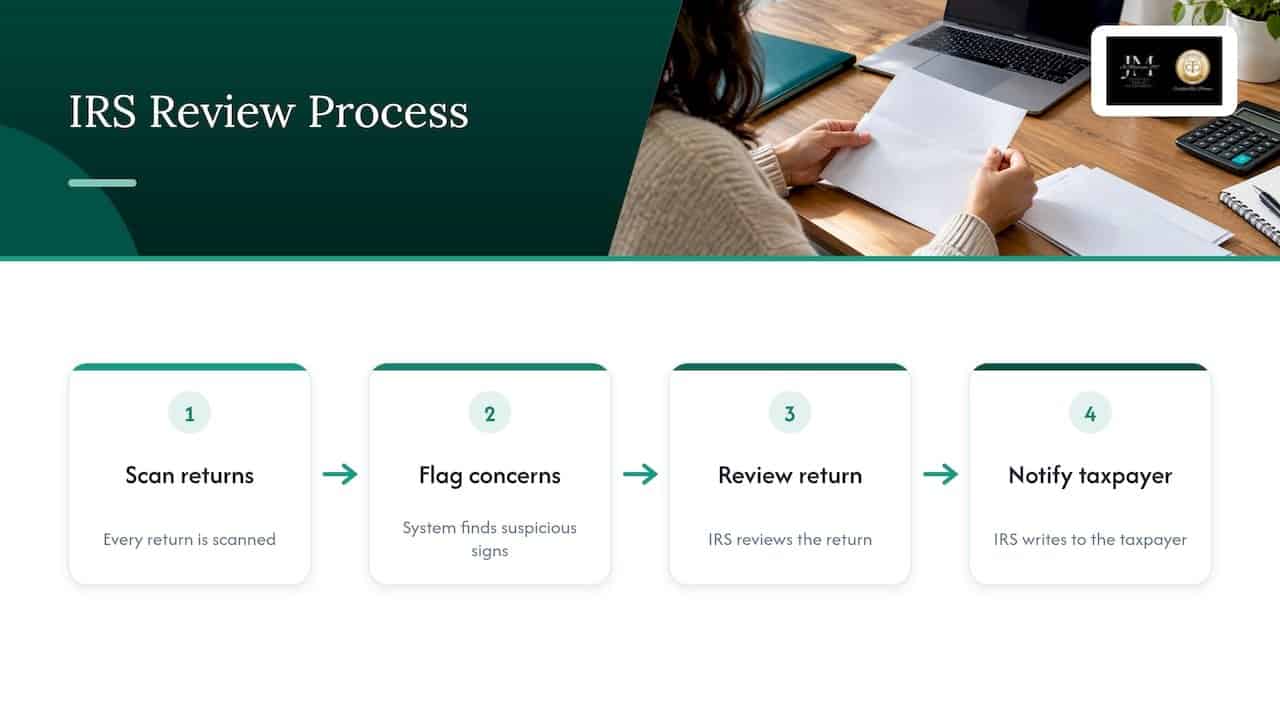
Why you got it is usually mechanical. The IRS scans every return for signs of fraud. When the system finds something suspicious, the IRS reviews it and writes to the taxpayer. Common triggers include a different address than last year, a refund much larger than usual, or income figures that do not match employer reports. A flag does not mean you did anything wrong. It means the system could not be sure the person filing was you.
Related letters you may see
The Taxpayer Advocate Service lists four letters sent when a return is flagged for possible identity theft: 5071C, 4883C, 5447C and 5747C. Which one you get depends on where the return was in processing and whether an online option exists. In limited situations, you may be asked to make an appointment at a Taxpayer Assistance Center to authenticate in person.
Is the letter real? Check before you act
Scammers imitate IRS letters, so confirm before you give out anything. Look for these points:
- The letter carries the notice number 5071C (or CP5071 series) and a date.
- It refers to a specific tax return you recognize, or one you did not file.
- It directs you to the IRS’s own identity verification tools and an IRS toll-free number.
- It does not demand payment by gift card, wire or cryptocurrency.
If anything seems off, do not use a link or number from an email or text. Go to IRS.gov directly and sign in to your online account, or call the number on the official letter. The Taxpayer Advocate Service notes that the identity verification number on the letter is for verification only. No refund status or other tax information is available through it.
How to verify your identity step by step
Online
The letter names the online tool and gives you a case-specific code. You will need the letter, a copy of last year’s return if you filed one, and the return in question if you have it. Have your SSN or ITIN, a phone, and a photo ID ready, because the IRS identity verification process asks for them.

By phone
If you choose phone verification, the Taxpayer Advocate Service says to call the toll-free IRS Identity Verification number in the CP 5071 notice within 30 days of the letter date. Have the letter in hand, because the representative will ask questions tied to the return.
A second number comes up in many searches. The IRS Taxpayer Protection Program line is 800-830-5084 for callers in the U.S. and 267-941-1000 for callers outside the U.S. Use the number printed on your own letter first. The Taxpayer Protection Program line is the fallback if the letter’s instructions do not work.
In person
If you cannot verify with a representative, the IRS says you may be asked to visit a Taxpayer Assistance Center. Appointments are required, so follow the instructions you are given and bring the letter and valid photo ID.
Pro tip: Keep a folder with the letter, the date and time of each call, and the representative’s ID number. If the case drags on, that record is what a Taxpayer Advocate or a tax professional will ask for first.
If you did not file the return
This is the branch many people fear, but the IRS process is clear. Per the IRS page on how ID theft victim assistance works, if you did not file the return, tell the IRS through the online tool or by calling the number on the letter. The IRS then removes the fraudulent return from your records. If you have not yet filed your own return for that year, the IRS may recommend filing on paper.
Two points trip people up:
- Do not file Form 14039 for Letter 5071C, 4883C or 5747C. The IRS says following the letter’s verification steps is enough.
- Do not ignore the letter because you assume it is a scam or because you did not file. The IRS will keep the return in limbo until you respond, and any real return you file may be delayed.
Whichever branch applies, some taxpayers also look into tax resolution services in San Diego when the identity problem sits on top of other filing or balance issues.
Once the case is resolved, the IRS issues you an IP PIN automatically, and you must use it on all future filings. Our own page on how tax identity theft disrupts IRS filings covers the wider fallout, such as mismatched income records and delayed returns.
If you did file the return
If the return is yours, you confirm that during verification and the IRS releases it for processing. Verification does not mean the return is approved as filed. Normal processing and any other reviews still apply. Once you have verified, the IRS says it may take up to 9 weeks to receive your refund or have the overpayment applied to next year’s estimated tax.
If the return shows a balance due, verification still has to happen first. Then the normal notices follow. Our pages on CP14 and CP501 notices explain what the balance-due sequence looks like.
How long will the refund take?
The honest answer depends on which path you are on.
| Situation | What the IRS and Taxpayer Advocate say |
|---|---|
| You verified that the return is yours | Up to 9 weeks for the refund or the credit to next year’s estimated tax |
| Confirmed identity theft case (you did not file) | The IRS says cases are supposed to be resolved within 120 days, but the average is now 580 days |
| Earlier backlog snapshot | The National Taxpayer Advocate reported that IDTVA processing time had reached 675 days as of April 2024 |
That 9-week window starts only after successful verification, so the fastest thing you control is responding promptly and accurately. Slow cases are usually the ones where the taxpayer did not file and an identity theft case must be worked by IRS specialists.
If your hardship is real, for example you cannot pay rent or medical bills while the refund is frozen, ask the Taxpayer Advocate Service for help. It is an independent office inside the IRS, and it can step in when a case is stuck or causing financial harm.
Protect yourself next year with an IP PIN
An IP PIN is a six-digit number known only to you and the IRS. The IRS explains that it helps verify your identity when you file a federal return. Anyone with an SSN or ITIN can request one for free, including taxpayers abroad, after verifying their identity. A new PIN is issued every year, and it must appear on all federal returns filed that year.
How to get one:
- Fastest: sign in to your IRS Individual Account and choose the IP PIN option under your profile.
- If you cannot verify online: you may apply with Form 15227 if your adjusted gross income is below $84,000 (individual) or $168,000 (married filing jointly), according to the same IRS announcement.
- Opting in voluntarily is allowed for anyone who can verify their identity, as the Taxpayer Advocate Service explains.
Because a new PIN is issued each year, keep your records tidy and do not share it with anyone except your tax preparer, and only through a secure channel.
What if the IRS sends a summons instead?
People researching Letter 5071C often land on summons questions too, so here is the distinction. Letter 5071C asks you to prove who you are. A summons is a legal demand, which IRS Publication 594 describes as compelling you or a third party to meet with an IRS officer and provide information, documents or testimony.
Key points from that publication:
- If you cannot make the appointment, call the number on the notice right away.
- If you do not call and do not attend, the IRS may sue in federal district court to require compliance.
- You have the right to petition to quash a third-party summons before the end of the 20th day after notice is given.
- A court may quash a summons if the resisting party disproves any of the four Powell factors, or successfully challenges it on grounds such as excessive burden, overbreadth or violation of a substantial countervailing policy.
The Justice Department’s Summons Enforcement Manual adds that a summons is not self-enforcing. If you do not comply, the government must go to court. That is no reason to ignore one. The 20-day window for third-party summonses is short, so take a summons to a licensed tax professional the day it arrives.
Perspective: how we handle these letters
In my practice I see two kinds of people with a 5071C. The first set aside the letter because it looks like a scam, and the refund sits for months. The second panic, call the first number they find online, and hand details to the wrong person. Both are avoidable.
My advice is simple. Confirm the letter is real, use the instructions printed on it, and write down every step. Verification pauses your return, it does not delete it, and a prompt response is the best lever you have.
Where it gets harder is when the identity issue lands on top of other IRS problems: unfiled prior-year returns, a balance that has already moved to a collection notice, or income mismatches. That is where a CPA who has spent decades on IRS cases earns the fee. As a licensed CPA, I can deal with the IRS on your behalf, review what the IRS has on file, and make sure a fix in one area does not create a problem in another.
Joe
When to bring in a CPA
Most people can complete Letter 5071C verification on their own. A professional becomes worth it in these cases:
- You have unfiled returns. An identity flag can expose gaps in your filing history. Our IRS delinquent returns service is built for getting current.
- You also have an IRS balance. A held refund can mean offsets or collection notices. See our guide to the CP504 notice if one has arrived.
- Your income does not match what employers reported. The next letter may be a CP2000 proposing changes.
- The case has dragged on. If you have verified and waited far past the stated timelines, representation can help move it.
Work with us
Taxpayer identity problems rarely arrive alone. If a 5071C is sitting next to unfiled returns, a balance due or a notice you do not understand, we can review your whole IRS situation and lay out the options. We handle representation before the IRS, delinquent returns, installment agreements and more. You can see the full list on our services page. Fees are covered on our consultation page, where you can set up a consultation with Joe.

If you want the whole picture before you decide, our tax relief process guide explains how IRS cases usually move from notice to resolution.
FAQ
Is Letter 5071C a scam?
The notice itself is a genuine IRS letter, though scammers do copy it. Check that the instructions point to IRS tools and an IRS toll-free number, and that no one demands payment by gift card or wire. If in doubt, sign in to your IRS online account or find the number on IRS.gov rather than using contact details from an email or text.
How long do I have to respond to Letter 5071C?
For phone verification, the Taxpayer Advocate Service says to call the toll-free number in the CP 5071 notice within 30 days of the letter date. Check your own letter for the exact timeframe and respond as early as you can, because the IRS holds the return and any refund until you do.
What is the phone number for Letter 5071C?
Use the toll-free Identity Verification number printed on your letter. The IRS Taxpayer Protection Program line is 800-830-5084 inside the U.S. and 267-941-1000 from abroad. Neither line is for refund status questions.
Do I need to file Form 14039 after getting Letter 5071C?
No. The IRS says taxpayers who receive Letter 5071C, 4883C or 5747C should follow the letter’s verification steps and do not need Form 14039. If you did not file the return, say so during verification and the IRS will remove it from your records.
Can I quash an IRS summons?
Sometimes. A taxpayer may petition to quash a third-party summons before the end of the 20th day after notice is given, and a court may quash a summons on certain grounds. Because the deadline is short, talk to a tax professional as soon as the summons arrives.
Sources
- Identity Verification and Your Tax Return, Taxpayer Advocate Service
- Understanding your CP5071 series notice, IRS
- The IRS alerts taxpayers of suspected identity theft by letter, IRS Newsroom
- Letter 5071C, Taxpayer Advocate Service
- How IRS ID theft victim assistance works, IRS
- Identity Theft Victims Are Waiting Nearly Two Years to Receive Their Tax Refunds, NTA Blog
- Identity Protection PINs help taxpayers guard against tax-related identity theft, IRS Newsroom
- How to handle a notification of tax-related identity theft, Taxpayer Advocate Service
- Publication 594, IRS
- Summons Enforcement Manual, Department of Justice