
For tax year 2026, third-party platforms like marketplaces and payment apps generally issue Form 1099-K only when your payments exceed $20,000 and you complete more than 200 transactions. Payment card processors still report every card transaction regardless of amount. Either way, you must reconcile your records now and report all taxable income, even if no form ever arrives.
TL;DR:
- Third party settlement organizations test the $20,000 payment minimum and more than 200 transactions separately for each platform; both conditions must be met.
- Some states, including Illinois, Maryland, Massachusetts, Vermont, Virginia, and Washington, D.C., have historically set lower thresholds, so check local rules.
- Box 1a reports gross payments rather than taxable income; reconcile refunds, processing fees, shipping charges, and personal reimbursements against transaction level records.
- An incorrect taxpayer identification number can trigger backup withholding, so verify that your legal name and number match each platform’s records before payments are processed.
- Platforms must furnish recipients a Form 1099 K copy by January 31, and businesses filing electronically should prepare for the shift from FIRE to IRIS.
Table of Contents
- What is Form 1099-K and who receives one in 2026?
- What changed for 2026: the legislative reversal and IRS updates
- How the threshold works in practice: aggregation, exceptions, and state differences
- Practical steps: bookkeeping, reconciling platform reports, and correcting errors
- Form 1099-K box-by-box essentials and filing notes for 2026
- CPA-led examples and audit-ready documentation
- Why this threshold change still demands your attention
- How we help you get ahead of 1099-K reporting issues
- FAQ
- Sources
What is Form 1099-K and who receives one in 2026?
Form 1099-K reports payments you received for goods or services, and two different types of filers send it. Payment card processors, the companies that handle debit and credit card transactions, must report card payments no matter how small the dollar amount or how few transactions occurred. Third-party settlement organizations (TPSOs), sometimes called payment settlement entities (PSEs), only file when you cross the $20,000 and 200-transaction mark for tax year 2026, according to the IRS.
If you sell on a marketplace, accept payments through a mobile app, or process cards through a merchant acquirer, you’re a “participating payee,” and the platform settling your funds is responsible for filing. Common scenarios include:
- Online marketplace sellers who ship physical goods to buyers nationwide.
- Gig workers paid through apps for rides, deliveries, or freelance tasks.
- Small businesses that accept card payments through a point-of-sale processor.
- Sellers on resale or auction platforms who exceed the reporting threshold.
Some states set lower thresholds than the federal rule, so a platform may still send you a form even if you fall under the $20,000 mark federally.
What changed for 2026: the legislative reversal and IRS updates
The One Big Beautiful Bill reset the federal 1099-K threshold back to $20,000 and more than 200 transactions, reversing a planned phase-down that would have dropped reporting to just $600. This reinstated threshold applies to payments made after December 31, 2025, which means tax year 2026 is the first full year under the restored rule, as confirmed in the IRS’s FAQ release.
Beyond the threshold itself, Pub. 1099 documents several form and system changes that matter for filers:
- New Box 1c for cash tips and Box 1d for Treasury Tipped Occupation Code (TTOC) reporting.
- Reformatted address fields on the form itself.
- The IRS is moving transmitter submissions from the FIRE system to IRIS, with FIRE set for retirement.
Backup withholding rules tied to Form 1099-K were also updated, so platforms that lack a correct taxpayer identification number on file may need to withhold a portion of your payments.
How the threshold works in practice: aggregation, exceptions, and state differences
Aggregation happens per platform, not across your entire financial life. If you sell on two different marketplaces, each one measures your activity against the $20,000 and 200-transaction test independently rather than combining your totals.
Two short examples show how this plays out:
- A seller with 250 transactions totaling $8,000 does not trigger reporting, since the dollar threshold isn’t met even though the transaction count is high.
- A seller with 15 transactions totaling $45,000 also does not trigger reporting from that platform, since the transaction count falls short of 200, even though the dollar amount is high.
Both tests have to be met for a TPSO to be required to file. That said, personal payments, like a friend reimbursing you for dinner, should never be coded as goods or services in the first place, so they shouldn’t appear on a 1099-K at all. If they do, the IRS notes you should document and separate those amounts rather than ignore the form.
State rules add another layer. Illinois, Maryland, Massachusetts, Vermont, Virginia, and Washington, D.C. have historically required reporting at lower thresholds, so check your state’s specific rule if you operate in one of these jurisdictions, since a platform may report there even when the federal threshold isn’t met.
Practical steps: bookkeeping, reconciling platform reports, and correcting errors
Clean, contemporaneous records are what stand between you and a confusing IRS notice. Keep these items organized year-round:
- Monthly merchant or platform statements showing gross payments received.
- A running refund log tied to each transaction or order number.
- Fee detail showing platform commissions and processing charges.
- Shipping cost records when you’re a seller who ships goods.
- Clear tags separating personal reimbursements or gifts from business sales.
When you reconcile the amount in Box 1a, remember it reflects gross payments, not your taxable income, so consider options for managing cash flow and business loan interest deductions when planning your small business taxes. You subtract refunds, shipping charges you collected and passed through, and processing fees to arrive at your actual business income, a point the IRS emphasizes for anyone preparing a return from platform data.
If a 1099-K contains an error, contact the platform directly, request a corrected form in writing, and keep a copy of that request along with any confirmation you receive. That paper trail becomes valuable if the IRS later asks why your return doesn’t match the original form.
Pro Tip: Confirm your legal name and taxpayer identification number match exactly what’s on file with every platform you use; a mismatch is one of the most common triggers for backup withholding.
Form 1099-K box-by-box essentials and filing notes for 2026
Understanding each box helps you spot overstatements before they become a problem on your return. Box 1a shows gross payments for goods and services, a figure that often overstates your actual taxable income because it includes refunds and fees you haven’t yet subtracted. Box 1b separates out card-not-present transactions, useful for sellers who process payments without a physical card swipe. Box 1c captures cash tips, and Box 1d reflects the new Treasury Tipped Occupation Code, both additions for the 2026 form year.
A few filing notes worth tracking:
- Payers must furnish your copy of Form 1099-K by January 31 following the tax year.
- Transmitters filing electronically are shifting from the FIRE system to IRIS, so businesses that file their own forms should plan ahead for the transition.
- If you receive payments through multiple PSEs, each one carries independent filing responsibility, and penalties can apply to a platform that fails to file correctly or on time.
You can find the current form and instructions on the IRS forms page when you need to reference box definitions directly.
CPA-led examples and audit-ready documentation
A clean journal entry separates gross platform revenue from the deductions that get you to taxable income. For example, you’d record total sales as revenue, then post refunds and shipping reimbursements as separate contra accounts rather than netting everything into one number. This keeps your books defensible if a platform’s 1099-K doesn’t match your general ledger.
When the IRS asks questions, the strongest response packet ties the platform’s reported gross directly to your internal records: start with the 1099-K total, then show the line-item offsets for refunds, fees, and non-taxable reimbursements. Our tax compliance checklist walks through building that kind of packet before you ever need it.
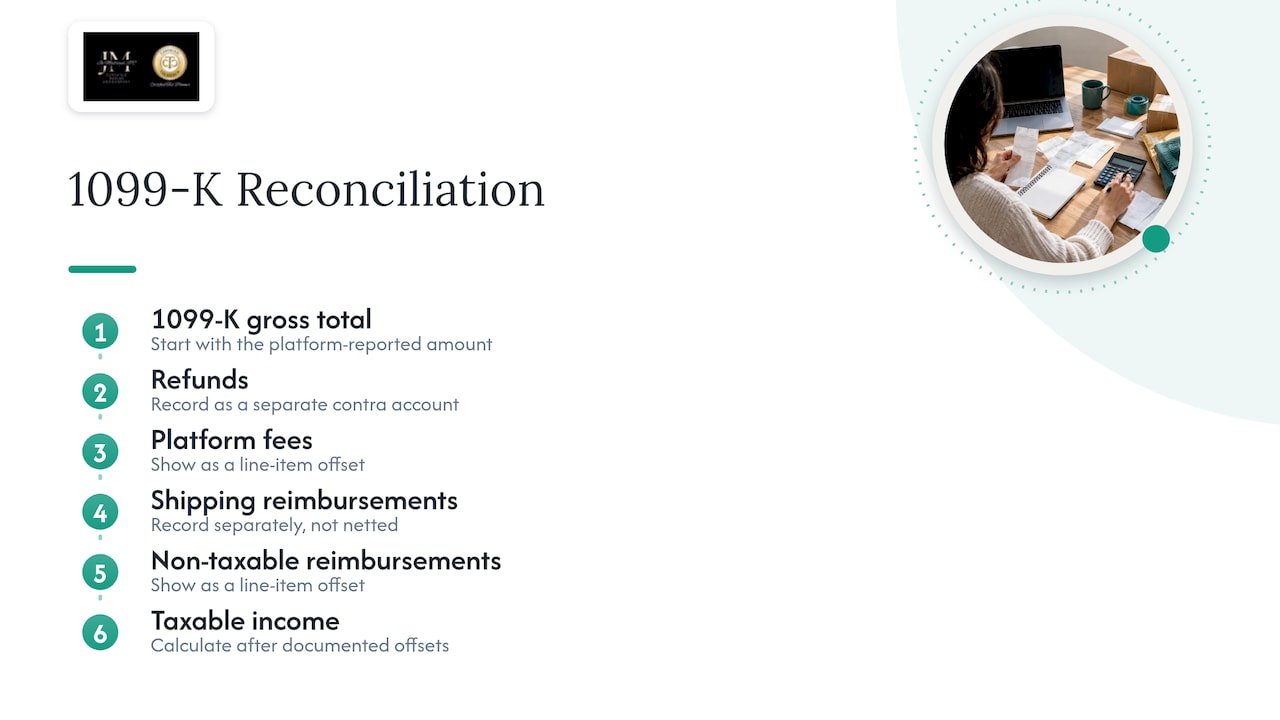
Engage a qualified tax professional when you receive an audit notice, face backup withholding you can’t explain, or see a discrepancy between platform totals and your records that you can’t reconcile on your own.
Why this threshold change still demands your attention
We’ve watched the 1099-K threshold swing back and forth for years, and the pattern is always the same: taxpayers assume a higher threshold means less responsibility. It doesn’t. The $20,000 and 200-transaction mark only changes who automatically gets a form in the mail. Your obligation to report every dollar of taxable income never moves, form or no form.
What separates a calm filing season from a stressful one is whether you reconciled your platform reports as the year went along, not in a scramble each April. Proactive bookkeeping and prompt correction requests save far more stress than they cost in time.
How we help you get ahead of 1099-K reporting issues
Reconciling platform reports, spotting an erroneous 1099-K, or responding to an IRS notice that doesn’t match your return takes more than a quick internet search, and that’s where we come in. With decades of experience representing taxpayers before the IRS, we help you build the kind of documentation that holds up under scrutiny.

Our services relevant to 1099-K situations include:
- Audit representation when discrepancies between platform totals and your return draw IRS attention.
- Reconciling platform reports against your internal books so your filed return reflects accurate taxable income.
- Responding to IRS letters and notices tied to mismatched 1099-K amounts.
- Setting up accurate, audit-ready bookkeeping systems for ongoing platform settlements.
If you’re unsure whether a 1099-K you received is accurate or how to report it, schedule a consultation with Joe to get a clear plan before a small discrepancy becomes a bigger problem.
This article is general information, not a substitute for advice from a qualified financial advisor. Consult a qualified financial professional about your own circumstances before acting on anything here.
FAQ
What are the tax changes for 2026?
The main change is the 1099-K threshold reverting to $20,000 and more than 200 transactions for third-party platforms, reversing the lower threshold that had been scheduled to take effect, according to the IRS. The form itself also added new boxes for cash tips and tipped occupation codes, and transmitters are shifting from the FIRE system to IRIS.
Do I have to report eBay sales under $20,000?
Yes. Even if your sales fall under the threshold and you don’t receive a 1099-K, the IRS still expects you to report taxable income from those sales on your return. Absence of a form is not a reason to skip reporting income you actually earned.
What is a 1099-K?
Form 1099-K reports payments you received for goods or services through payment cards or third-party settlement organizations. Payment card processors report regardless of dollar amount, while TPSOs report only once you exceed the federal threshold, as explained by the IRS.
What is the minimum amount to report on a 1099 form in 2026?
For TPSO-issued 1099-Ks, the federal minimum is $20,000 in gross payments combined with more than 200 transactions. Some states set lower thresholds, so a platform may still issue a form if you meet your state’s separate requirement even when you fall under the federal mark.