
If you received an IRS correspondence audit notice, the single most important action is to mail or upload a written response by the deadline on the notice: a one-page cover letter naming the notice number, tax year, and your taxpayer ID, stating clearly whether you agree or disagree, paired with an indexed packet of copies mapped to each challenged item and proof of delivery.
TL;DR:
- Respond promptly by mailing or uploading a clear, organized response with a cover letter, index, and supporting documents that directly address the challenged items.
- Calendar your response deadline from the notice date, using proof of delivery to avoid automatic processing without review.
- Match each document exactly to the specific issue raised, ensuring readability and proper annotation to facilitate quick review.
- Use the official response channels, such as the IRS Document Upload Tool or tracked mail, and keep proof of delivery in case of future disputes.
- Engage a professional if the audit involves significant amounts, complex records, or if deadlines have been missed to improve the chances of a favorable resolution.
Table of Contents
- What a Correspondence Audit Is and Why You Got This Notice
- How to Read the Notice and Calendar Your Deadline
- Gathering Documentation for Common Challenged Items
- Building the Response Packet: Cover Letter, Index, and Item Replies
- Common Mistakes That Escalate Correspondence Audits
- What Happens After You Submit Your Response
- When to Hire Help and How Representation Works
- Penalties, Interest, and Relief Options
- CP2000, Letter 566, and When to File an Amended Return
- Practitioner Perspective: What Makes a Response Stick
- How We Can Help With Your Audit Response
- FAQ
- Sources
What a Correspondence Audit Is and Why You Got This Notice
A correspondence audit is an IRS review conducted entirely by mail, without an in-person meeting or a single assigned examiner walking you through the process. The most common version is the CP2000 notice, which proposes an adjustment based on third-party information like a W-2 or 1099 that does not match what you reported. You may also see a Letter 566 series notice, which asks you to substantiate specific line items such as wages, withholding, or a refundable credit claim.
Most of these notices trace back to one of a few causes:
- A mismatch between your return and an information return filed by an employer, bank, or brokerage
- A math or calculation error the IRS system flagged automatically
- A refundable credit claim, such as the Earned Income Tax Credit, selected for verification
The CP2000 notice in particular is generated by an automated matching process that compares third-party data to your filed return, rather than by a human examiner reading your file line by line. That matters for how you respond: the system that flagged you is looking for a clean match between your documents and the specific items it questioned.
How to Read the Notice and Calendar Your Deadline
Before you gather a single document, read the notice itself carefully. Every correspondence audit letter contains a handful of fields that determine everything about your next steps.
- Find the notice number, usually in the top right corner (CP2000, Letter 566, or similar)
- Confirm the tax year under review and check that your Social Security number or ITIN on the page is correct
- Locate the response deadline and the exact instructions for returning your answer, including any response form
- Note every submission channel listed: mailing address, fax number, or Document Upload Tool link
- Make a clean photocopy of the entire notice before you write on or alter the original
Once you have those fields, take three immediate actions as outlined in this IRS audit letter checklist. Calendar the deadline using the date printed on the notice itself, not the day you happened to open the envelope. The Taxpayer Advocate Service has noted that IRS deadlines run from the notice date, and missing that window can let automated processing move forward without anyone reviewing your side of the story. Set at least two reminders ahead of that date, and keep an unaltered copy of the notice in a separate folder from your working documents.
Pro Tip: Write the deadline on your calendar the same day you open the envelope, before you do anything else with the notice.
Gathering Documentation for Common Challenged Items
The documents you send should match the exact issue the notice raises, nothing more and nothing less. A CP2000 questioning unreported income needs the W-2, 1099, or 1098 that corresponds to the mismatch. A questioned deduction needs receipts and canceled checks. A business mileage claim needs a contemporaneous mileage log, not a reconstructed estimate written the week the notice arrived.
Priority documents by issue type:
- Unreported wages or 1099 income: the actual W-2 or 1099 plus your own records showing how you reported it
- Unexplained bank deposits: bank statements with non-taxable deposits (transfers, gifts, loan proceeds) clearly marked
- Disputed deductions: original receipts, canceled checks, or credit card statements tied to each expense
- Business mileage or vehicle expenses: a mileage log showing dates, destinations, and business purpose
Make copies that are actually readable. A faded receipt or a crooked phone-camera scan forces the examiner to guess, and a guess rarely goes in your favor. Annotate each document briefly, a handwritten note or a sticky flag that says which line item it supports, so the connection between your evidence and the IRS’s question is obvious at a glance. Never send original documents; the IRS does not return them, and you may need them again for a future year or an amended filing.
When records are missing entirely, you have workable substitutes. A payer can often issue a duplicate W-2 or 1099, and some taxpayers request a wage and income transcript directly from the IRS to confirm what was reported under their Social Security number. For expenses without surviving receipts, a signed affidavit describing the expense, paired with any third-party confirmation you can obtain (a bank record, a vendor statement, a club or organization’s own records), carries more weight than an unsupported assertion. If you discover the original return itself contained an error once you start gathering records, that is often the point to consider filing Form 1040-X rather than arguing a position you now know is wrong.
Pro Tip: When a document covers more than one issue on the notice, make a separate labeled copy for each item rather than asking the examiner to reuse the same page twice.
Building the Response Packet: Cover Letter, Index, and Item Replies
The structure of your packet matters as much as its contents. Correspondence audits are processed by rotating staff and automated systems with no dedicated examiner following your case from start to finish, so a packet that explains itself gets through faster than one that assumes context the reviewer does not have.
Your cover letter should fit on one page and include:
- The notice number and tax year exactly as printed on the IRS letter
- Your name, Social Security number or ITIN, and current mailing address
- A one-sentence statement of whether you agree, partially agree, or disagree with the proposed change
- A daytime phone number and, if applicable, your representative’s contact information
- A short index listing each challenged item and the document that answers it
The index itself is the piece that separates a packet an examiner can process in minutes from one that sits in a pile. A simple numbered list works: “Item 1, Line 21 unreported income, see Exhibit A, page 2” tells the reviewer exactly where to look without making them search. For any item you disagree with, write two or three factual sentences: state what the notice claims, state what actually happened, and point to the specific document and page that proves it. Skip the argumentative tone entirely; the goal is a reviewer who can verify your claim quickly, not one who has to referee a dispute.
Once the packet is assembled, choose your submission channel carefully:
- Use the IRS Document Upload Tool when the notice offers it; it is generally the fastest and gives you an immediate confirmation
- If you must fax, keep the fax confirmation page showing a successful transmission
- If you mail, use certified mail with a return receipt or another trackable service
Whichever method you choose, keep proof of delivery with your copy of the packet. If the IRS later claims it never received your response, that proof is often the only thing standing between you and an escalated notice. For a closer look at building a cover letter and index that an examiner can act on quickly, our step-by-step guide to audit response walks through the format in more detail.
Common Mistakes That Escalate Correspondence Audits
A surprising number of correspondence audits turn into bigger problems not because the taxpayer owed money, but because the response itself created new issues. A few mistakes show up again and again:
- Missing the deadline entirely, which can allow the case to move toward a statutory notice without further contact
- Sending unindexed, disorganized, or illegible copies that force the examiner to guess what each page proves
- Failing to state clearly whether you agree or disagree, leaving the examiner to interpret a silent packet
- Sending original documents instead of copies, risking permanent loss of records you may need again
- Including unrelated extra documentation that raises new questions the notice never asked about
Each of these is avoidable with the same discipline: answer exactly what was asked, organize it so the connection between claim and evidence is obvious, and submit before the clock runs out. Our guide to responding to an IRS examination letter covers the cover letter and indexing format in a reusable checklist.
What Happens After You Submit Your Response
Correspondence audits do not move quickly once they leave your hands. The Taxpayer Advocate Service’s review of correspondence examinations found significant processing delays and a frequent lack of a single assigned examiner, meaning your file may be reviewed by whoever picks it up next rather than someone familiar with your case. A separate GAO review found process weaknesses in how correspondence audits are selected and handled, including a high rate of taxpayers who never respond at all, which is part of why a clear, well-organized reply stands out.
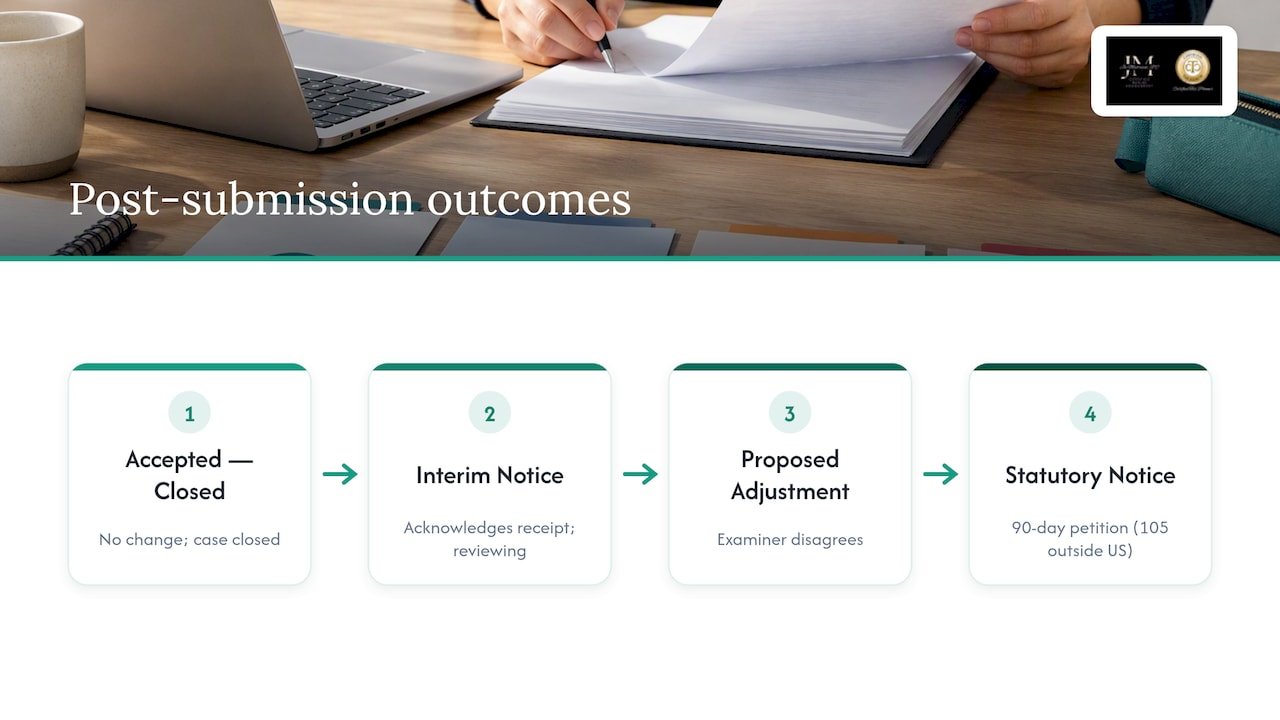
After you submit, expect one of a few outcomes. The IRS may accept your documentation and close the case with no change. It may send an interim letter acknowledging receipt and asking for more time to review. Or, if the examiner disagrees with your position, it may issue a formal proposed adjustment followed eventually by a Statutory Notice of Deficiency, which starts a strict 90-day window (105 days if addressed outside the United States) to petition Tax Court.
Keep every piece of proof that you responded on time: a Document Upload Tool confirmation screen, a certified mail receipt, or a fax confirmation page. If the IRS later claims it has no record of your submission, that proof is what lets you push back rather than start over.
When to Hire Help and How Representation Works
Some correspondence audits are simple enough to handle yourself: a single missing 1099 with a clear explanation rarely needs a professional. Representation becomes worth considering when any of the following apply:
- The proposed adjustment involves a large dollar amount or multiple tax years
- Your records are complex, incomplete, or scattered across business and personal accounts
- You already missed the original deadline and need to request reconsideration
- You have tried calling the IRS and cannot get a straight answer on your case status
Hiring a CPA, enrolled agent, or attorney to represent you requires Form 2848, Power of Attorney and Declaration of Representative. Filing it authorizes your representative to communicate directly with the IRS, receive copies of notices, and speak on your behalf, so you are not stuck on hold while your deadline approaches.
Penalties, Interest, and Relief Options
Interest on an unpaid balance begins accruing from the original due date of the return, regardless of when the audit concludes, and accuracy-related or failure-to-file penalties can be added on top depending on what the examiner finds. A timely, well-documented response does not just resolve the audit question itself; it also preserves your standing to request penalty abatement later if a penalty is assessed. Reasonable-cause relief typically requires showing a specific, documented reason for the error, such as reliance on incorrect third-party information or a serious illness, rather than a general claim of confusion. The practical steps are the same ones that make your audit response strong in the first place: document your reasoning as you go, respond before the deadline, and if a penalty does land, request abatement in writing with the supporting facts attached.
CP2000, Letter 566, and When to File an Amended Return
CP2000 notices come with a built-in response form where you check a box agreeing or disagreeing with the proposed change, attach your documentation, and return it by the stated date. Letter 566 and its variants (566S, 566E) typically ask for proof of wages, withholding, or eligibility for a refundable credit like the EITC, and the documentation expectations differ slightly from a CP2000’s income-matching focus.
- CP2000: use the response form, check agree or disagree, attach supporting documents or payment if you owe
- Letter 566 series: focus on proving the specific item named, often wages, withholding, or credit eligibility
- If your own review reveals an actual error on the original return, file Form 1040-X and reference the notice (write “CP2000” or the letter number) so the IRS can match it to your open case
Practitioner Perspective: What Makes a Response Stick
In 45 years of representing taxpayers in front of the IRS, I have seen the same pattern over and over: a technically correct response still gets questioned again when it is hard to follow. Examiners are processing volume, often without the time to piece together a disorganized packet. A clean index and short, factual item replies consistently move faster through the system because they do the reviewer’s work for them instead of asking them to dig.
— Joe
How We Can Help With Your Audit Response

If your correspondence audit involves a sizable proposed adjustment, missing records, or a deadline you are not confident you can meet alone, we prepare the full response packet for you rather than leaving you to piece it together under time pressure. Typically included are:
- Reviewing your notice and documentation to identify exactly what the IRS is questioning
- Preparing an indexed cover letter and item-by-item response built around what examiners actually need to see
- Filing Form 2848 so we can communicate with the IRS directly on your behalf
- Submitting your packet securely and tracking confirmation of delivery
A first conversation usually starts with a review of your notice and your records so we can tell you realistically what the case involves before any engagement begins. You can see the full range of representation and audit response services we provide, or start with a consultation to go over your specific notice and timeline.
This article is general information, not a substitute for advice from a qualified financial advisor. Consult a qualified financial professional about your own circumstances before acting on anything here.
FAQ
How much time does a taxpayer usually have to respond to a correspondence audit?
Most correspondence audit notices give you 30 days from the notice date to respond, though some notices specify a different window printed directly on the letter. Always use the date on the notice itself, not the day you opened the mail, to calculate your deadline.
What is a correspondence audit by the IRS?
A correspondence audit is an IRS review conducted entirely through the mail or Document Upload Tool, without an in-person meeting, typically focused on a specific item like unreported income or a disputed deduction. The CP2000 notice is the most common form and is generated when third-party information does not match your filed return.
Why is the IRS sending out letters right now?
Correspondence notices are largely driven by automated systems that compare your return against information returns filed by employers, banks, and other payers, and these matching checks run on an ongoing basis rather than at one point in the year. A mismatch, a math error, or a refundable credit claim can each trigger a letter independent of any broader enforcement push.
What does correspondence mean in audit?
“Correspondence” describes the format of the audit itself: everything happens through written exchange rather than a face-to-face or phone examination. The IRS sends a notice describing its question, you respond in writing with documentation, and the case is typically resolved without either side ever speaking directly.
Sources
- IRS — Topic No. 652, CP2000 Notice
- GAO: IRS audits weaknesses in selecting and conducting correspondence audits